

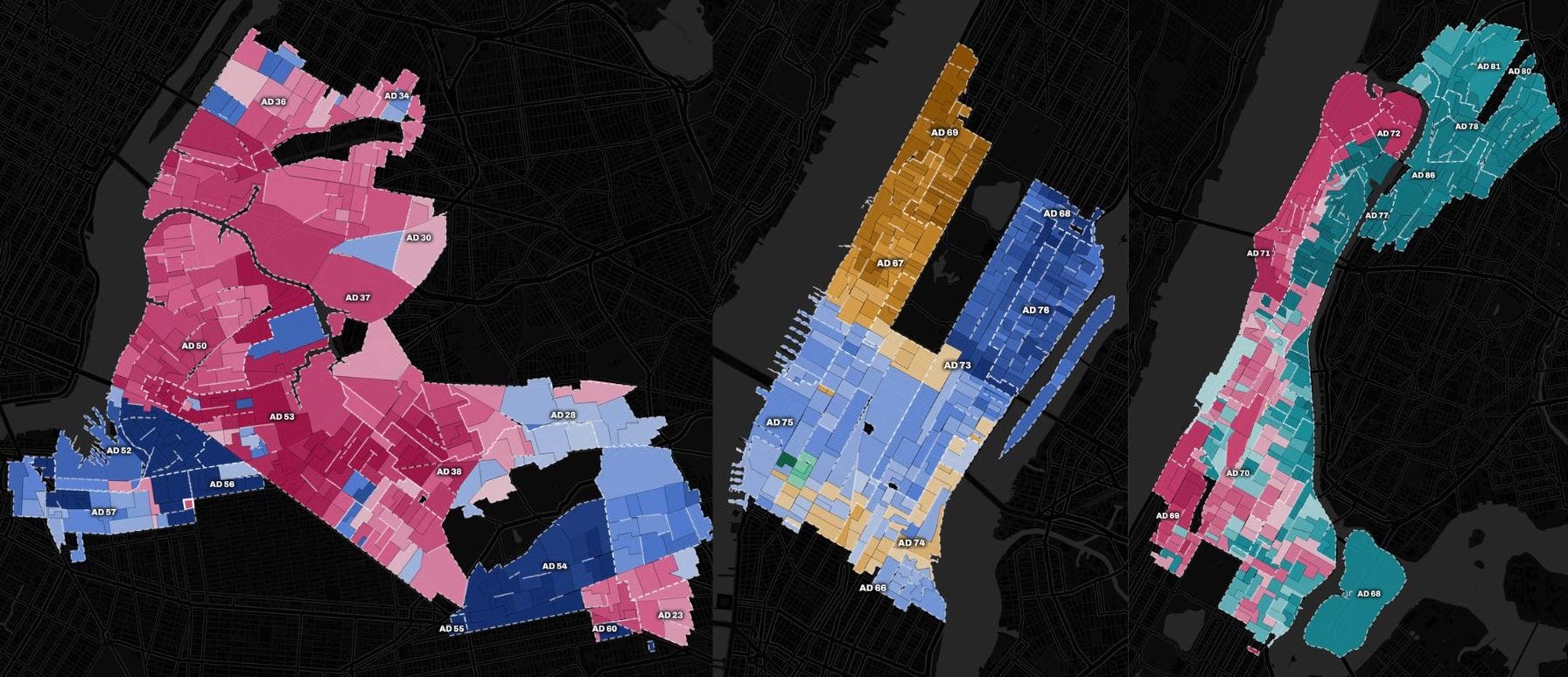
This time last year, Zohran Mamdani dramatically dismantled one of the last political dynasties. But was his victory the ascension of a great man, or the triumph of a movement? And what did it mean for the future of the Democratic Party? One year later, we are still reckoning with these pressing questions. And tomorrow — Tuesday, June 23rd — we will receive, if not an answer, at least an indication.
In Brooklyn and Queens, NYC-DSA and Mayor Mamdani are trying to send one of their own to Congress, versus the son of the district blessed by the outgoing incumbent. On the West and East Sides of Manhattan, the last bastion of the city’s old liberal establishment is defending itself against a nationalized, well-funded insurgency that has devolved into an Artificial Intelligence proxy war. And in Upper Manhattan, which I have called “The Next Commie Corridor,” a 30-year-old political machine is fighting for its life to fend off a 32-year-old challenger with the wind in her sails.
These three races — unfolding in Manhattan, Brooklyn, and Queens — are among the most competitive Democratic primaries in the nation. As I laid out in The Dress Rehearsal for 2028, each race is a small bellwether for a far greater phenomena: to what extent the Mamdani coalition travels, the salience of Artificial Intelligence and the liability of AIPAC, and whether The Left can win over older, working-class voters.
A quick word on the mechanics, because they influence everything that follows. Nine days of early voting are in the books. While not the final electorate, the early vote is still an informative sample — if read correctly (as I hope to do). Last year, the Mamdani coalition banked their ballots early; this year, youth voter turnout did not pick up until later in the week, which means a relatively large, relatively young Election Day vote remains outstanding in several important districts.
For each Congressional primary, you will be able to see how I built the electorate, with respect to age and race and turnout, from the street to the Assembly District level.
Remember, these are not endorsements, simply predictions.
Here is my best read of all three, block by block.
NY-7: The Bitter Battle for the Commie Corridor
The Horse Race
New York’s 7th District is the densest concentration of millennials and renters in any congressional seat in America. It is also, per this newsletter’s coinage, the heart of The Commie Corridor — the belt of North Brooklyn and Western Queens neighborhoods that powered Mamdani’s upset victory. The contest has three well-funded contestants, but it will come down to two. Claire Valdez — a longtime UAW organizer elected to the State Assembly in 2024, and cadre member of NYC-DSA — carries the banner of the New Left, and with it the endorsement of the Mayor and his movement. Antonio Reynoso, the Brooklyn Borough President, holds the mantle of the Old Left: backed by the Working Families Party, progressive non-profits and labor unions, and outgoing Rep. Nydia Velázquez. Julie Won, the Western Queens Council Member, is running a distant third; the only question is whom, if anyone, she pulls the most votes from.
I have written at length about this race: the institutional battle for the future of The Left in DSA vs. WFP; the Millennial and Gen-Z turnout dynamics that will decide the outcome in The Dress Rehearsal for 2028; and the bitter closing battle in The (Not So) Civil War for the Commie Corridor. The short version: even five years ago, Reynoso would have been a shoo-in for this seat, but the neighborhoods have changed beneath his feet. His own decades of work — like expelling the Vito Lopez machine — helped till the soil in which NYC-DSA grew. But the harvest may no longer be his to claim.
However, both public perception and the betting markets have misread this contest, and it will not be a Valdez landslide. This race has been statistically tied for months, with neither candidate pulling away. While the underlying trends favor Valdez, the conclusion is closer than most people think, and it will be a nail-biting Tuesday night.
Early Voting
The first nine days of NY-7 early voting told two vastly different tales.
The first is the Satmar tsunami, and it is unambiguously good for Antonio Reynoso. An Orthodox Jewish community in South Williamsburg (that spills into Bed-Stuy), the Satmar are a near-unanimous political bloc that votes in accordance with the whims of rabbinical leaders. The Satmar bloc made up a staggering 16% of NY-7’s early vote electorate, almost triple its 2025 share. If you assume those voters break for Reynoso by a ten-to-one margin, then these ultra-Orthodox precincts alone could swing the final result by several points.
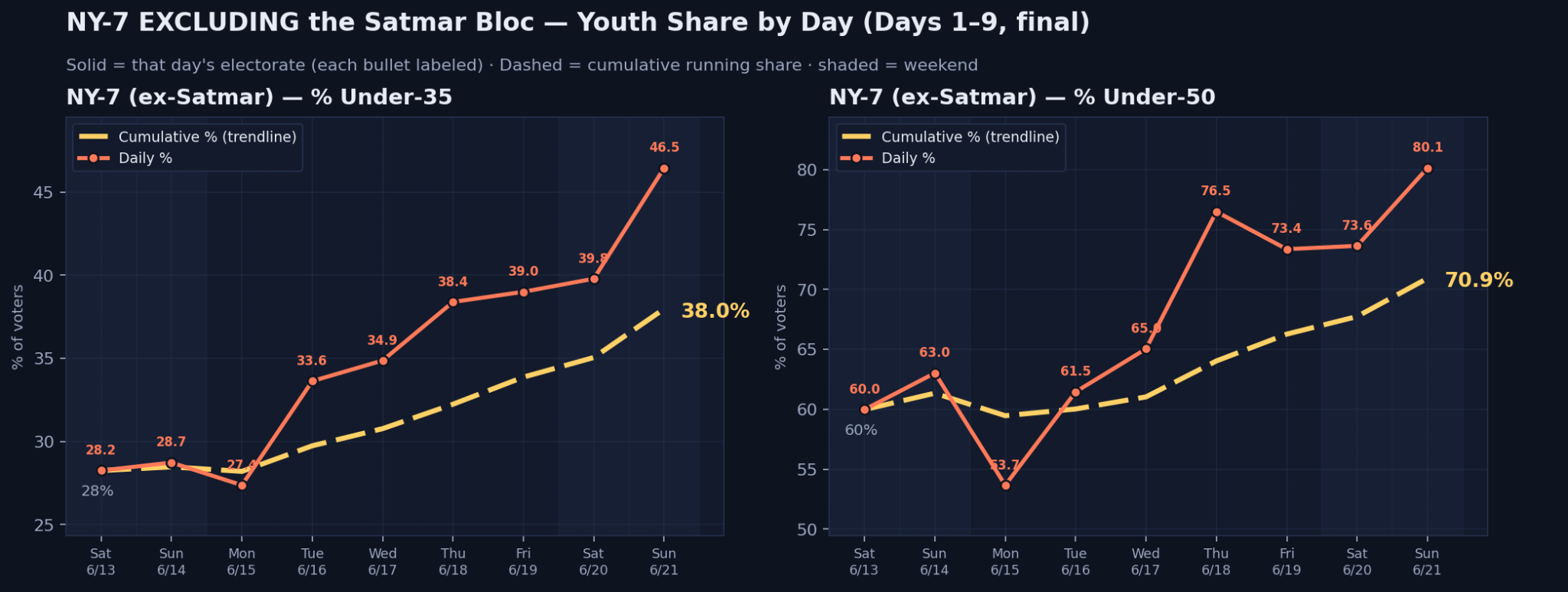
But the counter-narrative is the late-breaking youth wave, and it is just as beneficial to Claire Valdez as the Satmar are to Reynoso. Strip the Satmar bloc out entirely — because their young median age can skew the trend — and the non-Satmar under-35 share rose almost every single day, from a paltry 28% in the opening weekend to a high of 46.5% on the final Sunday. The millennial democratic socialists did not check out, as NYC-DSA once feared. They came, just a little later than last year.
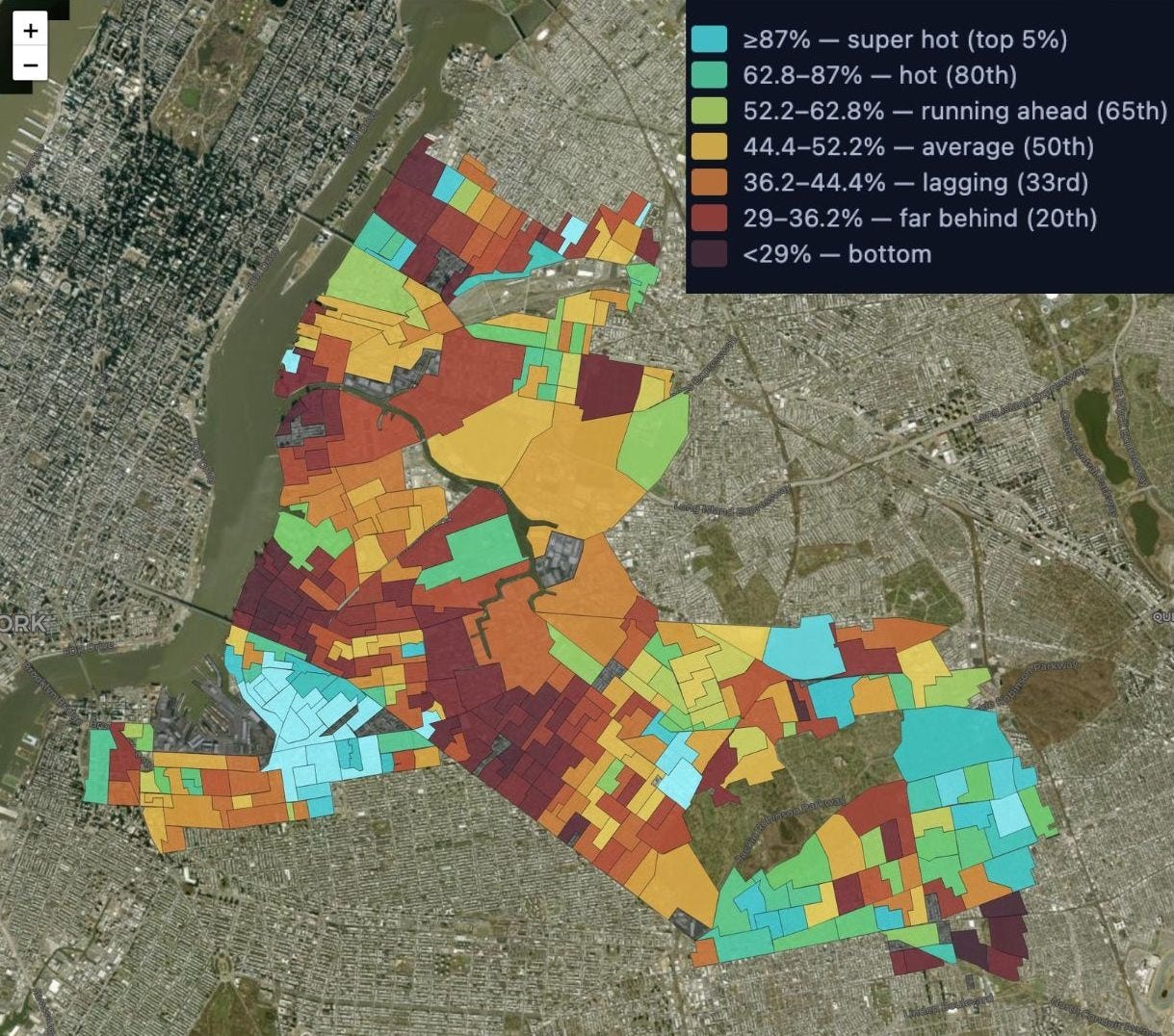
And yet, the Commie Corridor core is still running cold compared to last year. The DSA spine — Bushwick, Greenpoint, Williamsburg, East Williamsburg — banked just 35% of their 2025 vote through nine days, the frostiest geography on my citywide retention map, compared to 58% for the rest of the district. The optimistic read: Valdez’s base is loaded for Election Day, exactly as the age curve foreshadows, and is on the verge of detonation. Her ceiling is higher; the only question is whether she can hit it in time.
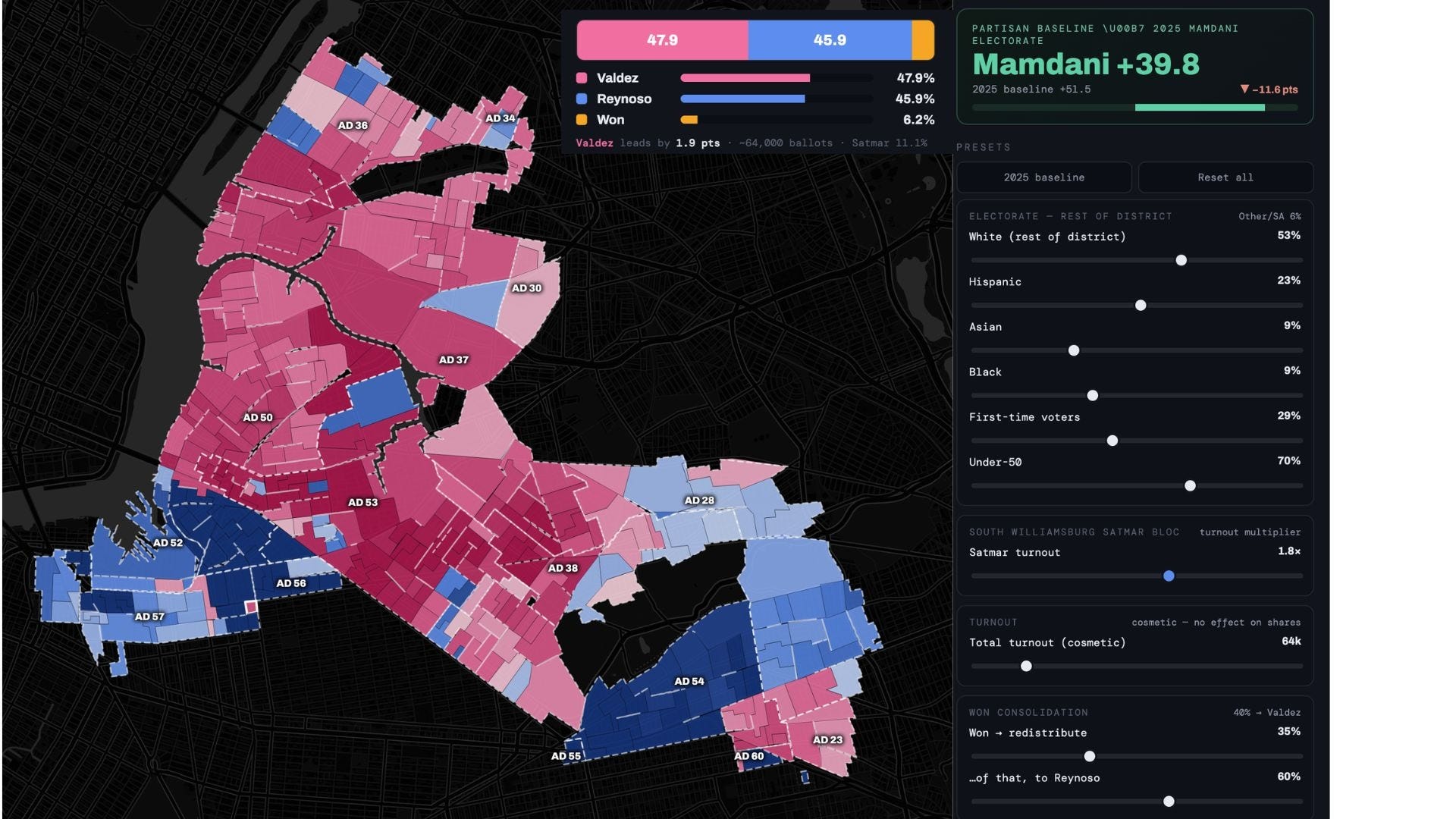
My Prediction: Valdez 48%, Reynoso 46%, Won 6%
The dismal early returns pointed to a base of young voters that was checked out; but the noticeable uptick since Thursday shows a cavalry on the precipice of arrival.
NYC-DSA runs the most sophisticated get-out-the-vote in New York City, and it is almost perfectly optimized for Election Day in NY-7.
Zohran Mamdani, too, sensing the high stakes, has also closed strongly for Valdez. The Mayor cannot transfer his coalition by fiat — intangibles cannot be inherited — but he can push himself to the brink of exhaustion to help his comrade over the finish line, and he has. On Friday and Saturday alone, Mamdani and Valdez walked the streets of Greenpoint, launched a canvass in Maria Hernandez Park, greeted voters outside Bushwick High School, took selfies at McCarren Park, and went clubbing together.
This is more about turnout than persuasion. The persuadable middle in NY-7 — progressives aged 35-49 who support both Mamdani and the Working Families Party — is up for grabs. But the far more pertinent question is who shows up, and I expect the under-35 surge that defined the close of early voting will carry into a young Election Day, to the benefit of Valdez. Nonetheless, Reynoso will have a solid floor on Tuesday as well; his older and working-class base, oftentimes quite far from their nearest early voting poll site, is poised to turn out in force on Election Day, too.
Block-by-block, neighborhood-by-neighborhood, the contours are familiar, but unique. Valdez runs up the score where the Corridor is youngest and whitest-collar: Bushwick, Ridgewood, East Williamsburg, Greenpoint — the precincts that gave Mamdani his greatest margins and have the most votes still outstanding. While I expect their proportion of the electorate to decline compared to last year, I predict Valdez will nonetheless receive the margins she needs. Reynoso holds the older Black and Hispanic blocks; the Puerto Rican pockets on the Southside where he is the son of Los Sures, the Hispanic homeowner stretches of Cypress Hills and Woodhaven on both sides of the Brooklyn-Queens border, and (of course) the Satmar of South Williamsburg, who value the relationship with their Borough President. Won is a small factor in Western Queens — Sunnyside, Long Island City, Woodside — but she pulls relatively equally from both Reynoso and Valdez. But it is here that Valdez, a one-term Queens assemblywoman, builds an advantage in the World’s Borough.
I have the Satmar as ~11% of the final electorate, a pronounced increase from last year, and a daunting deficit for Valdez to overcome — but one I think she will.
Valdez HQ should not celebrate too early, though, because there is a good chance Reynoso wins the early vote, thanks in large part to the Satmar surge. So, when the Board of Elections drops the early vote batch at roughly ~9:05pm on Tuesday night, the first numbers on the screen could show Reynoso leading — and the room at the Valdez watch party could go very quiet, very fast, before the Election Day precincts in Bushwick and Ridgewood report over the following sixty minutes and, potentially, turn the tide in her favor. Valdez may need to claw her way back, one ballot drop at a time.
NY-7 also overlaps with several competitive NYC-DSA races down the ballot. I expect Aber Kawas — blessed with the trio of Ridgewood, Sunnyside, and Astoria — to succeed Michael Gianaris in the State Senate relatively comfortably. David Orkin, pitted against incumbent Jenifer Rajkumar (and her red dress), ekes out an upset by a couple points. Christian Celeste Tate, facing longtime incumbent Erik Dilan, feels like a genuine coin flip. Valdez’s coattails will help both Kawas and Orkin in Ridgewood and Tate in Bushwick — but the same Reynoso-aligned older voters in Cypress Hills and Woodhaven who keep NY-7 close will decide the fate of both Orkin and Tate.
If I’m wrong, it’s because: (1) the Satmar finish as more than 13% of the total electorate, and Reynoso wins them by a ten-to-one margin; (2) the son of Los Sures runs up the score among older Black and Hispanic voters; (3) the Brooklyn Borough President wins Downtown Brooklyn and Fort Greene outright and keeps the margin respectable in Western Queens, Greenpoint, and Williamsburg; and (4) the young voters of Bushwick and East Williamsburg, cold on the early returns, remain frigid on Election Day — and the socialists do not inherit the district once destined to be theirs.
NY-12: The Last District of Local Institutions
The Horse Race
If NY-7 is a war to define the future of The Left, NY-12 is a test of the endurance of local institutions in a political arena that has become increasingly nationalized.
The Twelfth District lies at the heart of Manhattan, anchored by the Upper West and Upper East Sides, running as far south as 14th Street. It is the last vestige of the city’s vanishing local institutions: the clubs, the co-op boards, the synagogue mailing lists, and the liberal reform Democrats who have been voting in primaries since Lindsay, Abzug, and Koch represented them in Washington. But most importantly, it is a contest between the West Side and the East Side, because geography tells the whole story.
Micah Lasher, the Upper West Side assemblyman and longtime political aide — backed by Jerry Nadler, Michael Bloomberg, and Governor Hochul — is the candidate of the institutions. Alex Bores, the East Side assemblyman, is the insurgent; more a reflection of structural disadvantages than left-leaning ideology. A nationally profiled, tech-altruist, Bores has turned this race into a proxy war over Artificial Intelligence, drawing the attention (and the money) of the AI industry and its critics alike. Jack Schlossberg, the grandson of President Kennedy, and George Conway, an attorney allied with the Lincoln Project, round out the field, but have faded down the stretch.
The arc of Bores’s candidacy is instructive for Democrats well beyond Manhattan, because the influence — and spending — that orbit AI regulation will only increase exponentially in the coming years. He has run a genuinely strong, attention-grabbing campaign. But, in arguably the last district of local institutions, national is not enough.
Early Voting
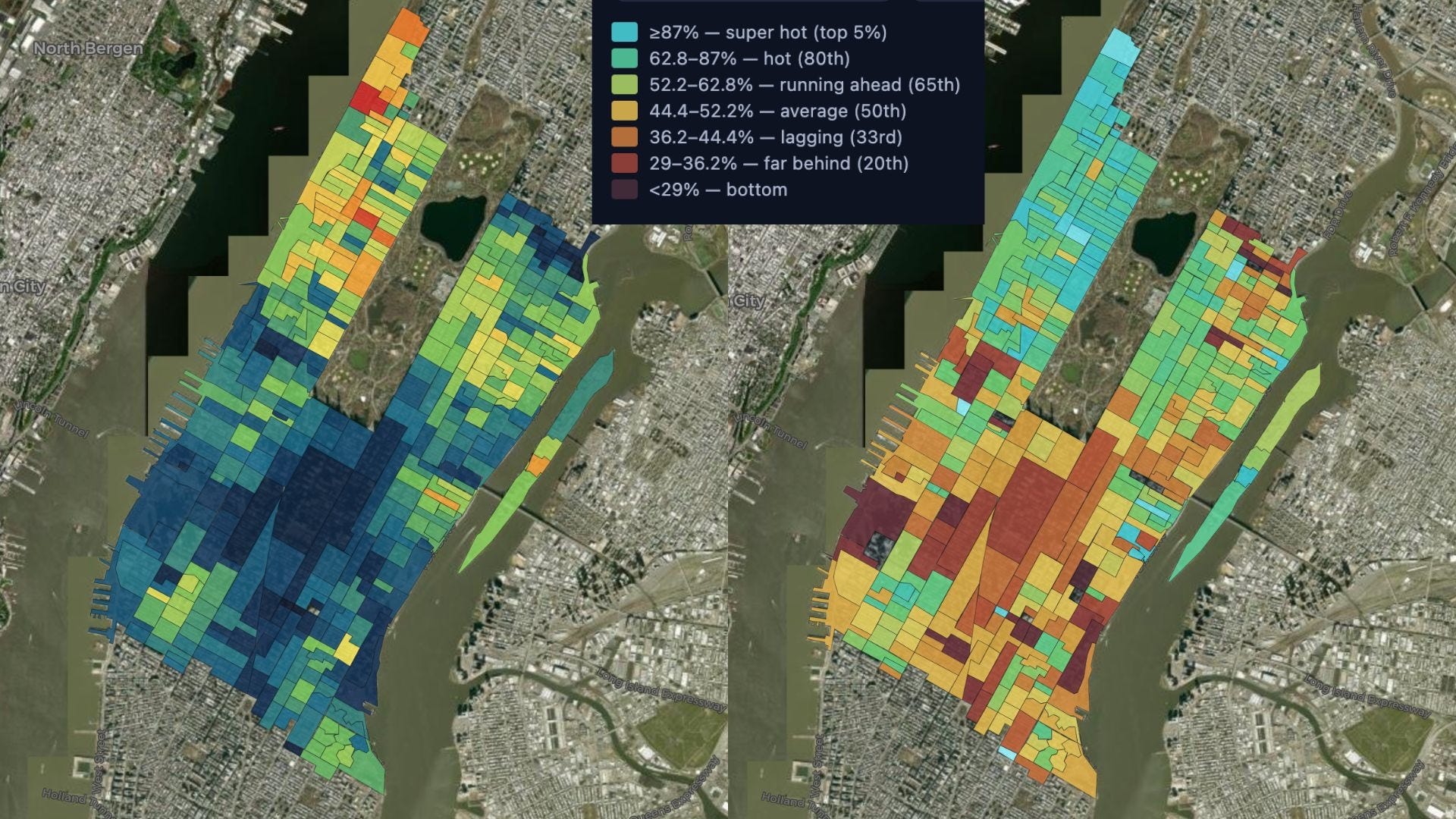
The early vote in NY-12 produced 38,340 ballots — the most of any district, and 60% of its entire 2025 early vote. The electorate was old: the median early voter was 63; barely a third were under 50; and nearly half were over 65. This is a high-propensity, institutionally-aligned voting base, which greatly benefits the candidate who is incumbent-adjacent, Micah Lasher.
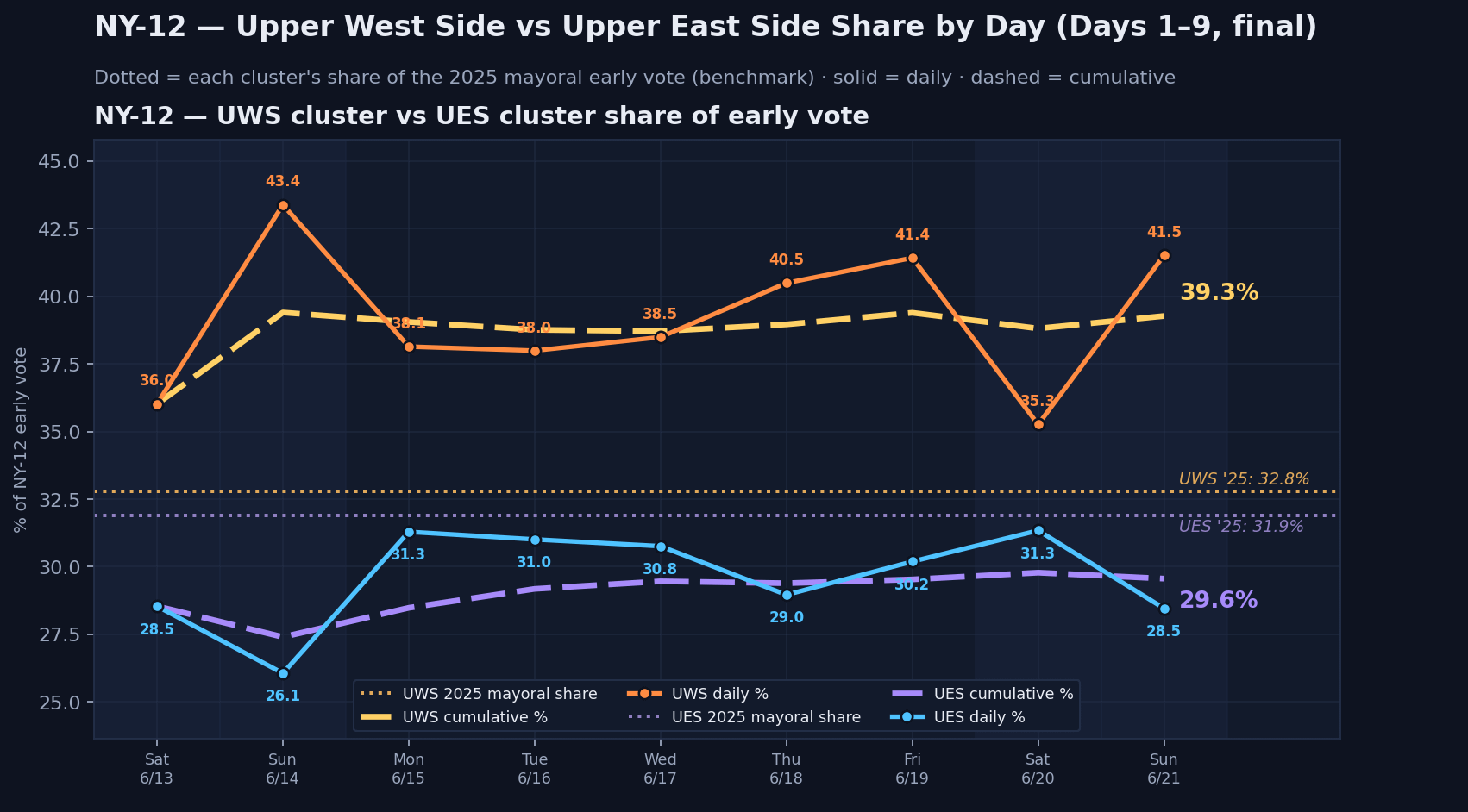
Most importantly, the early vote broke decidedly West. For context, in last year’s mayoral primary, the Upper West Side and the Upper East Side banked almost the same number of early votes. However, in the race for NY-12, the Upper West Side finished with 39% of the early vote; compared to just 29% for the Upper East Side — a ten-point edge for Lasher’s geographic base before a single Election Day ballot has been cast. The open Assembly primary in AD-69, unequivocally Lasher’s home turf, includes the highest-turnout blocks in the city, retaining 70-87% of last year’s turnout across its poll sites. So far, the East Side has simply not matched this energy. Bores needed the West Side’s structural advantage — more Democrats, more high-propensity voters, more institutional cohesion — to be neutralized.
Instead it was reinforced.
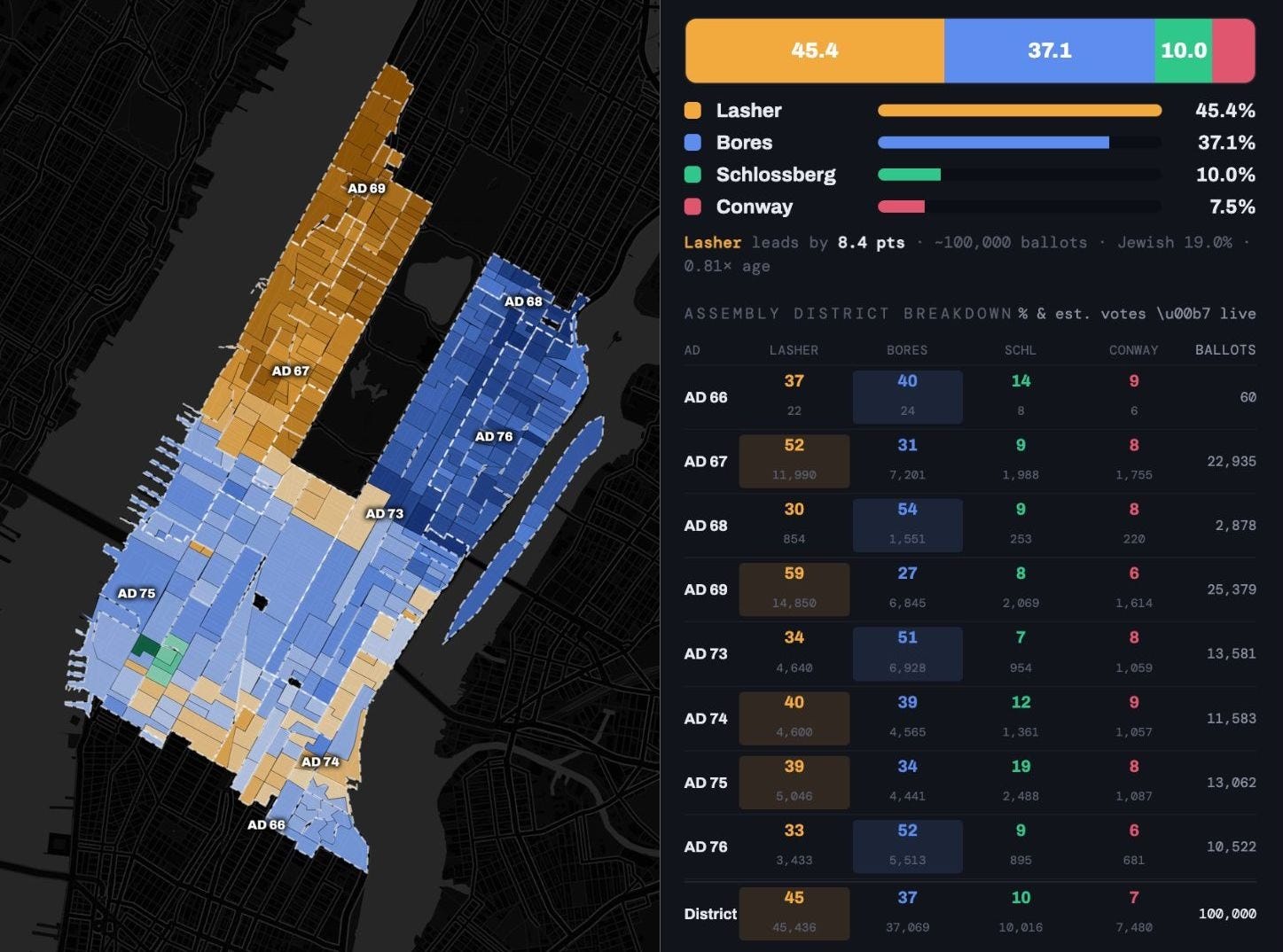
My Prediction: Lasher 45%, Bores 37%, Schlossberg 10%, Conway 7%
Over the course of a long campaign, we often lose sight of our priors, and occasionally what actually matters. Sometimes the first read is the best one. At the onset of this race, Lasher was tipped as the prohibitive favorite for a reason — not only had the institutional establishment lined up behind him, but the oldest rule in Manhattan politics tilted in his favor: The West Side candidate always beats The East Side candidate.
Bores needed two of three things to break his way to pull off the upset heard across Central Park. First, a boost in turnout from younger, white-collar professionals, particularly in Hell’s Kitchen, Yorkville, and Murray Hill (not quite a “Mamdani electorate,” but a derivative). Second, a surge from the Upper East Side large enough to neutralize the West Side’s built-in advantage (ironically, what happened during last year’s mayoral primary). And third, discernible inroads on the West Side itself, denting Lasher’s margins at the heart of his own base.
Thus far, I have seen scant evidence of any of these three developments. While the electorate, still old overall (better than two-thirds over 50), has trended younger day by day, the Upper West Side’s early vote advantage over the Upper East Side has not budged from a commanding twelve-point-lead. While Bores is making a late push, and should keep the margin respectable, Lasher’s base is running white hot. If Bores pulls off the upset, it will come from south of Central Park — in the younger, renter-heavier, less institutionally cohesive blocks of StuyTown, Kips Bay, Murray Hill, and Hell’s Kitchen, but there may not be enough votes down there to overcome what is happening north of 59th Street.
Lasher will dominate the pre-war co-ops of the Upper West Side, and run strongest along Morningside Drive, buoyed by the older Jewish liberals eager to cast their ballots for Nadler’s heir apparent. Bores will win both Oligarch Alley, the district’s wealthiest corridor from Park to Fifth Avenue, and the East Side’s younger professional pockets, most notably Yorkville. He will make inroads across the district among the AI-curious professional class that made his campaign a national story, but Lasher’s endorsement from former Mayor Bloomberg, robustly popular in NY-12, will prove to be an effective counter. It is a fascinating and predictable map; yet one that fails to undo decades of relationships and institutions.
In the race to replace Lasher in AD-69, I predict Eli Northrup — the public defender backed by Mamdani, AOC, Bernie Sanders, and the Working Families Party — to edge rabbi Stephanie Ruskay, in another bitter contest defined by PAC spending.
If I’m wrong, it’s because: the Bores campaign’s nationalization of the AI fight broke through in a way the early vote could never capture; the East Side assemblyman made significant headway across Central Park into Lasher’s base and cleaned up in the millennial-heavy neighborhoods south of the Park, turning out a white-collar professional electorate that the high-propensity early vote systematically under-sampled. If that happens, the race has implications well beyond Manhattan, because it would mean AI is now a winning offensive issue in a Democratic primary.
I don’t think we’re there yet. But we will be — next cycle.
NY-13: Movements vs. Machines
The Horse Race
NY-13 has the richest ethnographic tapestry of any district in the five boroughs. I mapped it all granularly in The Thirteen Neighborhoods of NY-13, and I earlier coined it “The Next Commie Corridor” for a reason: this is the ground where Mamdani’s largest overperformance (relative to expectation) occurred; not in the hipster precincts of Brooklyn, but in the supermajority-renter, working-class blocks of Upper Manhattan.
Adriano Espaillat — five-term incumbent, dean of New York’s Dominican elected officials, and the first formerly undocumented immigrant ever to serve in Congress — is the machine, and not metaphorically either. Still, I questioned whether Espaillat’s apparatus was more mythos than machine, and pondered whether he was the next Joe Crowley hiding in plain sight. Darializa Avila Chevalier — the student organizer backed by NYC-DSA and Justice Democrats — is the movement, attempting to do to Espaillat what he once did to Keith Wright: end a dynasty by demographic arithmetic.
A month ago, I thought Dari was on track for an epic upset. The momentum across Upper Manhattan felt real, and Espaillat appeared asleep at the wheel, destined to wake up only when it was too late. But the political establishment, eager to save the chair of the Congressional Hispanic Caucus, rallied — hard. A deluge of independent expenditures arrived soon thereafter, blanketing televisions and stuffing mailboxes across NY-13. Now, I’m not so sure.
Early Voting
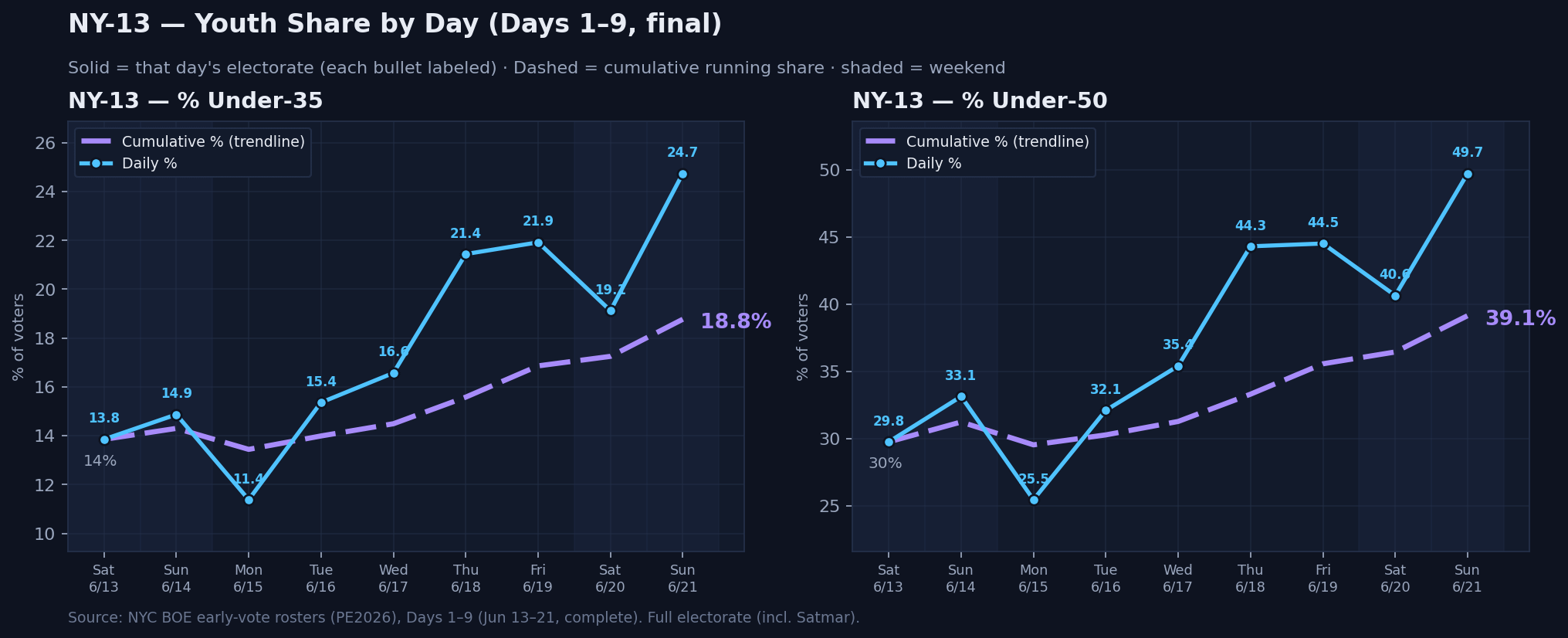
NY-13 retained two-thirds of its 2025 early vote total in 2026, the best mark of any Congressional District in New York City. The enthusiasm and age trendline bode well for the insurgent, Avila Chevalier, but the distribution of the early vote map indicates Espaillat is pulling out his people, too. Compared to NY-7 and NY-12, the early voting data from NY-13 is more difficult to parse cleanly, because many of the older Black and Hispanic precincts, favorable to the incumbent, hold out for Election Day.
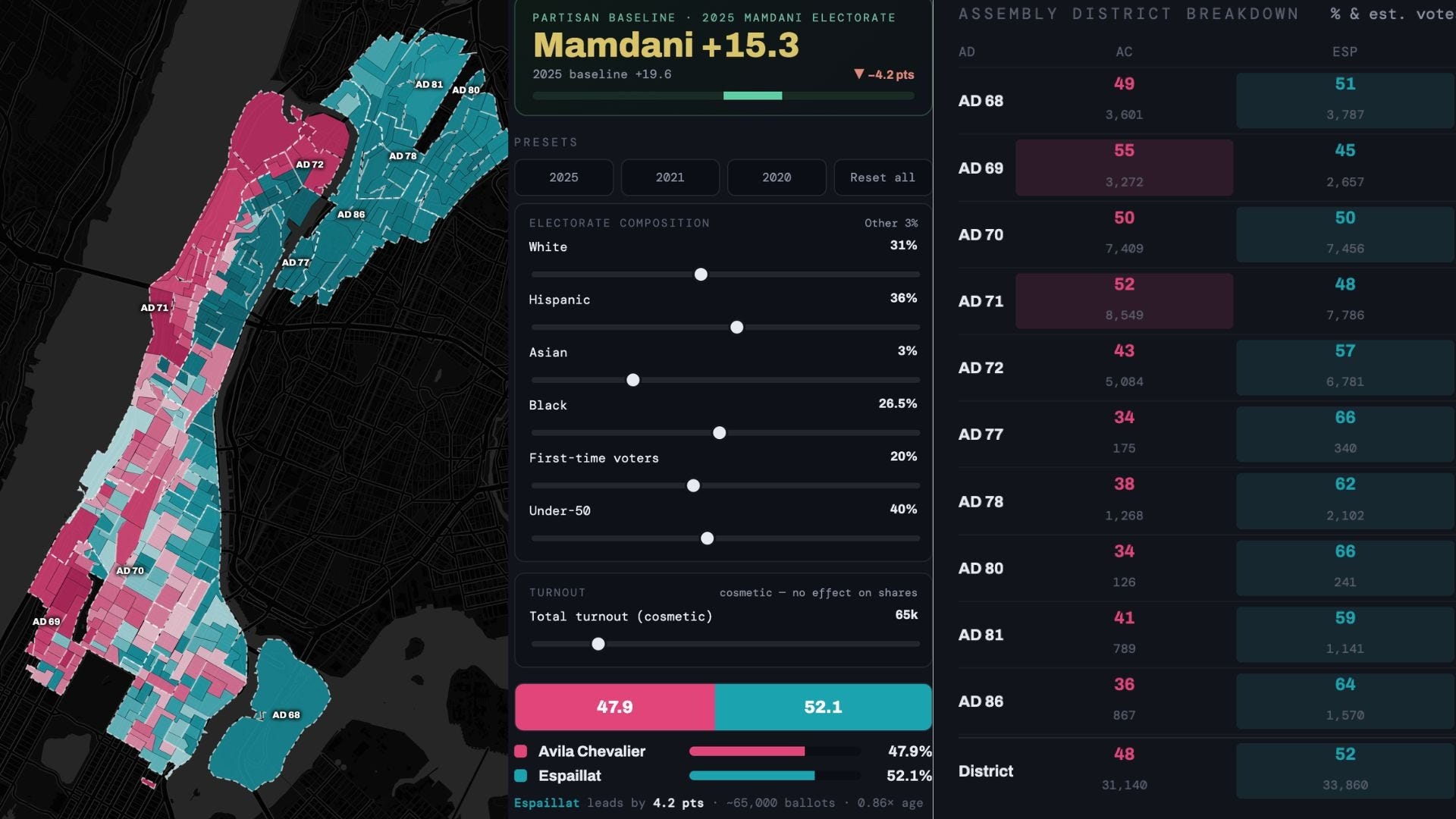
My Prediction: Espaillat 52%, Avila Chevalier 48%
I’ll put my cards on the table: I’m a constituent of NY-13, and I voted for Avila Chevalier. My honest read is that the negative spending hurt her significantly with older voters, and a challenge once primed for an upset may fall a couple points short.
The increased salience of this race — spurred by the challenger closing the gap and the Mayor’s intervention — may have been a net-negative for the insurgent. When the race was sleepier, I liked Avila Chevalier’s odds to surprise the establishment. However, once the contest became the race to watch, Espaillat and co. could see the threat Avila Chevalier (and Mamdani) posed, and responded with overwhelming force to crush it: Hakeem Jeffries working aggressively to save his colleague, labor unions deploying their operatives, and several million dollars of independent expenditure landing on a candidate most voters had never heard of three months ago. Avila Chevalier is a lesser-known candidate being defined by a seven-figure avalanche, and in a fundamentally different position from the one Mamdani occupied a year ago.
Mamdani was a juggernaut of earned and new media, a candidate so saturated in coverage that he was effectively inoculated against a similar rash of late attacks. Dari has no such immunity. When the first thing an older voter, who was not raised in the social media era, learns about you is the worst thing a PAC can find, the deleted tweet has done its damage. Espaillat, who has long battled Harlem’s Black political leaders, has cynically swooped in, made a temporary truce with his erstwhile enemies, and is poised to win a majority of older Black voters on Tuesday. The race largely hinges on progressive and liberal white voters — many of them Jewish — in Morningside Heights, Hudson Heights, and Inwood. Win them decisively and Avila Chevalier has a multiracial coalition that carries the district. Lose them, or even win them (but not by the margins she needs), and her path to victory is strained.
Block by block, lean on the Thirteen Neighborhoods of NY-13: Avila Chevalier wins Hamilton Heights (Commie Corridor lite) and runs strong through Manhattan Valley and South Harlem. Espaillat maintains and aggressively turns out his stronghold in Washington Heights and Inwood east of Broadway, the beating heart of the Little Dominican Republic, and makes enough inroads to survive among older Black voters in Riverton, Lenox Terrace, Esplanade Gardens, and the Polo Grounds. The Bronx exclaves, beset by weak turnout, break for the incumbent, albeit not decisively.
This race has downballot implications, too. Conrad Blackburn, a public defender also backed by NYC-DSA, is challenging native son of Harlem, Jordan Wright, in the 70th Assembly District. Of all the DSA insurgents, Blackburn has the most challenging race. While the PACs held their fire on Avila Chevalier until she began to build momentum, Blackburn has been blitzed for months on end; dueling lessons in the damage spending can inflict on first-time candidates. The question remains whether Blackburn or Avila Chevalier has had enough time to inoculate voters.
If I’m wrong, it’s because: Avila Chevalier changed the electorate in a Mamdani-lite manner, and no one cared about her deleted tweets when the incumbent was cashing checks from AIPAC. If Dari can run up the score among middle-aged progressives and older liberals in Morningside, Hudson Heights, and Inwood — holding the very voters the spending was meant to scare off — and activate the college-educated renters of South Harlem and Hamilton Heights, she slays the giant of Upper Manhattan.
Connect With Me:
Follow me on Twitter @MichaelLangeNYC
Email me at Michael.James.Lange@gmail.com
Juggernaut analysis as expected. The big thing I’d add as a longtime Darializa field lead is that I truly believe the race is less about many young people she can mobilize and more about how many old people she can persuade. My theory of victory for her always has been that Espaillat’s longstanding weakness with high engagement older black and older white voters in the southern half of the district—where he’s perpetually absent—can translate into a different kind of NYC-DSA coalition. The current turnout data seems to suggest that this theory will be directly put to the test.
I think all these predictions are pretty accurate I hope darializa wins though the attacks on her have been so bigoted especially coming from democrats