

You can walk it all in less than a day.
Watch the sun rise in Sunnyside, where the youngest Congressional District in America will choose between The Socialists and The Progressives. Cross the bridge into Midtown Manhattan, where the most Jewish district in New York has quietly ceased arguing about AIPAC, and started litigating Artificial Intelligence. Spend your final hours in Harlem before the polls close, and see whether The Left can win the trust of older working-class voters. The Democratic Party will spend the next two years overlooking what happened here, even though it may hold the blueprint to 2028.
Every couple years, the Democratic Party wages a never-ending argument about what it is and whom it serves. Each time, the loudest voices rehearse their lines somewhere else beforehand. Ahead of the upcoming Presidential Primary, that rehearsal space is New York City; a dynamic the rest of the Party resents but depends on in equal measure. And if Zohran Mamdani’s stunning triumph was akin to a viral Broadway show, then the Congressional Primaries here later this month constitute a more low-key, but equally consequential dress rehearsal for what comes next.
I have written previously — in The Mamdani Model — that New York City is not merely a Democratic stronghold, but the cutting edge of American politics: the place where each party’s coalitions, from Outer Borough populism to Rockefeller Republicanism, are stress-tested before they are exported; whose neighborhoods shape Presidents (Donald Trump), an old-guard establishment (Hakeem Jeffries, Chuck Schumer) and the movement leaders (Bernie Sanders, Alexandria Ocasio-Cortez) who threaten it.
Zohran Mamdani did not invent the young, renter-heavy, diverse, left-leaning coalition that carried him to City Hall. But he did work tirelessly to organize it: speaking to their economic grievances, meeting them in their own media ecosystems, and giving them a stake in the political process. The Democratic Party, slowly but surely, is now studying that model — and it goes far beyond repeating “affordability.”
Any good argument acknowledges its limitations. A mayoral primary in a deep-blue city, even the largest in the country, is not a national contest. The electorate that comes to the polls for a Congressional Primary in Manhattan is not the electorate that turns out for a Presidential Primary in South Carolina; nor is Astoria, Queens comparable to Scranton, Pennsylvania — much less Savannah, Georgia. New York City is sui generis: blue, denser, younger, home to more Jews and Catholics than Protestants, with double the number of renters as homeowners. And yet, one can still find almost every constituency imaginable represented across these five boroughs.
However, the parallels are real, and they absolutely matter. The Democratic Party is becoming younger, more urban, and more college-educated with every cycle; but simultaneously hemorrhaging the Black and Hispanic voters who were, until recently, its core constituency. The 2024 defection of working-class voters of color to Donald Trump is the central trauma the Party is still recovering from, and nowhere was that pain more acutely felt than the five boroughs: the forgotten people of Fordham Road in the Bronx and Roosevelt Avenue in Queens rebuked Manhattan’s limousine liberals.
That is what makes New York City worth watching on June 23rd. Not that it perfectly resembles the nation, but that it strips away the noise that muddies a Presidential Primary and lets us see each argument in isolation: the Youth Vote absent a historic turnout machine; support for Israel and Palestine in the country’s most Jewish neighborhoods; an AI proxy war in a district of elites and oligarchs; The Left’s earnest pitch to Black voters who have spent fifty years eschewing insurgents.
All to answer the question pulsing below the pavement: who gets to define the Democratic Party for the next two years, and whom does that party belong to?
The Youth Vote
We begin with New York’s 7th Congressional District, so young and left-leaning that its neighborhoods have taken on a nickname of their own: The Commie Corridor.
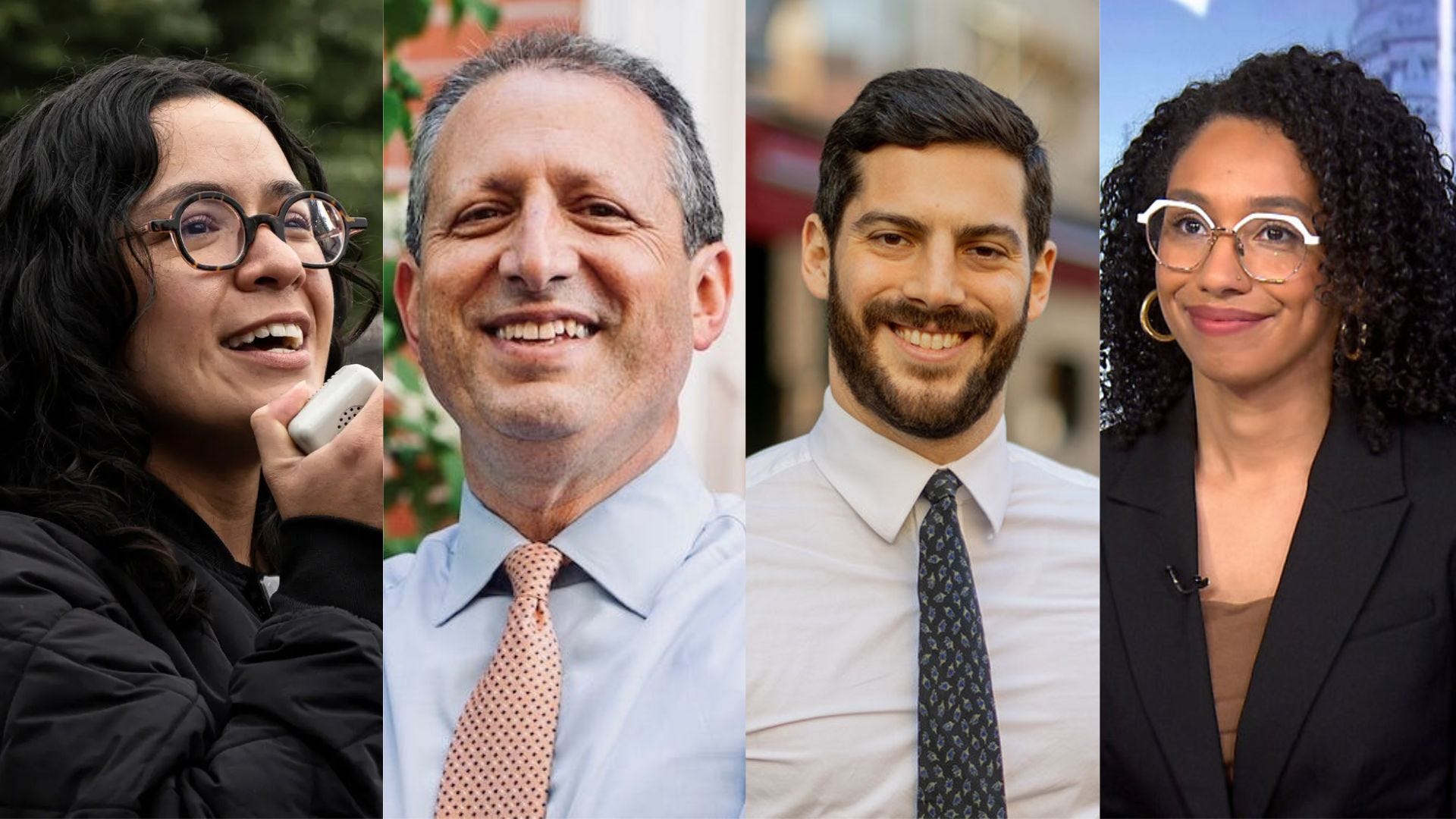
Rep. Nydia Velázquez, the first Puerto Rican woman elected to Congress, announced she would not seek re-election last fall after more than three decades in office. Into her vacuum stepped a field that neatly maps the Left’s internal tensions: pitting Claire Valdez, a freshman Queens assemblymember, UAW organizer, and NYC-DSA member endorsed by Mayor Mamdani; against Antonio Reynoso, the Brooklyn Borough President backed by the outgoing Velázquez, along with the Working Families Party, plus a lion’s share of organized labor and progressive non-profits.
As I told The New York Times, because the erstwhile “establishment” is receding across many neighborhoods and districts, electoral duels between Socialists and Progressives will become “the new [frontier] in New York City and urban politics.”
The race for NY-7 is a proxy battle with ramifications far beyond a sole Congressional District, a quasi-referendum on the question of “Who leads The Left in New York City?” between NYC-DSA and the Working Families Party. Undoubtedly, Valdez vs. Reynoso has shades of Sanders vs. Warren during the 2020 Presidential Primary.
Still, the 7th Congressional District’s lasting impact on 2028 may have less to do with which faction of The Left prevails than with whether the electorate that increasingly defines it — the young, college-educated renters — shows up to the same extent.
Every progressive campaign in America says it will expand the electorate, particularly amongst younger voters. But it almost never comes to fruition. Zohran Mamdani, armed with over 90,000 volunteers and attentional hegemony across social media, upended this orthodoxy in a manner even Bernie Sanders never could.
The under-50 vote is the Sleeping Giant of the national Democratic Party: the youngest, fastest growing, most progressive, but least reliable bloc in the coalition. Mamdani demonstrated that, with enough elbow grease and economic populism, it can be roused; but those intangibles cannot be inherited. What will happen, on June 23rd, when the Mayor is not on the ballot, even if his movement is?
This is precisely the problem staring down The Left nationally ahead of 2028.
Picture a scenario in which Alexandria Ocasio-Cortez — the original, giant-slaying democratic socialist who retired Joe Crowley — eschews running for President.
Who, then, wakes the sleeping giant?
The energy, burgeoning and desperate, will not evaporate. It will inevitably look for an outlet. The challenge for The Left is that the outlet might be no one; dissipating among Ro Khanna, Chris Van Hollen, or even Kamala Harris. How much of The Left’s success is built upon force of personality, as opposed to policy alignment? NY-7 is a case study as to whether the Mamdani electorate is a durable electoral realignment or a one hit wonder. And the answer will reverberate well beyond The Commie Corridor.
AIPAC and AI
There is a prediction I shared with Haaretz in January that has aged quite well: A Presidential Candidate Cannot Win a Democratic Primary by Taking AIPAC Money.
Already, the shadow Presidential field has re-arranged themselves around this notion. J.B. Pritzker, the Jewish Governor of Illinois and a former AIPAC board member, now calls the pro-Israel outfit’s spending “interference” and backed Bernie Sanders’ resolutions to limit offensive weapons sales to Israel. Gavin Newsom routinely repeats that he never has and “never will” take AIPAC money. Even Cory Booker, long a reliable recipient, cut AIPAC off earlier this year. Furthermore, Alexandria Ocasio-Cortez’s call for Congress to withhold funding for the Iron Dome, in accordance with the Leahy Law (announced on an NYC-DSA endorsement call no less), was quickly echoed across the Democratic Party. Once a litmus test, swearing off pro-Israel money is now par for the course among Democrats with national aspirations. AIPAC itself, pushing back, can only protest that it has “never given to a presidential campaign,” less a rebuttal than a confession of where the wind is blowing.
The casualty of this shift in public opinion is Josh Shapiro. The Pennsylvania Governor is, on paper, the most “electable” Democrat in the field, having consistently outperformed his Party’s baseline in the Keystone State, often the tipping point in Presidential races. Nonetheless, Shapiro’s staunch support for Israel may be a deal-breaker in a national Democratic Primary, regardless of whether he ever cashes an AIPAC check. “He would be my top pick, but he’s not getting through a primary,” one longtime Democratic donor told The Hill. Once firmly inside the Democratic mainstream on this issue, Shapiro now finds himself beyond the Overton window.
This development is underscored by two House primaries in Manhattan and Brooklyn.
Consider New York’s 10th Congressional District, where incumbent Dan Goldman, the Levi Strauss heir who burnished his profile as the lead counsel during the first Trump impeachment, is on the verge of losing his seat to Brad Lander, a liberal zionist backed by Mayor Mamdani. The former City Comptroller (who finished third in last year’s mayoral primary), Lander has accused the incumbent of “doing AIPAC’s bidding,” and called for ending weapons aid to Israel, offensive and defensive. According to a recent Emerson poll, Lander is leading Goldman by a staggering 34 point margin, an almost unprecedented deficit for a non-scandal-scarred incumbent. Lander’s most lopsided margins, tellingly, were among voters under 40, who broke for him 73% to 15%. Goldman, for his part, never endorsed Zohran Mamdani, was a leading defender of Israel’s war of annihilation in Gaza, and is among the top recipients of AIPAC money in the New York delegation. His forthcoming defeat, at the behest of Lander, stems from a callous indifference to the Palestinian plight.
This zeitgeist shift can also be seen in New York’s 12th Congressional District: a seat represented by Jerry Nadler that straddles the Upper East and West Sides of Manhattan. Home to one of the largest Jewish (and zionist) communities in the United States, and a political class that rarely moves ahead of consensus, pro-Israel money is conspicuously absent, with every candidate rejecting AIPAC’s support.
The fault lines have moved — towards Artificial Intelligence.
Alex Bores is arguably the most interesting candidate in New York City this cycle because of how he has overcome significant outside spending against him. Best known for authoring the RAISE Act — which implemented modest safety guardrails for large AI models — Bores has become the first target of Leading the Future, the pro-industry super PAC bankrolled by Marc Andreessen, OpenAI president Greg Brockman, and Palantir co-founder Joe Lonsdale, among others. The PAC pledged at least $10 million to bury him before he ever reached Washington.
However, this dynamic has helped Bores overcome a structural disadvantage. His chief opponent, Micah Lasher, hails from the West Side and is backed by Nadler, a revered figure across Manhattan; whereas Bores represents the East Side, the ancestral home of the old moneyed GOP that counts fewer Democrats among its ranks. (A cursory review of past campaigns reveals the West Side candidate always defeats the East Side candidate in NY-12). But the spending deluge against him spurred a plethora of favorable earned media (like Ezra Klein’s podcast), successfully raising his profile across the district, which threatens to upend the traditional geographic binary of the West Side vs. the East Side. Ads hammering Bores for his past work at Palantir failed to drive up his negatives; if anything, the spectacle of tech oligarchs trying to buy a Manhattan congressional seat has polarized undecided voters towards him. Now, Bores is statistically tied with Lasher, despite almost $2 million in attack ads against the former. Even if he does not prevail, the manner in which Bores has shaped the race for NY-12 is worth internalizing ahead of 2028.
The issues that generate hostile spending are precisely the issues on which that spending backfires, because the financial flood itself becomes the scandal. AIPAC discovered this, which is why they go to great lengths to disguise their advertisements. The AI lobby is learning this as we speak. Still, the weakness of this argument lies with the fact that the NY-12 electorate — high-information and well-educated — can decipher this (well-reported) influx of dark money better than most constituencies. Nonetheless, AI regulation will only increase in salience over the next two years: with every mass layoff and utility bill swollen by a data center.
Thus the 2028 Democratic nominee will not only refuse AIPAC money, they will pair that refusal with an affirmative platform to regulate artificial intelligence: the two litmus tests of a party whose voters have decided, on Israel and Silicon Valley, they are done being told what they are allowed to want. But while the litmus tests may tell us what the next nominee believes, they won’t tell us which voters they need to win.
Left Insurgency with Black Voters
The most pressing question The Left faces is not whether it can win young renters in Brooklyn or college graduates in Manhattan (they already do), but whether it can make durable inroads with older Black voters: the most ideologically moderate, institution-aligned constituency in the Democratic coalition, and the electoral firewall that has decided every contested Presidential Primary this century. And that question is being asked, with remarkable clarity, in New York’s 13th Congressional District.
NY-13 has the highest percentage of renters of any congressional district in America, a population skewing young and millennial, and an incumbent whose particular style of power — transactional, ethnic, machine-rooted — is more structurally vulnerable than it has been in a generation. The five-term incumbent is Adriano Espaillat: the chair of the Congressional Hispanic Caucus, who is both the first formerly undocumented and first Dominican-American member of Congress. He has no clean national corollary, which is part of what makes him interesting: Espaillat is relatively progressive with respect to immigration, with a biography that earns it; but simultaneously a top recipient of AIPAC money and an old-school machine pol who has built his entire career around ethnic politics. His challenger, Darializa Avila Chevalier, is a 32-year-old Muslim convert who cut her teeth organizing the Columbia encampment alongside her friend, Mahmoud Khalil. First recruited by Justice Democrats, the same outfit that helped AOC defeat Joe Crowley, she was soon thereafter endorsed by NYC-DSA. Last fundraising quarter, Avila Chevalier was the only challenger to outraise a House incumbent, a monetary manifestation of momentum that matches the feeling on the ground. Thus, I have taken a keen interest in New York’s 13th Congressional District, even foreshadowing the incumbent’s demise — and that was before Mayor Mamdani endorsed Avila Chevalier.
However, I have danced around the constituency that will most likely decide the race: Black voters, concentrated in Harlem, and over one-quarter of the electorate.
Adriano Espaillat has spent a career, his critics charge, building Dominican power at the expense of Harlem’s African-American establishment. Whereas Avila Chevalier, leading on Palestine and affordability, remains vulnerable with respect to crime and defund. Nor is there an identity-based advantage, because their identity is shared: both Espaillat and Avila Chevalier are Dominican-American and Afro-Hispanic.
Can the millennial democratic socialist speak to Black voters more persuasively than the ethnic political machine that has ignored them for a decade?
Now think ahead to 2028. Kamala Harris will inevitably consolidate the lion’s share of the Black vote, across the rural south and urban north. But what if the former Vice President stumbles early, as many of her skeptics believe, and is forced to exit the race? Then, for the first time in decades, Black voters become a genuine swing constituency rather than a settled bloc, the skeleton key to which faction emerges from a bloody and fraught Democratic Primary. Does the opening favor an institutionalist like Gavin Newsom? An insurgent like Alexandria Ocasio-Cortez? Or a center-left Southerner who can credibly straddle both camps, like Jon Ossoff?
Harlem, at the heart of the 13th District, is a prime opportunity for The Left to make real inroads with middle-class Black voters of all ages. Can Avila Chevalier win over the grandmothers of Esplanade Gardens and Riverton, who have voted for every Democrat since Percy Sutton? Will she resonate with the college-graduate who moved to Lenox Terrace from Georgia and the low-income single mother who lives in the Polo Grounds? Win here, at the heart of Black political power no less, and the coalition is realized. But lose, and skeptics deride the movement for falling short with the party’s most loyal constituency; a subtle acknowledgment of how far The Left has come over the past decade, and a stern reminder of how far it still has to go.
Connect With Me:
Follow me on Twitter @MichaelLangeNYC
Email me at Michael.James.Lange@gmail.com
Fantastic! You've got me more tuned in to NYC politics than ever. I'll be watching you on election night!
I would argue that black voters aren't ideological moderates at all - the much hyped Third Way and Manhattan Institute polls have cross-tabs showing black voters' high support for all types of social democratic policies. The issue is one of affect, respect, and institutional engagement.