

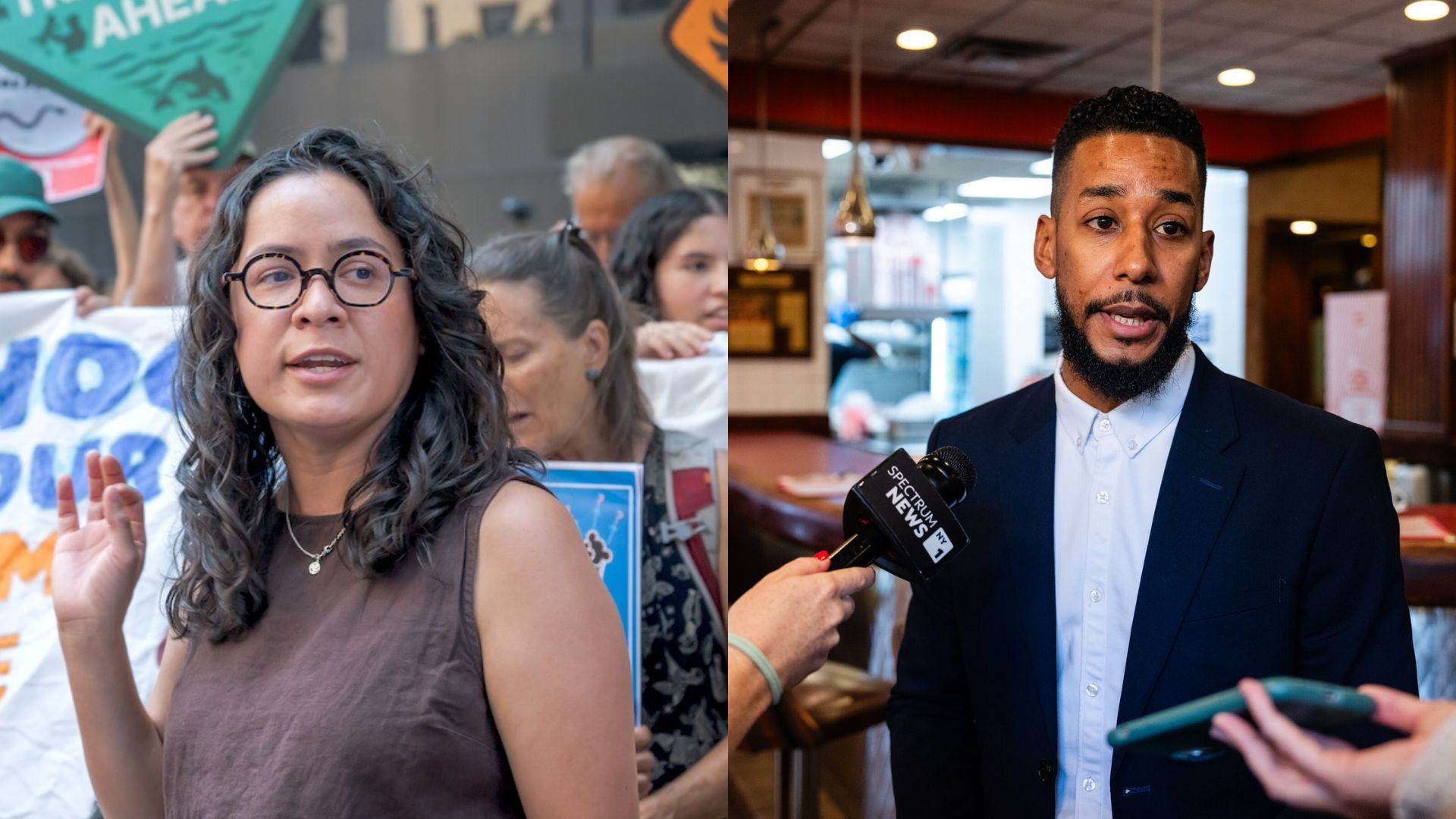
“I am the underdog.”
This remark, shared candidly with a roundtable of journalists, was a telling admission from Antonio Reynoso, one of the leading candidates for Congress in North Brooklyn and Western Queens. Reynoso is the district’s native son, raised by Dominican immigrants on the South Side of Williamsburg. For over a decade, he has represented its neighborhoods; first in the City Council, and then as Brooklyn Borough President. Reynoso co-founded New Kings Democrats, which wrestled power from the atrophying machine of Vito Lopez, setting the stage for a progressive boom across North Brooklyn. He was instrumental in the passage of The Right to Know Act, which required NYPD officers to identify themselves to civilians. Of the three candidates running, Reynoso has by far the deepest roots in the district. And no one has more endorsements from organized labor and local elected officials, either. Perhaps most importantly, the son of Los Sures has received the full-throated support of the outgoing incumbent, Rep. Nydia Velázquez, a progressive stalwart who has represented many of these neighborhoods for the better part of three decades.
He should be anything but the underdog.
And yet, Reynoso was absolutely correct. He is the underdog.
Claire Valdez, the choice of Mayor Zohran Mamdani, is the favorite.
“If it was just me and Claire and Zohran didn’t endorse her, we’re not even having this conversation,” Reynoso told The New York Editorial Board. “It’s over. But Zohran means something. He has like an 80% favorability rating in this district. He won [this district] with the biggest margin against Cuomo. That’s why it’s a toss-up.”
Mamdani, in Reynoso’s telling, has achieved “celebrity status… at the levels of AOC and Bernie Sanders.” And nowhere is his voice more revered than New York’s 7th Congressional District, which straddles the Brooklyn-Queens border.
It is less a district than a nuanced world unto itself. A place where the former stomping grounds of the Irish of Sunnyside and the Polish of Greenpoint have given way to post-industrial hyper-gentrification in Long Island City and Williamsburg. Where residential Ridgewood blends seamlessly into hipster Bushwick; both neighborhoods left for dead half a century ago, yet now boasting higher median rents than parts of the Upper East Side. Where the Latino working-class of Los Sures and Hope Gardens strive to become the Latino middle-class of Cypress Hills and Woodhaven. Where the full spectrum of the Mamdani coalition is represented: from the masjids of City Line, home to a large Bangladeshi community; to the secular, professional class of Fort Greene’s brownstones. Where the college-educated White population has steadily climbed, becoming more and more involved with local Democratic politics; while the blue-collar Hispanic population has gradually decreased, and drifted from the Party once synonymous with their support.
It is also, per this newsletter’s coinage, the heart of The Commie Corridor: the densest concentration of millennials and renters in any district in America.
The Mayor, according to the Brooklyn Borough President, is “a movement.”
But Reynoso’s answer, key to accurately framing the contest, is also incomplete. Valdez, in addition to Mamdani, has the support of their shared political home, the New York City chapter of the Democratic Socialists of America (NYC-DSA).
Since Bernie Sanders ran for President in 2016, the Socialist Left has grown unevenly, but exponentially. A volunteer-led organization with only two paid staffers, NYC-DSA embraces the party surrogate model: changing the Democratic Party by winning primary elections (often in deep blue districts), rather than forming a third party that competes in November. In less than a decade, NYC-DSA has parlayed a handful of victories down the ballot, marrying message discipline and viral charisma with a small army of door knockers, into the political earthquake of Mamdani’s victory last summer.
That anti-establishment lane, prior to NYC-DSA’s meteoric rise, was solely occupied by the New York Working Families Party (WFP), which has enthusiastically endorsed Reynoso. Unlike NYC-DSA, the Working Families Party is a political party, with its own ballot line. This allows WFP to raise and spend money like a Super PAC (funding television advertisements, internal polling, paid canvassing, direct mail); but, unlike a Super PAC, they can coordinate with candidates directly.
Reynoso, by his own admission, is a “WFP pup,” a loyal friend of the progressive third party since the beginning of his career. Valdez, meanwhile, is a “cadre” member of NYC-DSA: a longtime UAW organizer elected to the State Assembly in 2024.
The Socialists vs. The Progressives, indeed.
Reynoso named this dynamic in his aforementioned interview: “The DSA and Zohran Mamdani and Bernie Sanders versus the WFP, and Tish James, Jumaane Williams, the group of progressives that have been doing a lot of work for a long time.”
This piece is structured around the NYC-DSA vs WFP framing, which is why Julie Won, the Western Queens Council Member who is also running for NY-7 but is endorsed by neither organization, is not featured prominently.
Five years ago, Antonio Reynoso would have been a shoo-in for this seat. But in 2026, acknowledging the uphill battle before him is simply an honest read of the room.
Now, he’s on the wrong side of the demographic curve, and the wrong side of the Mamdani coalition, which — if betting odds and internal polls are to be believed — may lead him to be on the wrong side of the outcome on June 23rd.
We’ll get there. But first, some housekeeping and history.
The Working Families Party was founded in 1998 by a coalition of labor unions (the Communications Workers of America’s District 1, UAW Region 9, the Hotel Trades Council, RWDSU, 1199 SEIU), community organizations (ACORN and its eventual successor New York Communities for Change, Citizen Action of New York), and a handful of operatives, most notably Dan Cantor, from the defunct New Party.
The New Party, formed years prior by Cantor, a former labor coordinator for Jesse Jackson’s 1988 Presidential campaign, pursued an “inside/outside” strategy pushing Democrats to the left through the fusion voting system, which allowed candidates to run on multiple ballot lines. (The New Party endorsed Barack Obama in his successful 1996 election to the Illinois State Senate). However, the Supreme Court decision, Timmons v. Twin Cities Area New Party, closed the door on nationwide fusion voting, and killed The New Party. But in New York, fusion voting remained not only legal, but alive and well; in fact, the American Labor Party and the Liberal Party played a pre-eminent role in municipal and state politics for significant periods of the 20th century. Cantor’s bet was that the Working Families Party could run a permanent third party in New York, with ballot access, that almost never ran its own candidates, but instead used the threat of a withheld cross-endorsement to drag Democrats leftward.
WFP’s plan to build a more left-leaning, labor-friendly Democratic Party was ambitious: Rudy Giuliani had just cruised to a second term as Mayor, Republican George Pataki reigned as Governor, and Clintonian neoliberalism dominated the national party.
In 1998, the threshold for securing a third party ballot line in New York was 50,000 votes. The task fell to Peter Vallone Sr., the City Council Speaker from Astoria, Queens; uninspiring and relatively moderate, the party’s rank and file were less than enthused. Vallone Sr., who was crushed by Pataki, nonetheless won 51,325 votes on the newly-minted Working Families Party ballot line. “For the most part, Vallone’s politics represented the antithesis of what we hoped to build — and we took an enormous amount of shit from a lot of activists about that contradiction,” Bob Master recalled to Buzzfeed News. “But the tactic worked.”
Over the next decade, the New York Working Families Party became, arguably, the most influential third party in the nation. A decade of highlights included: electing future Attorney General Letitia James solely on their ballot line in 2003 (granted, James had scores of establishment support); powering the freshman City Council class in 2009 — Brad Lander, Jumaane Williams, Jimmy Van Bramer, Daniel Dromm — which would help overturn Mayor Bloomberg’s veto of paid sick leave, and later formed the nucleus of the Progressive Caucus; while lending crucial support to Bill de Blasio throughout his early career. When the former Park Slope Councilman was elected Mayor, one of WFP’s best organizers, Emma Wolfe, became his Chief of Staff.
But then came Andrew Cuomo, and a long, ugly divorce from labor.
Elected Governor in 2010, Cuomo — a cost-cutting, fiscal centrist — soon made it a personal mission to break the Working Families Party. After the party reluctantly endorsed his 2014 re-election versus Zephyr Teachout (the party’s activist wing wanted Teachout, but labor preferred Cuomo), the vengeful Governor retaliated by creating the similar-sounding Women’s Equality Party, expressly to confuse Working Families Party voters. The rupture came to a head in 2018, when the Working Families Party endorsed actress-turned-activist Cynthia Nixon over Cuomo; immediately, 32BJ SEIU, the Communications Workers of America District 1, the Hotel Trades Council, RWDSU, and 1199 SEIU walked away from the progressive third party. Bill Lipton, then WFP’s New York State Director, told CNN that “[Cuomo] said ‘if unions or anyone give money to any of these groups, they can lose my number.’”
Overnight, the party that had been founded by labor was no longer a labor party.
It was now The Alphabet Left, a collection of non-profits and NGOs.
The exodus of unions restructured the Working Families Party, ideologically and financially. Without labor dues, a significant piece of the Party’s finances, WFP was forced to rely more on foundation grants and high dollar donors. And, absent their former union member base, integral to getting out the vote, the Party developed a smaller, more ideological staff of professional organizers. Dan Cantor stepped aside as National Director in 2018; Maurice Mitchell, a Movement for Black Lives veteran, took over. Bill Lipton, the sharp-elbowed New York State Director who had been there from the beginning, followed suit two years later. By 2023, the New York outfit was co-led by Ana María Archila (Center for Popular Democracy) and Jasmine Gripper (Alliance for Quality Education); both products of the progressive non-profit ecosystem, rather than the labor movement. The transformation was complete.
Still, the Working Families Party continued their solid electoral track record: preserving their ballot line (despite Cuomo’s best efforts to the contrary); winning several more seats on the City Council; expanding their foothold in the Hudson Valley and Upstate New York; and electing Brad Lander, a longstanding ally, as City Comptroller.
Unfortunately, these efforts were marred by a series of higher-profile defeats. Jumaane Williams, a longtime WFP ally, was crushed in the 2022 Gubernatorial race by Kathy Hochul. But, most devastating to the WFP brand was the result of the 2021 Democratic Primary for Mayor. The Party unveiled a ranked-choice voting slate of Comptroller Scott Stringer (#1), non-profit executive Dianne Morales (#2), and well-respected civil rights attorney Maya Wiley (#3). Stringer, an old school liberal struggling to gain traction with younger voters, was accused of sexual assault and promptly dropped from the slate. Morales, more fluent in the language of the left, inherited the coveted first rank only to watch her campaign immediately implode following accusations of union busting. Wiley, the sole candidate on the slate untainted by scandal, became WFP’s first choice by default. Despite a late push (spurred by an endorsement from Rep. Alexandria Ocasio-Cortez), she finished third, eliminated in the penultimate round behind Eric Adams, the law-and-order Brooklyn Borough President, and Kathryn Garcia, a technocratic ex-Commissioner. None of the three candidates originally backed by the Working Families Party made the final two.
This result, bluntly, was devastating to WFP’s reputation. Given that Adams, the antithesis of the party’s progressive ethos, emerged victorious, WFP needed to play the next mayoral race correctly. But by 2025, it was no longer alone on The Left…
The Working Families Party, compared to NYC-DSA, is less democratic. A prospective candidate must first be recommended to the New York City Regional Advisory Council (RAC) by the local chapter that has “jurisdiction” over the given race. The RAC consists mostly of non-profits and some unions. The respective voting power of each union and non-profit on the RAC is weighted based on “membership and money” (the more dues paid to WFP, the greater the number of votes). For example, the New York State Nurses Association has 8 votes, while UAW Region 9A has 2. Despite having a similar number of members, NYSNA pays more dues to WFP than UAW, giving them 8 votes on the RAC. The RAC then either approves or overrides the local chapter’s recommendation. According to Peter Sterne’s reporting for City and State, “the RAC routinely disregards local chapter recommendations, making them all but irrelevant.” The opaqueness of WFP’s endorsement process extends to national politics: after endorsing Elizabeth Warren over Bernie Sanders, the party drew extended scrutiny for refusing to release the vote totals of rank-and-file members. Even now, Sanders is closely associated with DSA, while Warren is synonymous with WFP.
While each candidate endorsed by NYC-DSA receives a comparable baseline of institutional support from the organization, the range of outcomes for a WFP-backed candidate is far greater. Some candidates receive the full breadth of the party’s resources: full-time field organizers, direct mail, internal polling, digital and television advertisements, even an independent expenditure — all funded by the Working Families Party. To a cash-strapped campaign, particularly at the local level, this support is not only invaluable, but often makes the difference between winning and losing. Additionally, WFP boasts a year-round staff of its own political operatives, who can provide day-to-day support to priority campaigns. This model, ironically, complements NYC-DSA’s strengths quite well; when partnered together, the two left-leaning orgs have a far stronger electoral record than when they are on their own.
Nonetheless, other less-fortunate campaigns receive little more than a paper endorsement and a couple of volunteers from the local chapter. Given that WFP’s financial resources are not infinite, the party brass have to strategically invest in their endorsed campaigns: if an insurgent surges across the final weeks, they may receive an influx of spending from the party to help push them over the top; whereas if a poll comes back showing a campaign far behind, investments may be directed elsewhere.
Prior to Bernie Sanders’ 2016 campaign for President, the New York City chapter of the Democratic Socialists of America was little more than a reading group of two dozen members arguing about the legacy of Eugene Debs.
A decade later, NYC-DSA is the largest chapter of the largest socialist organization in the nation, with more than 14,000 dues-paying members in the five boroughs, and the “political home” of the Mayor of New York City. That trajectory — from study group to City Hall in ten years — has no real analog in modern American politics.
That arc is worth rehearsing, briefly. The Bernie campaign exploded membership in the socialist organization, both locally and nationally. Increasingly, those eager volunteers, oftentimes Millennials who found themselves disillusioned by Obama but revived by Sanders, gravitated to the organizing they knew best: knocking on doors. At first, NYC-DSA flirted with backing third party candidates (such as Jabari Brisport on the Green Party line) before internalizing that running in closed Democratic Primaries had far more upside. The big breakthroughs came in the summer of 2018: NYC-DSA was a junior partner to Justice Democrats on Alexandria Ocasio-Cortez’s victory over Rep. Joe Crowley, a political upset so pronounced it helped electrify the campaign of Julia Salazar, running for State Senate against a machine-aligned incumbent in North Brooklyn. Salazar’s victory in September was the first of many for NYC-DSA in the belt of gentrifying neighborhoods in Western Queens and North Brooklyn, now coined The Commie Corridor. A razor-thin defeat in a contentious race for Queens District Attorney in 2019 proved that the socialist organization had the juice to credibly compete with the establishment across entire boroughs, not just individual neighborhoods. In the depths of COVID, NYC-DSA’s first slate of candidates — Jabari Brisport, Phara Souffrant Forrest, Marcela Mitaynes, Zohran Mamdani — went undefeated in the 2020 Democratic Primary (unseating three incumbents). Door knocking, NYC-DSA’s most effective mode of outreach to voters, was shelved on account of the pandemic. And it did not matter — every candidate still won.
The setbacks that followed embodied the nadir felt across The Left during the Biden administration. In 2021, while WFP stumbled in the mayoral race, the progressive third party still bested NYC-DSA in two key Council races, contributing to a less than stellar 2-for-6 record. One year later, NYC-DSA once again ran an ambitious slate of multiple candidates, but struggled to persuade working-class natives and re-activate their base of younger voters. Nonetheless, by 2022, the entirety of Astoria — colloquially known as The People’s Republic — had democratic socialist representation at the City Council, State Assembly, State Senate, and Congressional levels simultaneously, an arrangement that has not existed anywhere in American politics since Milwaukee in the early 20th century. (Today, Bushwick and Ridgewood are within shouting distance of the same). After October 7th, many commentators pronounced NYC-DSA, which unapologetically supports Palestinian human rights and the BDS movement, too politically toxic to win elections. While such doomsday predictions did not come to pass, 2024 marked the lowest point of NYC-DSA’s brief intervention in New York City politics. A smaller, more manageable slate of three candidates was fielded (a fourth, embattled Rep. Jamaal Bowman, was added later). All lost, deluged by outside PAC spending from the Real Estate and Pro-Israel lobbies, except for one: an unassuming labor organizer for UAW Local 2110 from Lubbock, Texas named Claire Valdez.
NYC-DSA is a member organization: anyone in the five boroughs can pay dues, attend their local branch meeting, debate with comrades, and vote. The endorsement and candidate recruitment process is famously rigorous, with the most successful applicants engaging both volunteer leaders and rank-and-file membership. If granted an endorsement forum by the Electoral Working Group (EWG), candidates pitch themselves to a room of hundreds of members, who then debate amongst themselves at the EWG forum and vote thereafter. Each prospective candidate needs to exceed a 60% threshold for their endorsement to be “recommended,” which advances them to the branch level, and then the Citywide Leadership Committee (CLC) for ratification. To be eligible to vote on the all-important EWG recommendation, one must be a dues-paying member of NYC-DSA for at least two months, and have participated in one electoral activity in the past two years (per the honor system). For context, Claire Valdez won the NY-7 endorsement vote with 94% — a mandate in NYC-DSA terms. Functionally, the EWG forum is the most important step in the process (their recommendation is seldom overturned). Once elected, legislators join the Socialists in Office (SIO) committee, a weekly meeting between NYC-DSA elected officials, their staff, and chapter leadership.
The best NYC-DSA candidates thread the needle of viability (a pre-existing base of support in their district, and the work ethic to campaign rigorously), strategic opportunity (a district relatively amenable to socialist politics, with upside for the movement, win or lose), loyalty to the organization (prospective candidates are often asked if they will continue to run regardless of whether they are endorsed or not), and capacity to inspire (the candidate’s intangible ability to motivate a critical mass of people to donate their time and money).
Upon receiving the support of NYC-DSA, the endorsed candidate will benefit from the socialist organization’s greatest competitive advantage: an influx of volunteers willing to knock doors and talk to voters, over and over again, for free. These organizers, who further develop their skills with each successive campaign, have proven invaluable in ousting complacent incumbents. The extent of this advantage varies greatly based on campaign scale (races for Mayor and Congress garner the most attention, whereas down-ballot state legislative contests are less attractive), location (it is far easier to recruit NYC-DSA volunteers to canvass in member-dense areas like North and Central Brooklyn, than, for instance, the East Bronx), and macro-political conditions (enthusiasm and engagement across The Left peaked during both Trump eras, but noticeably declined in between).
The maturation of NYC-DSA has also borne an emerging class of savvy political operatives. On Zohran Mamdani’s mayoral campaign, many of his core staffers (Campaign Manager Elle Bisgaard-Church, Deputy Campaign Manager Katie Riley, Field Director Tascha Van Auken, Communications Director Andrew Epstein) cut their teeth organizing with NYC-DSA. Amidst a field flush with veteran operatives, Mamdani’s fresh-faced team was underestimated. These “inexperienced” upstarts collectively steered one of the best campaigns in recent memory on their way to a historic upset. The internal development of talent within NYC-DSA, similar to the incubation once offered by WFP, is arguably the most important, yet least discussed, development in New York City politics. Now, many top staffers from the Mamdani campaign (Andrew Epstein, Morris Katz, Ravi Sahai, Melted Solids), have turned their attention to their next shared political project: electing Claire Valdez to Congress.
As The Left approached the 2025 Democratic Primary for Mayor, in need of a rebound after several difficult cycles, two candidates emerged, from distinctly different factions, to vie for the mantle of opposition versus Andrew Cuomo: Brad Lander, the left-liberal City Comptroller and longstanding ally of the Working Families; and Zohran Mamdani, a NYC-DSA organizer turned Assembly Member from Astoria.
Many assumed Lander, a Park Slope policy wonk who had already won a citywide campaign, would be advantaged in a five-borough campaign compared to Mamdani, a relatively unknown legislator who spent his weeks in Albany. Both candidates responded to the 2024 Presidential election, and the backlash against progressives, differently: Lander sought to moderate on issues of crime and policing, playing defense against The Left’s weaknesses; whereas Mamdani diagnosed Trump’s victory (and his pronounced inroads across the city’s multi-racial working class) as downstream from runaway costs, around which he would orient his entire campaign.
As time wore on, the candidate quality gap between Mamdani, the dynamic democratic socialist, and Lander, the mild-mannered bureaucrat, proved to be significant. Lander seemed to be parodying Mamdani’s style, only worse, rather than leaning into his own strengths. The progressive Comptroller struggled to cultivate a lane: Cuomo captured working-class Black and Hispanic voters, Orthodox and Hasidic Jews, and ideological moderates; while Mamdani inspired college-educated progressives, South Asian and Muslim voters, and young socialists; too liberal for moderates, and not progressive enough for leftists, Lander was stuck in a proverbial no man’s land. Starved for oxygen, he wilted under the pressure of the attention economy. Even the Working Families Party, reading the writing on the wall, eventually ranked Mamdani first and Lander second, dealing a final blow to the latter’s campaign.
Mamdani’s victory re-oriented New York City’s political hierarchy, nowhere more so than on The Left. NYC-DSA — powered by 14,000+ members and a Mayor who is now the leading avatar of the American Left and still calls the chapter his “political home” — controls the bully pulpit. NY-7 is the first major campaign to test this pecking order.
Running for office is an inherently emotional process, particularly in a place where you have launched your career, much less spent your entire life. Every day, you are asked to put yourself out there, inviting thousands of opinions from other people: calls from erstwhile allies go unreturned, leaflets bearing your face are discarded like trash in the street, strangers with anonymous avatars on the internet call you names. Worst of all, no one can relate to this strange experience, condemning the candidate to isolation.
Still, most candidates, media trained and pre-programmed for maximum inoffensiveness, rarely show themselves, overtly or tacitly. Antonio Reynoso, speaking with The New York Editorial Board, did not heed this tried-and-true orthodoxy.
His answers, candid but contradictory, revealed a politician making sense of the ever-changing landscape around him and struggling to adjust to a new era. In his telling, Mamdani was “lucky,” blessed by “good timing” and a weak field of opponents, circumstances akin to “a perfect storm.” And yet, simultaneously, the Mayor was the reason Reynoso currently trails a one-term state legislator. The Mayoral race, according to the Borough President, “was not a fight between the WFP and the DSA,” even though Lander and Mamdani, respectively, were ostensibly linked to each faction. Lander “could not meet the moment,” said his longtime ally, but that failure was not indicative of a broader political realignment, away from Progressives and towards Socialists. The history of the district, Reynoso intoned, was still important; even though the average voter, aged 34, had no recollection of Bertha Lewis or Jon Kest. The Brooklyn native spoke earnestly about how much the support of Nydia Velázquez meant to him, but acknowledged that one third of likely voters were born after she was first elected. These clear-eyed ruminations read like an exit interview, a candidate coming to terms, in real time, with what the internal polling has shown: the more voters understand that his opponent is supported by Mayor Mamdani, the worse Reynoso’s odds become. And if the electorate — shorthand for the age and demographic composition of voters — mirrors last year’s, Claire Valdez is destined to win. The Mayor’s shadow loomed over every word. Perhaps the most instructive line was merely a throwaway: “The timing has to be right,” Reynoso mused. “You have amazing, qualified people that run and lose because the timing isn’t right…”
Was the son of the South Side talking about himself?
Which brings us back to the question on the masthead: Who leads The Left in New York City? A decade or two ago, the implicit answer was the Working Families Party, although no one bothered asking such an obvious question. Five years ago, it was contested. Today, the answer is NYC-DSA: the organization that won City Hall, anchors The Commie Corridor, and is on the verge of sending Claire Valdez to Congress versus the candidate of Brooklyn’s progressive institutions.
But these moments can be fleeting, which is why NY-7 is existential for all parties. Post-Mamdani, NYC-DSA may be on top, but only victory can preserve their rapid ascent in the ever-changing hierarchy of New York politics. The Seventh District is the most explicitly left-leaning in the nation; any survey of the L train at rush hour underscores why Valdez is the favorite. Failure here, and even the Mayor’s victory, a triumph of the collective, could be re-written as more man than movement. In many respects, the Working Families Party of yore, non-profits and labor unions, has lined up behind its favorite son. But can those institutions still move masses of votes, like in the good old days, or is a new era upon us? The class-conscious Socialist Left, too, prides itself on building broader coalitions than their identity-based Left-Liberal counterparts; and yet in the Seventh District, it will be Reynoso, the local kid from Los Sures, pulling the most votes from the tenants of Williams Plaza and the seniors of Hope Gardens. The path to victory for Valdez, perhaps uncomfortably, runs through the newcomers, those less tethered to past and place. Once artists and hipsters with little interest in trad electoral politics, the neighborhoods of NY-7 are now the epicenter of the urban, college-educated class reshaping the Democratic Party.
Ben Max, when confronted by Reynoso’s bleak pronouncement, pressed him further. “How, despite all your accomplishments and advantages, are you the underdog?”
The honest answer is that the neighborhoods changed beneath Reynoso’s feet; the Mamdani movement, at least here, is a force he will struggle to replicate, let alone defeat. His own decades of work helped build the world in which NYC-DSA grew, but the rewards may no longer be his to claim. If Reynoso doesn’t dethrone Vito Lopez, does Julia Salazar beat Martin Malavé Dilan? And if Salazar never wins, does Mamdani even get elected? If the Progressives tilled the soil, the Socialists are bringing in the harvest. This unforgiving process is what political succession in New York City — Tammany Hall to The Little Flower, the regulars to the reformers, Rangel to Espaillat — has looked like for generations. The only difference, now, is the speed.
A decade ago, NYC-DSA had only a couple hundred active members. Now, the Socialists have the chance to elect the next Congresswoman from NY-7, all while the Mayor of New York City looks on. The Commie Corridor was not built in a day.
But it was built in less than ten years.
Connect With Me:
Follow me on Twitter @MichaelLangeNYC
Email me at Michael.James.Lange@gmail.com
This piece presents a strong basis for cheering DSA here, on results alone, and I'll sit with that. But I think the more important observation is that the WFP and DSA -- at least as proxies for broader divergences in the NYC left -- are most successful when they are working together. The reasons why are obvious, and that's part of why picking this fight has felt, to me, unstrategic on DSA's part. And a little bit disrespectful: Reynoso as an individual is not the institution of the WFP; his contributions to the left and to laying the ground work for DSA have a constituency that goes beyond factionalism. Should dues paid not be honored? Should Reynoso's supporters' new neighbors not feel compelled to honor the fight that was ongoing before they walked in the room? If not those who've been fighting it?
All of that is trivial, though, compared to the risks presented by this cleavage, which feels almost entirely factional; on the issues the two cohorts are nigh indistinguishable and share pretty much the same constituency. And we should note the example of Council Member Sandy Nurse, who took office in 2022 with the support of both cadres, representing more the lineage of Occupy Wall Street and its inheritor institutions which she helped create in "the Commie Corridor" long before DSA became relevant. There is no reason we cannot work together, and we are better off on the same team. We *are* the same team. It would be tragic to let acronyms get in the way of our seeing that.
So I still have hope for DSA as a connecting nexus between the various ideologically friendly cohorts in the city. But for that to happen, DSA has to act like team play is a thing it cares about. While sectarian feelings are probably very tempting to DSA right now, especially after defeating the unworthy centrist and right-wing billionaire factions, I urge DSA leaders and members to resist it when it comes to the organization's relationship to the rest of the NYC left. Folks like Reynoso are just one example of a broad set of relationships, organizations, and experiences of struggle that people carried on in much more lonesome fashion for a very long time. And as this piece correctly identifies (and in many more ways; for instance, People for Bernie is a direct OWS descendant personnel-wise), we wouldn't have this beautiful moment of hope and opportunity without them. So please, do what you can to stand on our shoulders, not our necks. And whatever happens next here, I hope we all learn lessons from it and try to avoid acquiring any scars or bitternesses. In this moment, we simply have to all keep trying to get it right.
What I really found fascinating was the mention in his interview that this all could have been avoided had Julia chosen to run