

I: How We Got Here
There is a version of this race that ended before it began. In this alternate universe, the two figures integral to the past and present of the New York left simply agree.
Mayor Zohran Mamdani, fresh off the biggest upset in a generation, and Rep. Nydia Velázquez, the sixteen-term incumbent and the first Puerto Rican woman elected to Congress, were close allies throughout 2025. She was among the earliest progressive validators to bless his once-longshot campaign, and appeared triumphantly on stage alongside him at his election night celebration; awaiting her flight to a political conference in Puerto Rico after the election, Velázquez jokingly asked “where’s my boyfriend,” a reference to the ever-charming Mamdani. And so when Velázquez, after thirty-two years in the House of Representatives, abruptly announced her retirement last fall, the script seemed to write itself. The Mayor and the Congresswoman would get on the phone, and settle on a consensus heir the whole coalition could stand behind: Tiffany Cabán, a Western Queens Council Member with Puerto Rican heritage, was floated; as was Julia Salazar, the North Brooklyn State Senator and NYC-DSA’s first socialist in office (SIO). Find a standard-bearer acceptable to both The Socialists and The Progressives alike, and the field clears before it ever forms.
No primary. No proxy war. The succession settled in a single phone call.
But that’s not at all what happened.
Salazar promptly took herself out of the running, while Cabán briefly explored a bid and bowed out once it was clear the Mayor and much of the DSA rank-and-file had landed elsewhere. And the broader socialist–progressive consensus never formed.
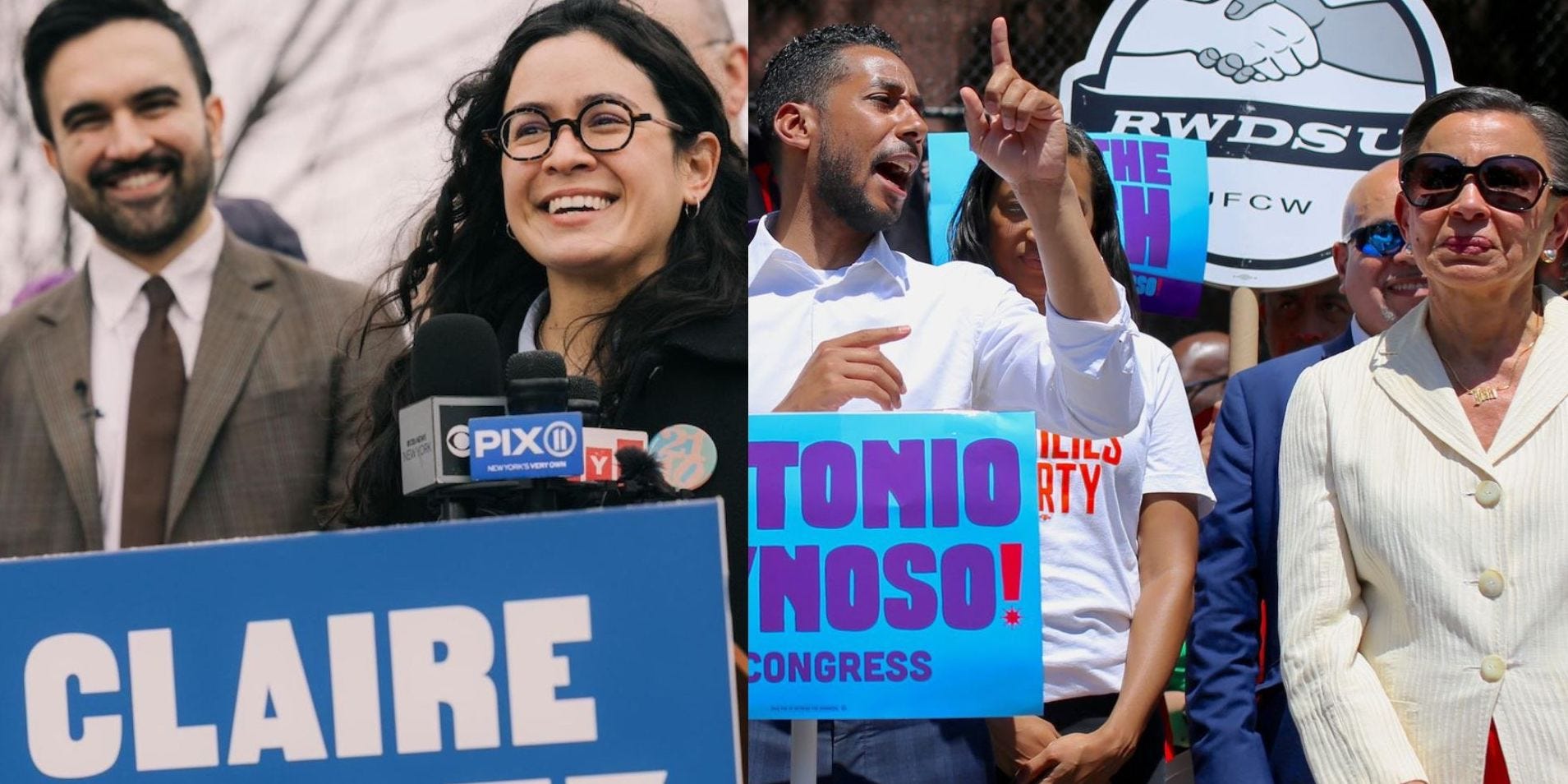
Instead, Mayor Mamdani endorsed Claire Valdez: a one-term Assembly Member, UAW organizer, and cadre member of NYC-DSA (who won 97% of the chapter vote). Velázquez, who warned The New York Times that the Mayor’s meddling “opens up fights” among the very coalition he now has to govern, anointed her own protégé instead: Antonio Reynoso. The alliance that helped elect a democratic socialist mayor split, bitterly, over who would inherit his most devoted district.
In any other era, the Brooklyn Borough President and son of Los Sures, backed by La Luchadora and the lion’s share of organized labor, would have won this seat without lifting a finger. Five years ago, this would not be a contest, but a coronation.
But a lot has changed in five years.
New York’s 7th Congressional District in 2026 is the densest concentration of millennials and renters of any district in America, and the heart of the Commie Corridor. And here, in the belt of gentrifying neighborhoods straddling the Brooklyn-Queens border, the ground has shifted beneath Reynoso’s feet. The Irish of Sunnyside and the Polish of Greenpoint have given way to the post-industrial hyper-gentrification of Long Island City and Williamsburg. Residential Ridgewood has blended into hipster Bushwick, collectively forming the most socialist spine in the nation. The college-educated professional class climbed, while the blue-collar Hispanic population drifted. The neighborhoods Reynoso helped midwife are now the epicenter of the urban, white-collar cohort remaking the Democratic Party — and they did not wait for his permission to do so. The coronation has curdled into a war.
Readers of this newsletter know the shape and scope of that war. It is less a bitter battle between two candidates than an existential fight between competing movements. It is The Socialists vs. The Progressives: NYC-DSA, the volunteer army that went from study hall to City Hall in a decade; versus the Working Families Party, the progressive third party that dominated the anti-establishment lane of New York politics for twenty years before the socialists arrived on the scene. Valdez carries the banner of NYC-DSA — and the Mayor’s. Reynoso — by his own cheerful admission, a “WFP pup” — is proudly backed by the Working Families Party, whose top brass overrode its own Brooklyn and Queens chapters to bless him. Tish James and Jumaane Williams on one side; Mamdani and Bernie Sanders on the other.
The stakes are not subtle. And the question is one I have been circling for months: Who leads The Left in New York City? A generation ago the answer was the Working Families Party, and nobody bothered to ask. Five years ago it was contested. Today — with 14,000 dues-paying members and the Mayor calling the chapter his “political home” — the answer is NYC-DSA. But these moments are fleeting, and a title held is not a title retained. The arc of the New York Working Families Party, bluntly, is proof of that. And the surest way to reduce the Mamdani earthquake from movement into man is to lose the first marquee race of the New Era™.
NY-7 is the first test of this new pecking order. We are four days from receiving the answer. And the race, in these final days, has turned mean.
II. The Bitterness
The first shot was fired back in January, and it came from La Luchadora herself.
When Velázquez endorsed Reynoso, she did not simply bless her protégé; she went after the woman running against him, and the Mayor standing behind her. Valdez had been in office eleven months, the Congresswoman noted; “I really don’t know her,” she told The New York Times, before doubting aloud whether the freshman even knew her way around the district. And then she turned the blade toward Mamdani, pointedly warning that “honeymoons are short,” while challenging the presumption that the Mayor could hand-pick the heir to a district that was hers long before it was his.
And then, for months — quiet.
The race settled into something resembling an uneasy truce. Two candidates with nearly identical platforms — calling Gaza a genocide, supporting abolishing ICE and taxing the rich, and praising Mamdani’s agenda — circled one another and declined to engage. Both sides held their fire, and the polls remained stubbornly static.
The détente broke in the closing weeks, and it ruptured like a dam.
First came the super PACs. In May, a new pro-Palestinian outfit called American Priorities — founded by a former Sanders strategist, built explicitly as a counterweight to AIPAC — committed $2 million to boosting the three Mamdani-endorsed congressional candidates: Darializa Avila Chevalier, Brad Lander, and Claire Valdez. The PAC’s rolodex of donors included a Texas businessman who has also cut checks to Marjorie Taylor Greene and Greg Abbott. Promptly, Reynoso and Julie Won, the Western Queens Council Member running in a distant third place, seized on this issue. In a joint statement, the two accused Valdez of breaking the no-super-PAC pledge every candidate in the race had made. Reynoso went even further, tweeting that Valdez was astroturfed by “MAGA Republican” donors. For a democratic socialist insurgent whose brand is small-dollar donors and grassroots purity, the charge of hypocrisy stung and was repeated ad nauseam. Then came the redbox.
For the uninitiated: a “redbox” is one of many loopholes in our broken campaign finance system. A campaign posts coded instructions on a public (but hidden) webpage — what message to repeat, where to target it, and which voters to reach — and the ostensibly “independent” super PAC reads those instructions and acts.
Valdez added her redbox months ago, and Reynoso added his shortly after. Reynoso then accused Valdez of “only wanting rich people to vote, not the working class,” because her redbox instructed PACs to spend in ZIP codes that included Greenpoint, Williamsburg, Bushwick, and Ridgewood; what Reynoso conveniently left out was that those four neighborhoods alone are collectively over three-fifths of NY-7’s electorate. At the NY1 debate, Reynoso pressed her on it directly. Valdez pivoted to her base: more than 22,000 small donors, she noted, more than both opponents combined. Pressed on whether she had reversed her pledge, she did not flinch. “We need to win,” she told a reporter. It was, for an idealistic socialist, a realpolitik answer.
But Valdez has a knife of her own, and she has not been shy about using it.
Her counterpunch lands on Reynoso’s donors. The Judge Street Journal traced a handful of Reynoso’s max-out contributors to AIPAC, Solidarity PAC, and pro-charter school PACs; a hedge-fund manager here, the chair of the ADL’s board there, in addition to several real estate developers (in a district that is 78% renters). The charge was not that Reynoso is an AIPAC-backed candidate (at least not for a couple of days), but that he was the candidate AIPAC’s donors could live with. “We don’t take any AIPAC money, and she knows that,” the Brooklyn Borough President told the Journal. But the donor trail is only half of Valdez’s indictment. The other half is timing.
The first time Reynoso ever used the word “genocide” to describe the Israeli government’s actions in Gaza, Valdez charged, was the day he launched his congressional campaign. Reynoso himself has all but conceded this is true, but waved the inconvenient gap away as a distinction his opponent had to invent because she needed one. Compare that to Valdez, who was immediately outspoken about the war after October 7th, and you have another contrast the socialists hope to highlight.
And the Valdez camp did not stop there, insisting that Reynoso’s no-PAC piety was a farce, before implying he was quietly being boosted by AIPAC-aligned money, laundered through shell PACs designed to mask the unpopular origin. But the accusation misfired. Real Fight NYC, the eleventh hour PAC supporting Reynoso with undisclosed money, was actually funded, in part, by the American Federation of Teachers, according to reporting from Ryan Grim and Peter Sterne. Reynoso’s campaign eagerly seized on the mishap, issuing a scathing press release titled “Where was Claire? Lying,” a play on Valdez’s campaign slogan “Claire was there.” Valdez spokesperson Andrew Epstein countered, “we now know where $200,000 of a potential $1 million spend comes from. We won’t know the full picture until after Tuesday.” Shortly thereafter, Jewish Insider reported that Scott Stringer — a pro-Israel Democrat, fervent Mamdani-critic, and twice unsuccessful candidate for mayor — is “deeply involved” in the PAC’s “organization and operations.”
A Civil War in the Commie Corridor, indeed.
Thus, as we approach the final hours of the race, both campaigns (and the super PACs orbiting them) have settled into a kind of mutual recrimination: each accusing the other of taking the tainted and dark money, each accusing the other of going negative. For both candidates, the message has become muddled.
And the vitriol is a symptom of how high the stakes have climbed.
Two campaigns, largely ideologically aligned, do not typically draw this much blood over a single open House seat, even if victory is tantamount to a lifetime appointment. The metaphorical bloodshed is because both sides understand that NY-7 is the proxy war for leadership. NYC-DSA needs to prove the Mamdani coalition is durable; that it transfers to the next candidate, the next district, the next cycle. The Working Families Party, which has watched the socialist upstarts erode its status on The Left, needs to prove it has not become obsolete. One institution is fighting for its ascendancy. The other is fighting for its relevance. And neither can afford to be polite about it.
And then there is the Mayor.
No one has more riding on the outcome of NY-7 than Zohran Mamdani. Reynoso has likened Mamdani to a political “boss,” accused Valdez of being “beholden” to him, and labeled his intervention “disloyal” to the district’s matriarch. It is certainly a gamble to challenge Mamdani among a constituency where his approval hovers around 78 percent, where Zohran is a cultural and political figure, and it tells us everything about how Reynoso reads the contest. He is not running against Claire Valdez. He is running against Mamdani’s shadow, because he knows the shadow is what beats him.
Mamdani has not been shy about the depth of his investment. He privately maneuvered to coax Valdez into the race, endorsed her at a rally in Maria Hernandez Park (alongside UAW President Shawn Fain) in January, and broke with his erstwhile ally Velázquez to do so. Much of Valdez’s senior staff are Mamdani campaign alumni; the Mayor’s closest adviser, Morris Katz, even cut the Knicks-themed get-out-the-vote ad: this is the team, this is our year. On the first weekend of early voting, Mamdani was marching alongside Valdez on Knickerbocker Avenue in the Puerto Rican Day Parade. As a strategist who worked on Mamdani’s campaign told NBC, the Mayor’s slate of endorsements is a “high-risk, high-reward” bet to remake the city’s delegation. NY-7 is the highest reward of the three. And it is also the highest risk.
The betting markets price Valdez as the heavy favorite, but the lone public poll — conducted by Emerson, in mid-May — had her up two points, 23 to 21, with a massive 43 percent undecided. But read that number again, slowly. Up two is not a lead. Up two, with a five-point margin of error and two in five voters still undecided, is a coin flip. I expected this race to be knotted in late May and then for Valdez — backed by the Mayor and NYC-DSA’s vaunted canvassing and GOTV apparatus — to pull away down the homestretch. But with almost 100 hours remaining, she has not pulled away.
This contest has sat, stubbornly deadlocked within the margin of error, for three months. The movement is not moving. Either the message is not landing, or the voters who are supposed to carry it are not yet tuned in. Quite possibly both.
This is a dead heat. Most people just don’t know it yet.
And a photo finish will be decided by turnout. Which means none of this matters if the people who made Claire Valdez the favorite all along do not actually show up to vote.
III. The District That Slept In
Here is what I keep coming back to, in these final hours, with the early voter files open on my desk. A year ago, NY-7 did not sleep in — it led the city.
In the 2025 mayoral primary, the Seventh District produced the most Mamdani-friendly early voting surge of any Congressional District in New York City. Mamdani’s share of the in-person early vote ran more than 9 points higher than his Election Day share here; a drop in vote share from a staggering 81.3% banked early to 71.9% on Election Day. Early vote ballots made up more than 40% of the district’s total, painting a portrait of a new coalition: younger, renter-heavy, college-educated, ideological, and excited — the kind of voters who don’t want to wait for Election Day to vote because they cannot wait. They voted the moment the doors opened, and they powered a historic upset.
That coalition is the lifeblood of the Valdez campaign, and it is also the thing that should concern her. I wrote in The Dress Rehearsal for 2028 that Mamdani proved this electorate can be roused, with “enough elbow grease and economic populism,” but that those intangibles cannot be simply inherited. What happens on June 23rd, I mused, when the Mayor is not on the ballot, even if his movement is? The early vote is the first glimpse of whether the changed electorate would endure — or whether it walked into the voting booth once, for one man, and then disappeared into the night.
The initial returns were dismal; but the latter batches indicated signs of life.
And together, they paint a picture of a campaign balanced on a knife’s edge.
By my analysis of the daily voter files, NY-7 remains — at a glance — the sleepiest competitive congressional district. It has banked a paltry 22% of its 2025 early vote through six days, dead last among the city’s marquee primaries; the open-seat scramble in NY-12 and the uptown brawl in NY-13 are banking early votes at better than a third of last year’s pace, while the Commie Corridor noticeably trails.
So far, the headline writes itself: the district that led the city a year ago slept in.
But underneath that sleepy topline, two blocs are surging in opposite directions — and the race is being decided in the space between them.
The first surge belongs to Reynoso, and it comes from South Williamsburg, home to the Satmar Hasidim. This Yiddish-speaking, ultra-Orthodox community is a world unto itself that votes as a near-unanimous bloc in accordance with local rabbinical leadership. Both Satmar factions have endorsed Reynoso, the kid who grew up only a few blocks away. For a community that values access and relationships more than ideology, the Borough President is a known quantity. And this week, on cue, they have come out in droves for Reynoso. South Williamsburg has already banked more than 60% of its entire 2025 early vote and now makes up 14% of the district’s early electorate — nearly triple its 5% share a year ago. Taylor Wythe Community Center, the Satmar-dominated site in South Williamsburg, is the busiest poll site in NY-7. And they didn’t even vote on Saturday, in accordance with the Sabbath.
So far, anti-Zionist voters under 35 are shaping the outcome of the most left-leaning district in America — except they are not wearing keffiyehs or sleeve tattoos on Jefferson Street; but donning shtreimel and black and white garb on Lee Avenue.
(The Satmar, despite their ultra-Orthodox orientation, are religious anti-Zionists.)
The second surge is Valdez’s, and it took longer to materialize. For the first couple of days, the youth vote share was alarmingly low, and the lone bright spots in the data were a mirage, propped up by the young Satmar bloc voting for Reynoso, and dragging the district’s median age down with it. Remove South Williamsburg entirely, and the (non-Satmar) under-35 share — Valdez’s best demographic — has increased for six days straight, from a paltry 28% in the opening days to a robust 40% on Thursday, its single-day high this cycle. The median voter in NY-7 is now 40 years old. The Commie Corridor core is still lagging badly on raw turnout: the DSA spine remains the coldest on my retention map, with less than 15% of its 2025 vote banked. Nonetheless, the trajectory has bent in Valdez’s direction every single day.
So which is it? Are the young democratic socialists of Bushwick and Ridgewood and East Williamsburg not coming at all — checked out, demobilized, proof that the alleged realignment was more man than movement? Or are they simply waiting for Election Day, the same way lower-propensity voters often do, and planning to stroll in on June 23rd the way it was always scripted? The youth “wave” is real. Whether it is large enough to counter a Satmar bloc that is almost fully banked, and arrives in time, is what the next four days will settle. And the answer will decide this election.
Of every candidate NYC-DSA has ever run, Claire Valdez’s path to victory may be the most ruthlessly indexed to age. Mamdani, an earned media phenom, had far greater reach with older and working-class voters, while thoroughly annihilating Cuomo, an arrogant fossil of the Democratic establishment, among Millennial and Gen-Z voters.
Valdez’s coalition is narrower and steeper: heavily reliant upon the young, college-educated, renter spine of the Commie Corridor (Greenpoint, Williamsburg, Bushwick, Ridgewood), and it takes a hit with every year you add to the median voter. Reynoso, meanwhile, has built precisely the countervailing coalition you would design to upset her: the Satmar Hasidim of South Williamsburg, who vote as a bloc and break roughly nine-to-one for the local kid who grew up a couple blocks away; the older Hispanic voters of Cypress Hills and Woodhaven: the Hispanic working- and middle-class who remember Velázquez, and who never quite warmed to the socialists; a reservoir of name recognition in the Brooklyn NYCHA developments, where a decade as Council Member and Borough President actually means something; and, crucially, the elder Millennial and Gen-X progressives — the Fort Greene brownstoners, the Downtown Brooklyn professionals, the Greenpoint-Williamsburg WFP loyalists — who are liberal enough to want a progressive but old enough, and institutionally tethered enough, to prefer the Working Families Party over NYC-DSA.
I built a precinct-level simulator of NY-7 to put hard numbers behind these instincts, and to ask what happens to the Valdez—Reynoso margin as the shape of the electorate changes. The 2025 Mamdani electorate is the foundation, and lets me rebuild the district lever by lever: age, race, share of first-time (Mamdani) voters, the turnout of the Satmar bloc, where Julie Won’s supporters go if she fades down the homestretch, how much Valdez is boosted in the NYC-DSA spine and Reynoso in WFP-friendly precincts, which neighborhoods over- and under-perform the turnout baseline, and even a customizable breakdown of age and race crosstabs.
I constructed seven scenarios, ranging from the electorate the democratic socialists are praying for, to the one that deals them their greatest setback in years. First, the age of the electorate as a whole, and the extent to which the Mamdani Voters turn out again, are intimately correlated. A relatively energized, youthful electorate is flush with Mamdani Voters, the lower-propensity leftists who came out last June, almost by definition; whereas an older, more traditional electorate lacks many of the voters Claire Valdez so desperately needs. Thus, I let the two rise and fall as one, the way they actually will on Tuesday. Here is the full ladder, from Valdez’s ceiling to her floor:
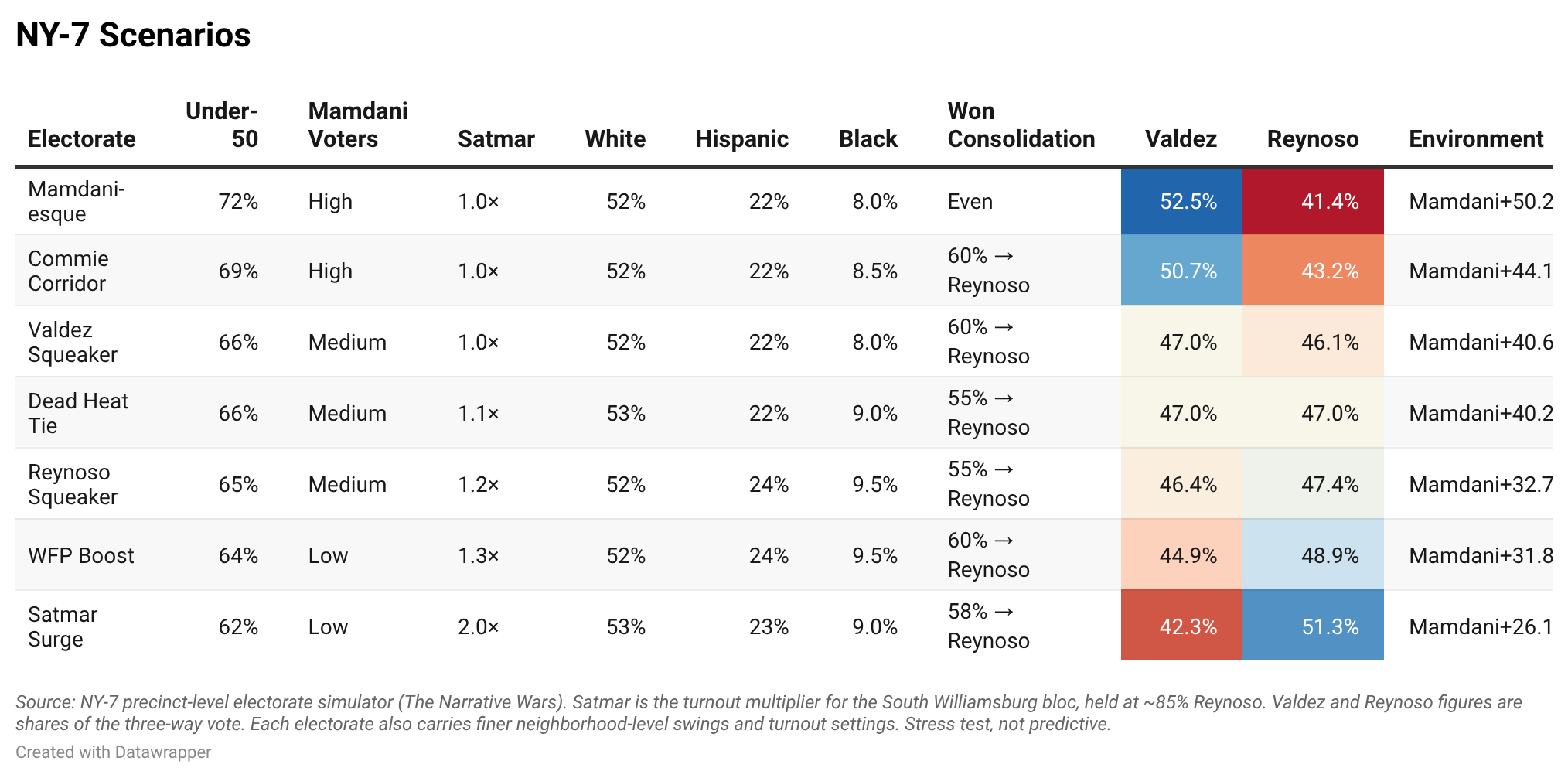
Read the ladder top to bottom and the most important variable is unmistakable: engagement. Where the electorate is young and rich with Mamdani Voters, Valdez wins; and the higher both are, the easier her path to victory is. The inverse is true for Reynoso, as an older, more habitual electorate benefits his incumbent-esque profile.
In my model, the tipping point in the district sits at 66% under-50 voters; freeze it right around there, and you can still land either result. On the margins, Valdez needs to cultivate a discernible advantage across Queens (Sunnyside and Long Island City), and hold both Greenpoint and Williamsburg by double digits; Reynoso needs the DSA spine through Bushwick and Ridgewood to noticeably underperform their baseline turnout, paired with robust Hispanic turnout (closer to ~25% of the electorate), and advantages in Downtown Brooklyn and Fort Greene (a mix of luxury condos, public housing, and the brownstone belt at the heart of the WFP coalition). The Satmar bloc vote for Reynoso is the wildcard: if their turnout matches last year’s ~5% share of the electorate, Valdez is fine; but if the bloc approaches ~10%, her path will be strained.
If you hold the district at my 66% under-50 coin flip — with Valdez and Reynoso tied — and isolate the variables to see what they are actually worth, the hierarchy is clear.
Nothing comes within shouting distance of the Mamdani Voters turning out, an infusion of Valdez-friendly voters that simultaneously drags down the age distribution of the electorate. An energized primary and a listless one swings the margin close to seven points. The distribution of Won’s supporters matters, too, as does the Satmar bloc. But the most powerful force deciding this election is whether some thousands of young people who only voted once in a Democratic Primary, for Zohran Mamdani last June, are willing to do the same for his comrade, Claire Valdez, this June.
Which returns us, fittingly, to the sentence I wrote back in January, and have not been able to shake since: demography is destiny — until logistics and turnout machinery rewrite it. NY-7 is the most demographically socialist-friendly district in the country, and it’s not even close. On paper, Valdez should win. But “on paper” is doing a tremendous amount of work in that sentence, and the early-vote returns are the first real ink on the page. So far, the district that led the city a year ago is yawning.
And there are four days left to find out whether it will wake up.
IV. The Shared Inheritance
The Commie Corridor was not built in a day, and the bitter battle for NY-7 has become a referendum on who gets to claim that inheritance.
The socialists climbed the ladder of insurgency one cycle at a time: Julia Salazar in 2018, Emily Gallagher in 2020, Kristen Gonzalez in 2022, Valdez herself in 2024. But the modern-day Commie Corridor was also built by the people the socialists are now trying to inherit, or take, it from. Reynoso represented what would become its heart — Williamsburg, Bushwick, Ridgewood — on the City Council for two terms. Velázquez has represented the core of these neighborhoods in Congress since 1993; and led a movement of Puerto Rican and Black leaders who went to court to draw the very lines the insurgents now run between. For decades, Velázquez and Reynoso worked to wrestle this ground from the entrenched machines of yore; and were enthusiastic supporters of Julia Salazar, NYC-DSA’s first SIO (Salazar has remained neutral in NY-7). But the arc of political power (and demographic change) in New York City is as endemic as it is unforgiving. In less than a decade, the socialists rose up through the same precincts, one election at a time, until they could plausibly lay claim to the whole district. Two competing claims of inheritance, but only one seat at the table. And therein lies the cruelty of this primary, and origin of its venom: NY-7 is not a war between the Commie Corridor’s builders and its enemies. It is a war between its builders. Both camps nurtured these blocks. Both believe, with cause, that it is theirs. You do not fight this bitterly over anything — except what you made yourself.
Zohran Mamdani is the Commie Corridor’s avatar, but not necessarily its author.
And that is exactly why this race frightens the people who love him most. Because if the coalition cannot elect the next candidate — if it turns out that the magic was Zohran, and not the organization that made Zohran possible — then last year was not a realignment, but a comet: beautiful, singular, gone.
For NYC-DSA, a loss in NY-7 would be the most devastating kind of defeat: not a setback in hostile territory, but a failure at home, in the most favorable district in America, with the Mayor himself leading the charge. It would hand the Working Families Party the one argument it has left: that the institutional left can still move votes, and that the socialist ascension at its expense is not inevitable. And it would give fodder to the skeptical establishment to do what it has always wanted to do with a movement it still struggles to understand: wait it out, and call the whole thing a fluke.
For Mamdani, the cost is more intimate. The Mayor has staked his own political capital here in a way he did not have to. He could have brokered a deal with Velázquez, or stayed neutral and let DSA and WFP bleed each other out. But he chose the opposite.
The Mayor put his reputation, his staffers, his advertisements, his fundraising network, and his name on the line for Claire Valdez, because Mamdani understands that his power is only worth what it can transfer. His fate and NYC-DSA’s are not adjacent, but shared — for better or worse. To lose NY-7 is to lose, in a single Tuesday evening, the argument that the project is bigger than the man.
The voters of New York’s Seventh District will settle it the way they always do — not in a poll, not in a betting market, and certainly not in my simulator — but in the abrupt and anticlimactic act of walking into a school gymnasium and bubbling in an oval.
A year ago, they did it early, and they did it in droves, and they reshaped the city. The question is whether that was the beginning of something, or the high-water mark of it.
Connect With Me:
Follow me on Twitter @MichaelLangeNYC
Email me at Michael.James.Lange@gmail.com
Really insightful and excellent storytelling. My only questions:
What if the early voting slump doesn’t represent a lack of investment, but an intense ambivalence?
What if the real problem is that this district broadly finds itself with reasons both pro and con, for either side in this race?
What if folks are, like me, pro-DSA and want it to be a lasting success, but are also inclined to feel defensive of what Reynoso and the WFP faction built over decades of coalition-shaped trench combat?
I think basically anyone who was politically involved prior to DSA’s emergence could fit this description. This probably makes demographic slicing a tough analytical tool to apply here — except for on the matter of age. But if the DSA/WFP split is substantially real, it strikes me as intra-generational. And those of us who’ve been committed the longest are going to be the ones who remember when WFP was one of the only organizations carrying the flag at all. But we also must recognize that DSA is a more promising and already more successful organizing formation. IMO it is very hard to feel like one or the other is, hands-down, a better choice for the district or for the future of the left in NYC.
All I know is this: if Valdez loses, it won’t mean DSA has no legs. And if Reynoso loses, it won’t mean that we’re happy with DSA being the only game in town. It’ll mean that one of two virtually identical candidates had the better of a complex set of circumstances. I hope folks can resist turning the outcome of what’s looking a lot like a coin toss into a source of fissure. We are all on the same team, and perhaps we’d be better served by focusing on races that remind us of that than picking fights that make us all feel conflicted and demoralized, and give folks reason to feel negatively about a super positive moment in this city that is just full of possibility.
Phenomenal Piece. O can feel it. I'll be watching whatever show you're doing Election Night.