

There is never a dull moment in New York City politics.
Last week, Rep. Nydia Velázquez, the outgoing member of New York’s 7th Congressional District, fired a warning shot at Mayor Zohran Mamdani.
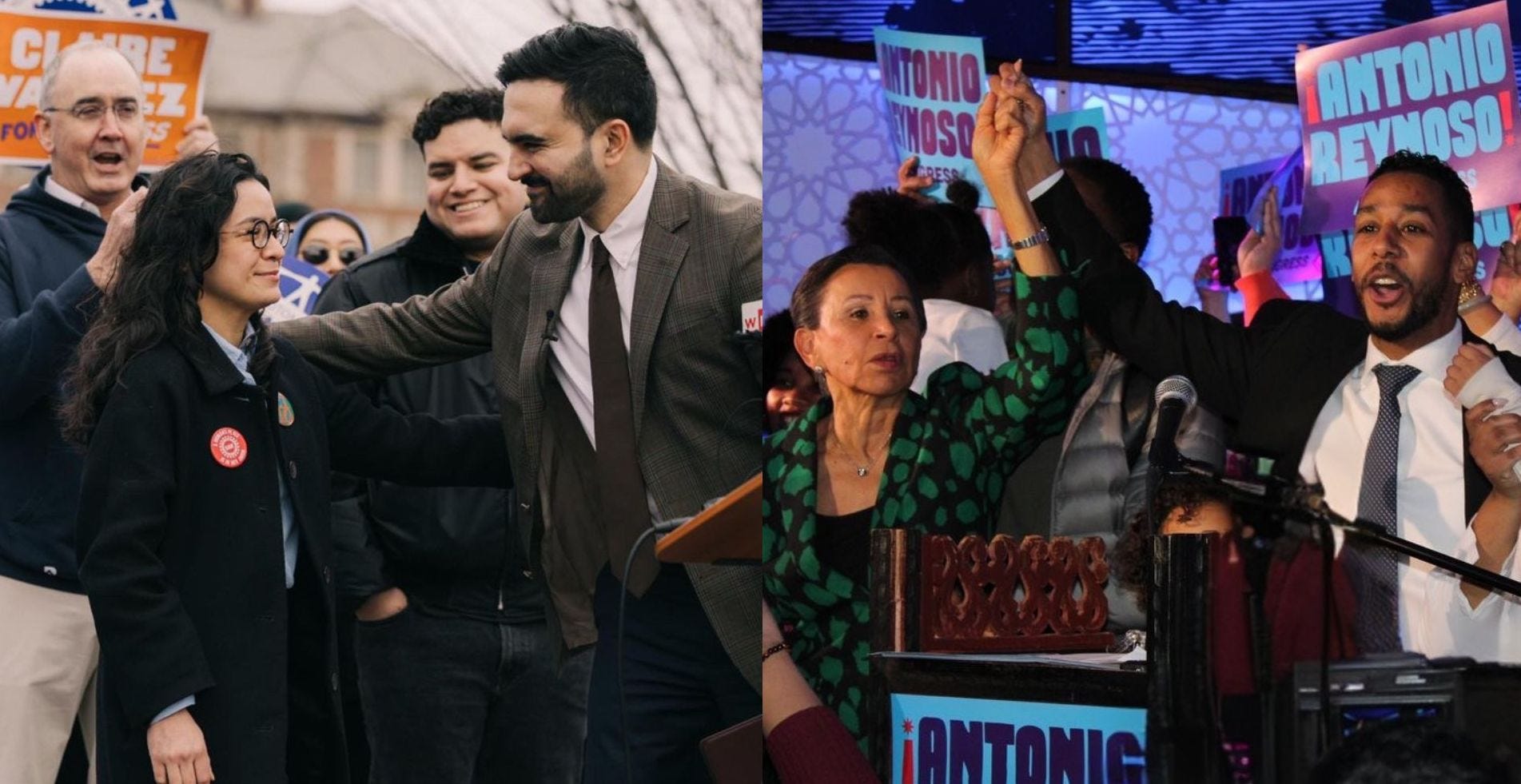
Velázquez and Mamdani found themselves on opposite sides of the upcoming Democratic Primary for the former’s successor: with Velázquez supporting Brooklyn Borough President Antonio Reynoso, a son of the Southside and longstanding mentee of “La Luchadora”; whereas Mamdani backed one-term Assemblymember Claire Valdez, an organizer with NYC-DSA and UAW, and the first elected official to endorse his campaign for mayor. Velázquez, who has represented various iterations of the 7th District since 1993, did not take kindly to the mayor’s intervention. In an interview with The New York Times, Velázquez excoriated Mamdani, despite their close alliance in the mayoral primary. “Honeymoons are short, and people need to pay attention to the work at hand,” she warned. “Primaries sometimes can be a distraction from the work that you need to do.” In addition to going after Mamdani, Velázquez had harsh words for his “political home,” NYC-DSA, the organization supporting Valdez: “It’s very nice to get to New York for a few years and to have opinions about other elected officials without knowing the history and the struggle and who was there fighting corrupt government. Now, all of the sudden, people want to come in and decide who is the best candidate with total disregard to the history, the background.”
The Socialists vs. The Progressives? More like The Townies vs. The Transplants.
This is, personally, somewhat of a strange column for me to write. I’m not sure anyone in New York City has closer combined ties to Velázquez (my former boss), Mamdani (the subject of my forthcoming book), and Valdez (my fellow DSA member, I’m not the type to say “comrade,” sorry). But this feels like an inflection point: for the political left, the neighborhoods of Brooklyn and Queens, and, perhaps, the Democratic Party.
Velázquez’s comments were personal, belying deep-seated resentment that is relational, ideological, and political. If this was the beginning of a Civil War in the Commie Corridor, the well-respected Congresswoman had fired the first shot.
In referencing “history” and “background,” Velázquez bemoaned the demographic and cultural changes that have transformed North Brooklyn and Western Queens over the past three decades. The 7th District (formerly the 12th), was created in 1992 to empower Hispanic voters, most notably Puerto Ricans, who chose one of their own, Nydia Velázquez, to represent them in Congress. Since then, “La Luchadora” (the fighter) has cultivated a bench of local progressive allies, including Reynoso, who collectively wrested power from the machines that once dominated North Brooklyn politics. It seemed inevitable that Velázquez would choose her successor.
However, the past decade has seen pronounced changes to the 7th District’s character. Once plagued by crack vials and crime, NY-7 is now home to more artists than any Congressional District in America. Today, there are more Dominicans in the 7th District than Puerto Ricans, and more white residents than Latinos. Now, political media refers to the 7th District as the heart of the “Commie Corridor,” a phrase first coined on this Substack, the consequence of a 99th percentile concentration of Millennials and renters. And, from Greenpoint, a gentrified neighborhood of young professionals and creatives, to City Line, an enclave of Bangladeshi Muslims, perhaps no district better embodies the breadth of the Mamdani Coalition.
“We don’t need to look outside for leaders. We grow our own right here in Brooklyn,” Velázquez told attendees at a rally over the weekend. But the 7th is a district of “outsiders,” as more than half of residents were born outside of New York state, a figure that ranks in the 78th percentile nationwide. The entire history of New York City politics is one of ethnic and ideological successions — from Greenwich Village bohemians dethroning the Italian and Irish-led Tammany Hall to Afro-Caribbeans and African Americans wrestling for power in Central Brooklyn. These fights, endemic to the five boroughs, are nonetheless painful and fraught. And the race for New York’s 7th Congressional District is shaping up to be the latest chapter in this cycle.
Antonio Reynoso is the homegrown candidate. Reynoso is best described as a progressive reformer, proudly battling political bosses, passing legislation to curtail the NYPD, and voting against the city budget before it was a common protest tactic. A former City Council Member and the current Brooklyn Borough President, his personal and professional network is decades deep, spanning every non-profit and community organization. In politics, relationships are a currency, and Reynoso has relationships. The most important of which is Nydia Velázquez, who blessed the son of the Southside as the candidate best equipped to continue her legacy. Ten years ago, Reynoso would have been a shoe-in to win. Now, he is the underdog.
That’s because of Claire Valdez. A Mexican-American native of Lubbock, Texas (a city of a quarter-million in the Great Plains region), Valdez moved to New York City in 2015. An organizer with both NYC-DSA and the United Auto Workers who was only elected to the State Assembly in 2024, she has become a key figure in the Mamdani era. Her goodwill amongst the democratic socialist rank-and-file, the earnest and dedicated volunteers who knock on thousands of doors apiece, is unrivaled; Valdez won 94% of the internal vote to secure NYC-DSA’s endorsement. Nonetheless, the first-term legislator born outside the five boroughs is already facing headwinds as the candidate not from the community. When asked about Valdez, Velázquez was curt: “she’s been in office for 11 months now. I really don’t know her,” before suggesting the millennial might not know her way around the district. All politics is local, indeed. Nonetheless, Valdez has a powerful relationship of her own: Zohran Mamdani.
On the surface, there are few explicit ideological differences between Antonio Reynoso and Claire Valdez. Both have deemed the Israeli government’s actions in Gaza a “genocide.” Both have called for the abolition of ICE. Both support raising taxes on the wealthy to further fund an expansive social safety net. But there is always room for nuance. At the NYC-DSA endorsement forum, Reynoso “declined to rule out” taking contributions from real estate developers and was “questioned” on his previous reluctance to call Israel’s actions in Gaza a “genocide,” according to City & State. These are serious enough liabilities, in the nation’s most left-leaning district, that even Velázquez reportedly told Mamdani she was “worried Reynoso wasn’t vocal enough about Gaza and about his ties to real estate developers.” Such underscores the broader dynamic that Reynoso stands to benefit from any widespread perception of ideological symmetry (that the two candidates are the same on every issue), whereas Valdez is relying on soft contrast and savvy communications. This extends to how the candidates talk about their ideology, too: Valdez is a proud democratic socialist, whereas Reynoso agrees with many democratic socialist principles.
Nonetheless, beneath the veneer of relationships and ideology lies a classic (and familiar) struggle for political power between the Socialist and Progressive Left. Allies when the opponent was Andrew Cuomo (or Martin Dilan), these dueling tenants of left-leaning politics in the five boroughs are now on opposite sides. While this battle is confined to a sole Congressional District, the repercussions will stretch far beyond, with potential to dictate who leads the left in New York City for years to come.
The Progressive Left possesses a deeper bench of legislators, with more allies in the media and government class, particularly from the Bill de Blasio era. And before 2018, the Progressive Left was the only game in town — until the nascent Socialist Left, resurrected in the wake of Bernie Sanders’ first Presidential campaign, began exponentially amassing power following Alexandria Ocasio Cortez’s upset victory.
Case in point: in 2021, the Socialist Left was little more than a footnote in the mayoral race, sitting out the contest to focus instead on building a bench down the ballot; whereas in 2025, one of their own stunned the political establishment and seized the most powerful bully pulpit in the five boroughs. Are the Socialists and Progressives on a collision course to decide the future of urban political power? Or will this be a respectful political joust that otherwise lacks broader implications?
Nydia Velázquez’s warning that Zohran Mamdani should “pay attention to the work at hand” is a subtle nod to the mayor’s vast influence with the electorate. Indeed, Mamdani annihilated Cuomo in the 7th District, 76% to 24%, amidst the highest voter turnout the district has ever seen (in a Democratic primary). NY-7 was not only Mamdani’s best district in the five boroughs, but is also home to the largest concentration of DSA members in the city. Naturally, Mamdani and NYC-DSA leapt at the chance to field a “cadre” candidate upon Velázquez’s retirement. Of course, the 17-term incumbent was also keen on influencing who would be her successor. However, the two trailblazing allies did not see eye-to-eye. Mamdani, from the onset, expressed enthusiasm about the prospect of Valdez running, to the chagrin of Velázquez, who settled on Reynoso, a longstanding ally. With each power broker committed to a candidate, the race materialized and the rift deepened, before spilling into the public eye last week. Now, the stakes have been raised for all parties.
For Mamdani, the race is an early test of whether his political prowess can translate to other, aligned candidates. Does his movement have coattails, or is it overly reliant on one man’s talent (and the presence of a scandal-scarred and flawed opponent)?
Over the next five months, you will hear me reference “1992” quite a bit. That was the year the modern iteration of (what would eventually become) New York’s 7th Congressional District was created, the result of repeated lawsuits from Puerto Rican communities under the Voting Rights Act. When Velázquez reflects that “we went to court for this district,” she is invoking this history, one held dear to her. In 1992, Velázquez emerged from a crowded field of Hispanic candidates to defeat incumbent Stephen Solarz, a high-ranking member of the Democratic establishment who championed interventionist foreign policy. Solarz, who watched his previous district be torn apart during redistricting, ran in the newly-created “Hispanic opportunity” district against Velázquez, in the hope of keeping his political career alive. Facing a well-funded and opportunistic carpetbagger naive to the lived experiences of low-income Latinos, Velázquez rallied her community. US versus THEM. More than 30 years later, political conditions may have changed, but the mentality has not.
One cannot parse Velázquez’s recent comments without understanding that history. It is possible, even likely, that she views the contest to choose her successor under similar terms. The memory of 1992 looms large over 2026.
Stephen Solarz, who absconded to a “sprawling” estate in suburban Virginia (only keeping a paper address in Brooklyn, his mother-in-law’s condo in Manhattan Beach) really was an outsider, with zero discernible ties to the neighborhoods of North Brooklyn. But Claire Valdez, a sitting elected official thirty-four years later, is not.
By June 2026, upwards of 40% of the Democratic electorate will have been born after Velázquez was first elected in 1992. Nostalgia is not a strategy.
In some ways, Claire Valdez is in a similar position to Nydia Velázquez back in 1992.
Valdez moved to New York City in 2015, and ran for Congress 11 years later; Velázquez settled in New York City in 1981, and ran for Congress 11 years later1.
But the parallels do not end there.
In 1992, Velázquez enjoyed support during her Congressional campaign from Mayor David Dinkins. Both were part of the ascendant “Rainbow Coalition,” a political marriage of the city’s growing Black and Hispanic communities, labor unions and liberals (Velázquez, through Atrévete Con Tu Voto, helped register hundreds of thousands of Latino voters). Velázquez was also supported by Denis Rivera of the influential healthcare workers union, 1199 SEIU, who counted many members amongst the working-class of Brooklyn and Queens. In 2026, Valdez is the one with the backing of recently elected Mayor, Zohran Mamdani, with the two symbolically at the vanguard of Socialist Left, having steadily built power over the past decade. (Dinkins was a paper member of DSA, but the organization was a fraction of its modern self). Alongside Mamdani, Valdez was also endorsed by Shawn Fain, the president of the United Auto Workers. (While Fain’s orientation is more national than Denis Rivera’s was, UAW’s political influence in 2026 is comparable to 1199 SEIU’s influence in 1992.) How the candidates were received, too, was eerily similar. Both were derided for a lack of legislative experience: Velázquez only served two years in the City Council, before losing a bitter primary to a challenger supported by the local Democratic machine; Valdez, elected in 2024, only recently completed her first year in the State Assembly. Both were also accused by critics of being insufficiently loyal to the district’s residents: Velázquez was seen as too close to the Puerto Rican government, and preoccupied with the island; Valdez has been mocked as too loyal to NYC-DSA, little more than a pawn in the mayor’s chess game. Now, the arguments once used to discredit Nydia Velázquez are being recycled against Claire Valdez.
Honoring the past, and those that came before us, is fundamental to the ethos of New York City. In this ever-changing municipality, if we were to lose sight of history, the good and the bad, we would be doomed to repeat it. Perhaps we already are.
Connect With Me:
Follow me on Twitter @MichaelLangeNYC
Email me at Michael.James.Lange@gmail.com
Velázquez also lived in New York City intermittently during the 1970s, when she completed her Master’s Degree at NYU.
God this column is like crack to me lol it’s truly pilled me into being an urbanist
What’s fascinating here is how identity politics collapses into pure organizational politics once a district flips composition. Reynoso has relationships and institutional memory. Valdez has activist energy and an aligned base. That tension is the story of every late-stage progressive city. The “Commie Corridor” label is funny, but the underlying lesson is serious: demography is destiny until logistics and turnout machinery rewrite it.