

“What is a political party, if not for its voters?” — Mayor Zohran Mamdani
On Tuesday night, The Left in New York City did not just win — they ran the table.
Claire Valdez cemented The Commie Corridor in a twenty-point landslide. Darializa Avila Chevalier, a 32-year-old insurgent, ended a 30-year-old political machine in Upper Manhattan. And Brad Lander easily dispatched incumbent Dan Goldman in Brownstone Brooklyn and Lower Manhattan. The seven-candidate slate backed by Mamdani swept, while NYC-DSA, the Mayor’s self-proclaimed “political home,” won nine of ten races. Almost a year to the day after Mamdani dismantled the Cuomo dynasty, the Mayor’s movement proved they could win without him on the ballot.
Within hours, a second contest began — The Narrative War — with the goal of ensuring these victories meant as little as possible. The framing was pre-packaged: the socialists had not built a coalition, they had merely colonized one. It was an extension of the failed arguments that had culminated in Tuesday’s reckoning, but few seemed aware of the irony. Attorney General Letitia James, once one of Mamdani’s strongest allies, told CNN the victors simply “do not understand the politics of New York City” — ignorant to the race and class issues at the heart of the neighborhoods they had just won so convincingly. House Minority Leader Hakeem Jeffries waved away the loss of two incumbents in his backyard, saying it was nothing more than a handful of “higher-income” districts. As Holly Pretsky wrote, it was “the kind of thing you say when you don’t totally understand what you’re up against.”
But this convenient story is also false — and we can prove it, block by block.
For The Nerds: A Note on Methodology
I have used two methods to read this electorate. Neither is perfect, but taken together they are quite accurate. The Weighted method is a turnout-weighted ecological estimation: take every election district, weight it by the real number of voters of a given group who cast ballots there — race and age drawn straight from the 2026 voter file in VAN, not the residential Census — and average the candidate shares accordingly. It is robust, but compresses swings toward the mean. The Homogeneous method is a sharper, but cruder alternative. It looks only at the precincts where a group is concentrated above a threshold and reads the result straight off the tape, which catches bigger swings but over-indexes on segregated geography. Where the two methods agree, almost always the case, the electorate has been found. I have also included a “Mamdani 2025” column, so that readers can see, across each demographic group, how much of the Mayor’s coalition his successors inherited. For the multi-candidate field in NY-7, I anchored Valdez to Mamdani’s first round performance; whereas in the head-to-head race for NY-13, I tied Avila Chevalier to Mamdani’s final round share versus Cuomo.
For my judgment calls on Weighted vs. Homogeneous, check the footnotes.
A Landslide in The Commie Corridor
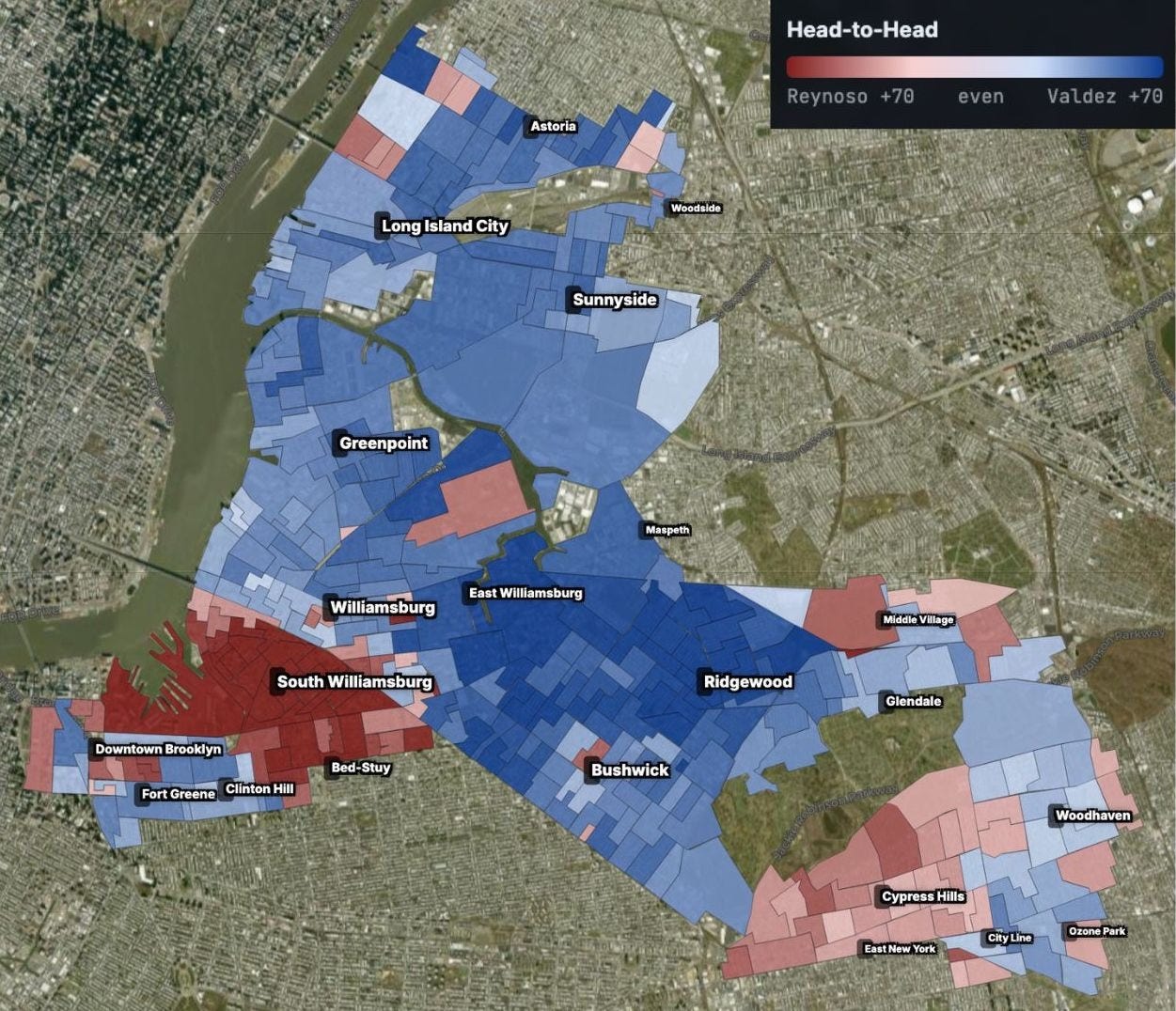
The scale is difficult to comprehend.
Across the entirety of New York’s 7th Congressional District, Claire Valdez (56.1%) crushed Antonio Reynoso (35.8%) by a commanding twenty-point margin.
But the topline understates the carnage, because it includes the Satmar Hasidim of South Williamsburg — a near-unanimous bloc that broke better than nine-to-one for the Brooklyn Borough President and more than doubled their turnout (proportionally) compared to last summer. But filter out the bloc-voting Satmar, and the scope of the election comes into focus: in the non-Satmar precincts of NY-7, Valdez won by almost 35 points — 62.9% to 28.0%. And, even though the Seventh District has been heavily gentrified in the 21st century, one cannot run up a thirty-five-point margin solely from los blanquitos. You do it by winning everyone everywhere.


Cross age with race and the generational law that has defined politics in the Mamdani Era snaps into focus; in each group, younger voters were to the left of older voters:
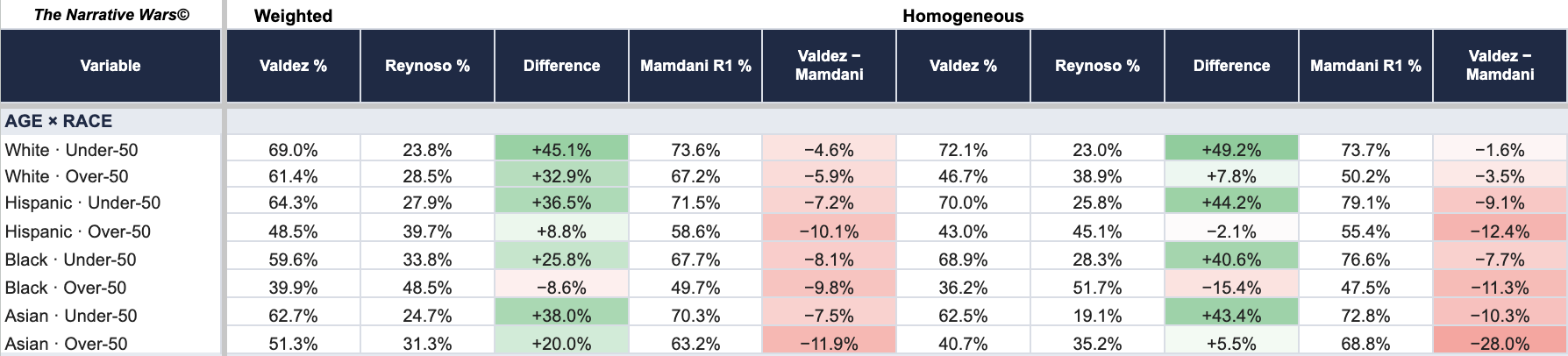
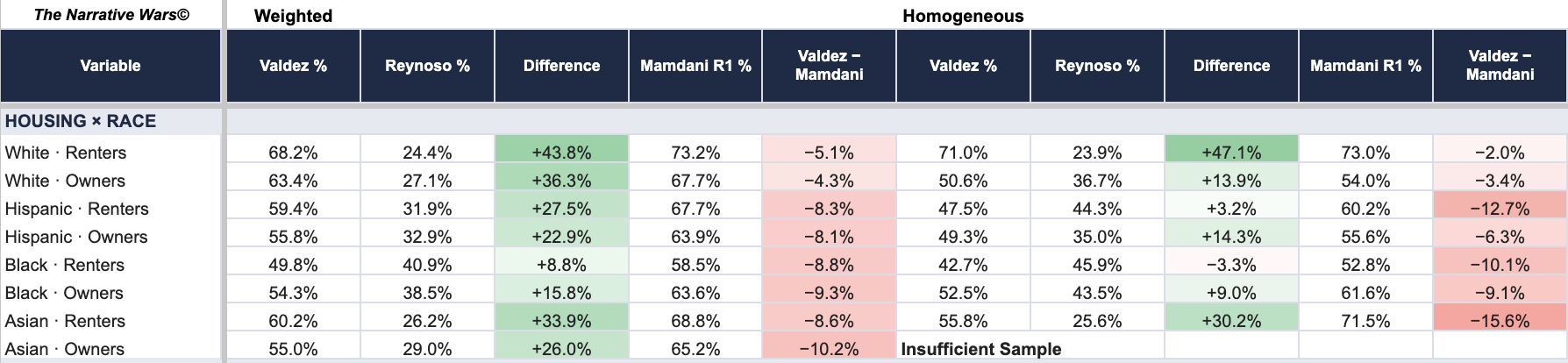
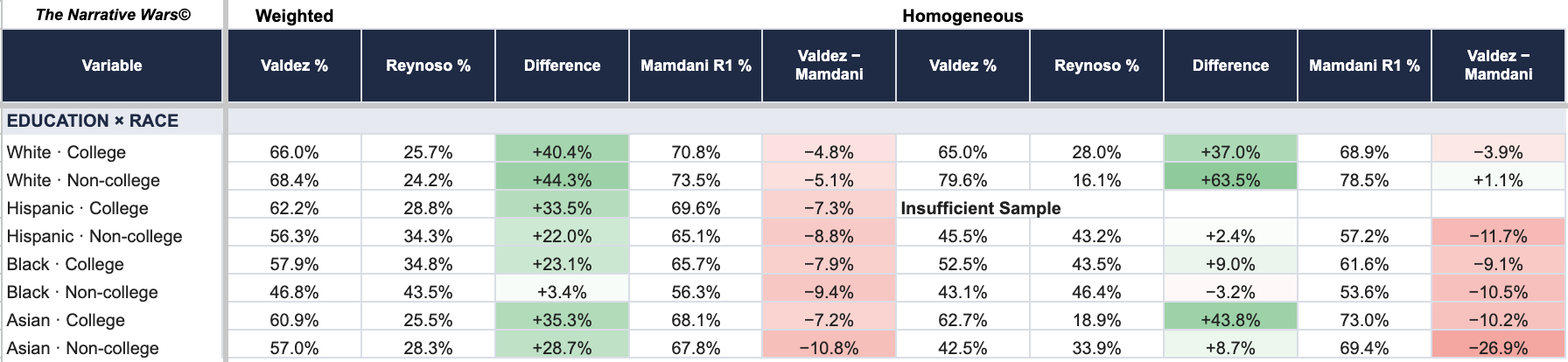
Read it however you prefer — Weighted or Homogeneous — and the direction remains constant: Claire Valdez won every age bracket and racial group. She won the young (under-50) by a landslide, and the old (50+) by a comfortable margin.
NOTE: Both methods (Weighted and Homogeneous) crown Valdez in every group; the only quarrels are about her margin. In four columns (Hispanic, Age 50-64, White 50+, Asian 50+), the estimates diverge by ten points or more. For each, trust the Weighted number for greater accuracy1.
This is not the electoral footprint of a gentrifier candidate, squeaking past on margins from Millennial and Gen-Z (white) transplants; it is the signature of a multi-racial, cross-generational coalition. Mamdani’s share from last year confirms the coalition traveled almost fully intact; Valdez ran marginally behind the Mayor’s own first-round share, within five points among White and Under-50 voters, and eight to twelve among the Black and Hispanic electorates. The one place she dips below water is older Black voters — the consequence of Reynoso’s advantages in public housing.
The narrative said her coalition was narrow. But it was as broad as the Mayor’s.
Down the ballot, the NYC-DSA slate strategy worked to perfection; the Valdez avalanche and Reynoso collapse turned what were expected to be close contests into blowouts. David Orkin (AD-38) and Christian Celeste Tate (AD-54), once tapped for tough races against entrenched incumbents, won easily; running up the score in the Valdez-friendly precincts juiced by the Congressional race at the top of the ticket.
A fascinating wrinkle: in the Bushwick and Cypress Hills precincts they shared, Celeste Tate outran Valdez with every single demographic, and by roughly six points across the board. The socialist surge in the Commie Corridor not only transferred downballot, it amplified. Hold that thought, because Harlem tells the opposite story.
The Narrative Buster in Upper Manhattan
Darializa Avila Chevalier defeated Adriano Espaillat — the chair of the Congressional Hispanic Caucus and dean of Dominican politics, with more than six million dollars in super PAC spending and endorsements from Jeffries, James, and Hochul — by a three-and-a-half-point margin, 49.4% to 45.9%. She did so as a first-time candidate who spent the final month being carpet-bombed on the air — her years-old tweets (an expletive aimed at Kamala Harris) weaponized in mailer after mailer, while Espaillat surrogates resorted to ugly race-baiting tactics in the closing days.
She authored, according to my analysis, one of the strongest performances any NYC-DSA candidate has ever produced. Still, some talking heads insisted she only won because of college-educated gentrifiers. On election night, I claimed that she won Black voters, the most ideologically moderate, institution-aligned constituency in the Democratic coalition, after one look at the map. But the precinct analysis later published by The New York Times and VoteHub corroborated my instinct.
Now, here is my granular analysis:
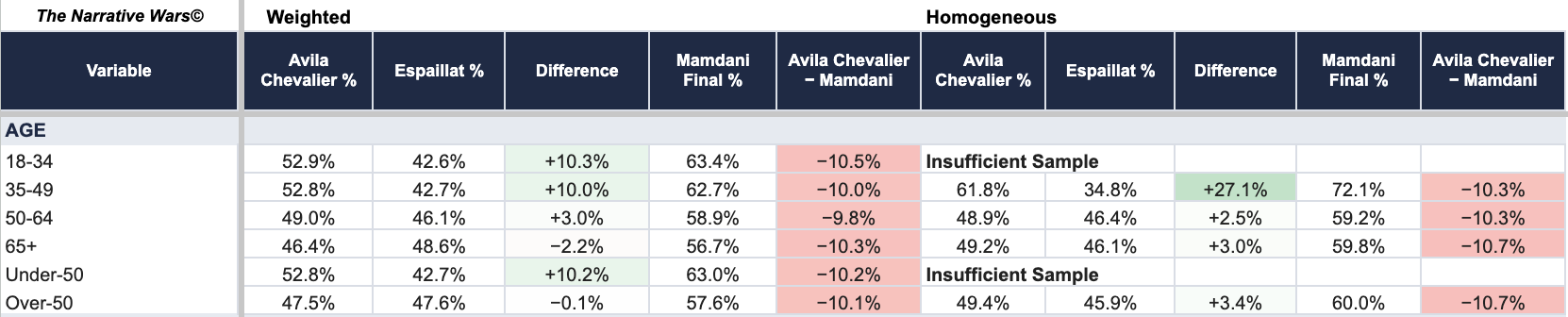

In NY-13, the age polarization cuts inside the Black vote, exactly as it did for Mamdani:
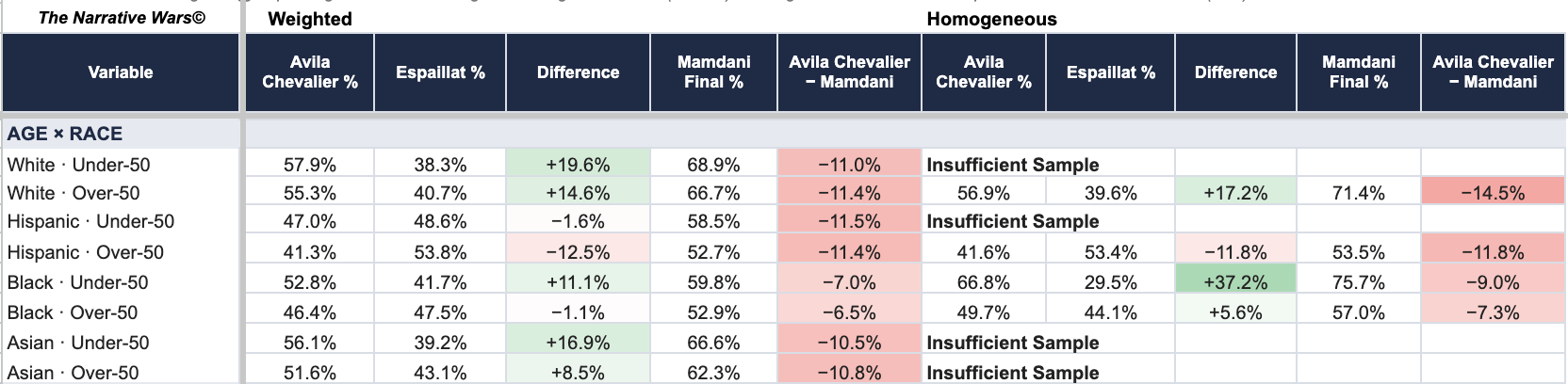
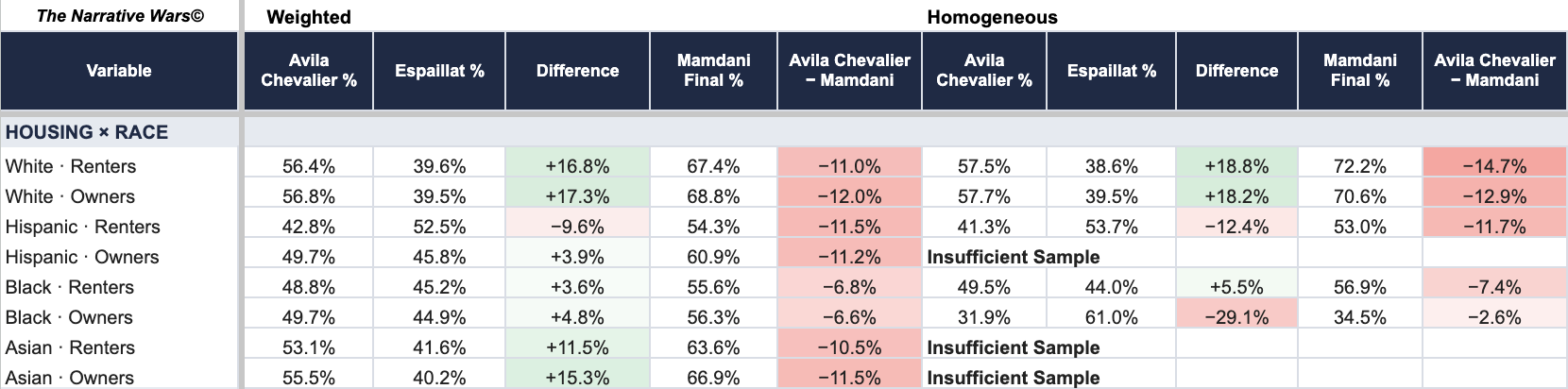
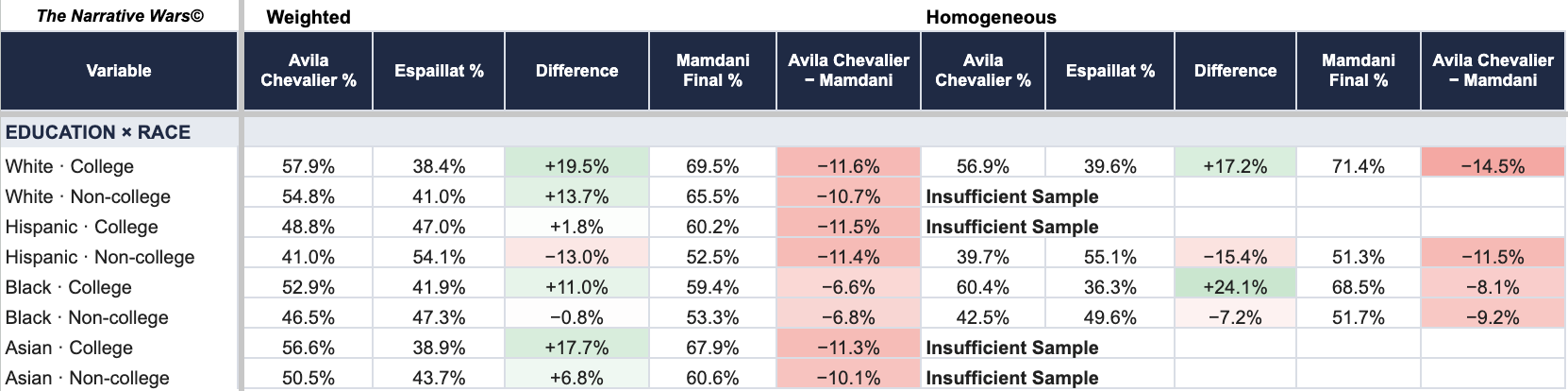
There it is, corroborated by both methodologies2:
Darializa Avila Chevalier won Black voters.
Narrowly (+3.8 Weighted, +5.8 Homogeneous) but she did — against a ten-year Democratic incumbent in the historic capital of Black America. She lost Hispanic voters, Espaillat’s base and the largest slice of the electorate, but not by a prohibitive margin, suggesting more age polarization. Avila Chevalier also won White voters, from college-educated renters in Hamilton Heights to cooperators in Inwood, comfortably.
Most remarkable is the Mamdani comparison. Measured against the Mayor’s own 2025 performance, Avila Chevalier under-performed him the least where she was supposed to the most. She ran about eleven points behind Mamdani’s topline among White and Hispanic voters — but only trailed by seven points among Black voters.
How? The same way Mamdani did: age.
The Black vote in Harlem cleaved generationally, as the insurgent Avila Chevalier carried Black voters under 50 by roughly an eleven point margin, and lost Black voters over 50 by approximately a single point. The homogeneous row is also instructive.
She won younger Black voters decisively, and fought Espaillat to a draw with older Black voters — precisely the path Zohran Mamdani rode to City Hall.
This is where geography, and in turn, class and housing, matters most.
Harlem is gentrifying, but it is not Central Brooklyn, flush with White plurality and majority precincts in Democratic primaries; nor is it Canarsie, a bastion of older homeowners. Harlem is super-majority renter, with a more even age distribution than the homeowner belt that defines Black politics in the outer boroughs. The electorate from 125th to 155th Street is still majority Black, and it is where, as I told NY1, “Adriano Espaillat lost this race.” Not in the rezoned Frederick Douglass corridor — but in the northernmost reaches of Harlem, among Black renters of all ages.
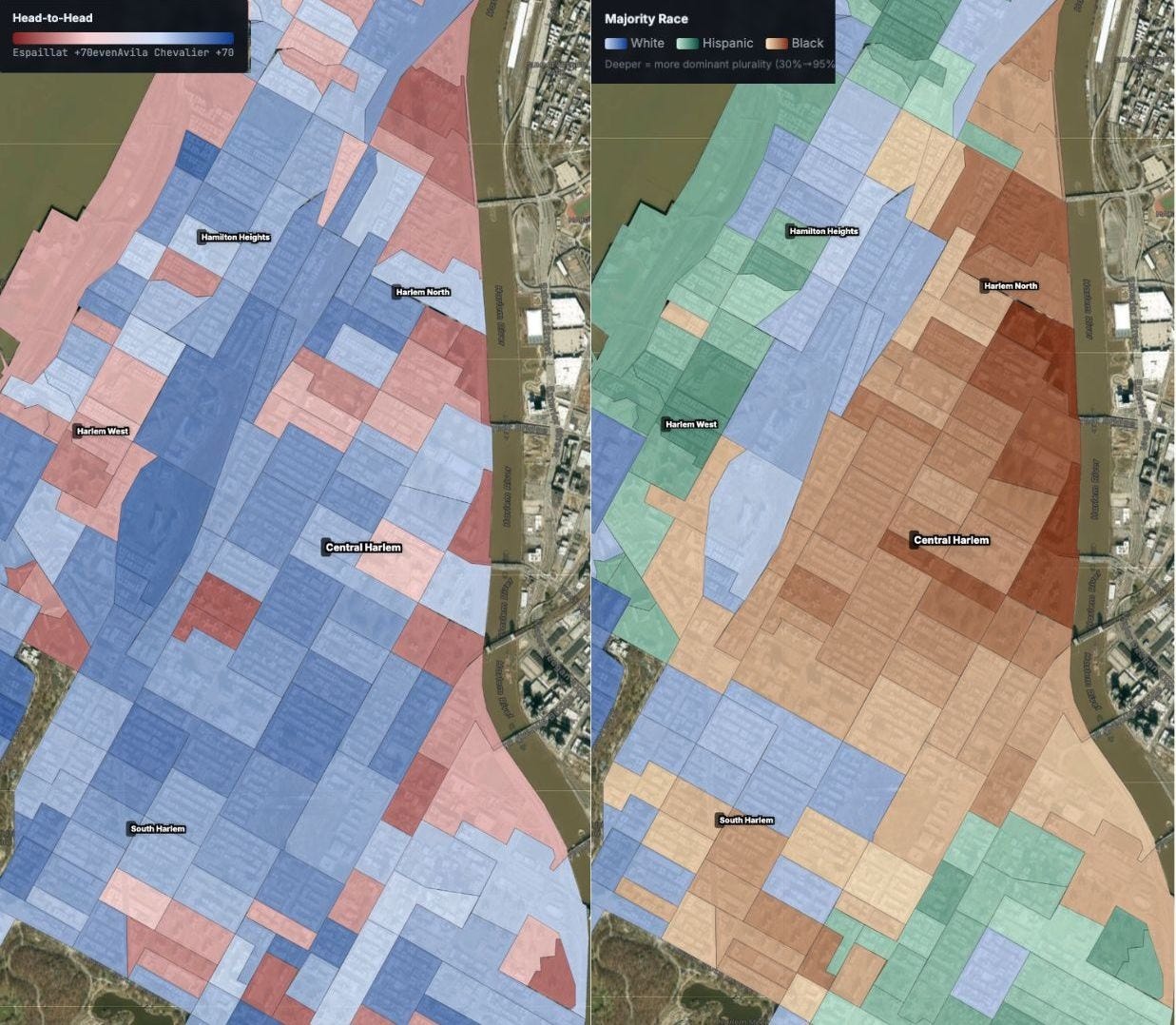
Which brings us to NYC-DSA’s lone defeat. In AD-70, the Central Harlem core of NY-13, Darializa Avila Chevalier won 55.5% of the vote. But on the same ballot, Conrad Blackburn, a candidate for State Assembly (and fellow NYC-DSA endorsee), took just 45.7% of the vote and lost to Jordan Wright, the scion of Harlem’s political dynasty.
Avila Chevalier ran 9.8 points ahead of Blackburn districtwide, and ahead in every demographic. The largest gap (~12 points) between candidates was among Black voters, to be expected given Wright’s family history and local institutional support. However, what arguably cost Blackburn the race was his 10-point falloff with White voters — the gentrifiers — in “South” Harlem compared to Dari: a twenty-point plus landslide in the Congressional, but a draw in the Assembly race. Blackburn, the lone candidate on the NYC-DSA slate who did not receive an endorsement from either Mayor Zohran Mamdani or Rep. Alexandria Ocasio-Cortez, already faced a narrower path to victory after months of heavy independent expenditure spending against him.
Red Tuesday
The Mamdani coalition has proven to be transferable: a movement, not just a man.
In two distinct Congressional Districts — from the young and white-collar NY-7 to the older Black and Hispanic NY-13 — the coalition that transformed New York politics was re-created, proportionally, by candidates who were not named Mamdani. And, for all the talk of community, NYC-DSA once again out-organized their opponents.
Mamdani’s inroads with Black and Hispanic voters, the folks the establishment swore were a one-time loan to a charismatic mayor, endured. The throughline that explains both results is the one I’ve circled for more than a year: age. Mamdani and Avila Chevalier won the younger Black voters; Mamdani and Valdez won the younger Hispanic voters. And younger New Yorkers are synonymous with renters. The single most important statistic in New York City politics is not someone’s race or whether they have a college degree or own their apartment — it is what year they were born.
That is why the establishment’s panic is rational, even as its narrative is false. Black voters remain, as a whole, the oldest Democratic electorate in the city — which is why the political machines of yore in Harlem, Southeast Queens, and the Northeast Bronx remain untouched. But White, Hispanic, and South Asian Democratic voters are increasingly young, and growing by the day. And 2026 proved that 2025 was no fluke.
The establishment is not spinning the results because they were ambiguous, but because they were clear. And clarity — that the coalition opposing them is not a vanity project, but actually increasing and getting younger and more diverse every June — is the one thing they cannot let the public see. They’ve lost the next generation.
The maps say so. Twice.
Connect With Me:
Follow me on Twitter @MichaelLangeNYC
Email me at Michael.James.Lange@gmail.com
For Hispanic voters (Weighted +26 / Homogeneous +3), the Homogeneous number reads the single most Reynoso-friendly slice of Hispanic voters in Los Sures and Cypress Hills and misses the younger, dispersed Hispanic voters who live in more mixed-race precincts; whereas weighted, drawing on the whole Hispanic electorate, is the better districtwide figure. For voters aged 50-64 (Weighted +23 / Homogeneous +8), the "homogeneous" 50–64 bracket self-selects the older neighborhoods, which lean Reynoso for reasons of geography, not generation. For White voters Over-50 (Weighted +33 / Homogeneous +8), the homogeneous method is most unreliable, over-sampling a small number of white-ethnic homeowners on the district's edge. For Asian voters Over-50 (Weighted +20 / Homogeneous +6), the answer lies somewhere in-between.
NOTE: For Black voters under-50 (Weighted 52.8% / Homogeneous 66.8% for Avila Chevalier), the truth is closer to the homogeneous ceiling; while weighted is a more modest floor. But either reading sustains the point — young Black voters broke noticeably for the insurgent — but the homogeneous method shows how decisively.
Great analysis! Anecdotal, but as a 25-year old black college-educated renter transplant in the East Harlem neighborhood of NY-13, this is a great change to see. I voted for Adriano Espaillat in the 2024 election, but only because he was the only viable option. It’s an outside city and I never saw him on the street until he was getting challenged. He got too comfortable until it was too late and it cost him the primary. They also tried to overplay the importance of her 4-year old tweets when everyone has seen how much the republicans have gotten away with recently. I hope this is only the beginning for the country.
"The establishment is not spinning the results because they were ambiguous, but because they were clear. And clarity...is the one thing they cannot let the public see." Stone cold bars right there