

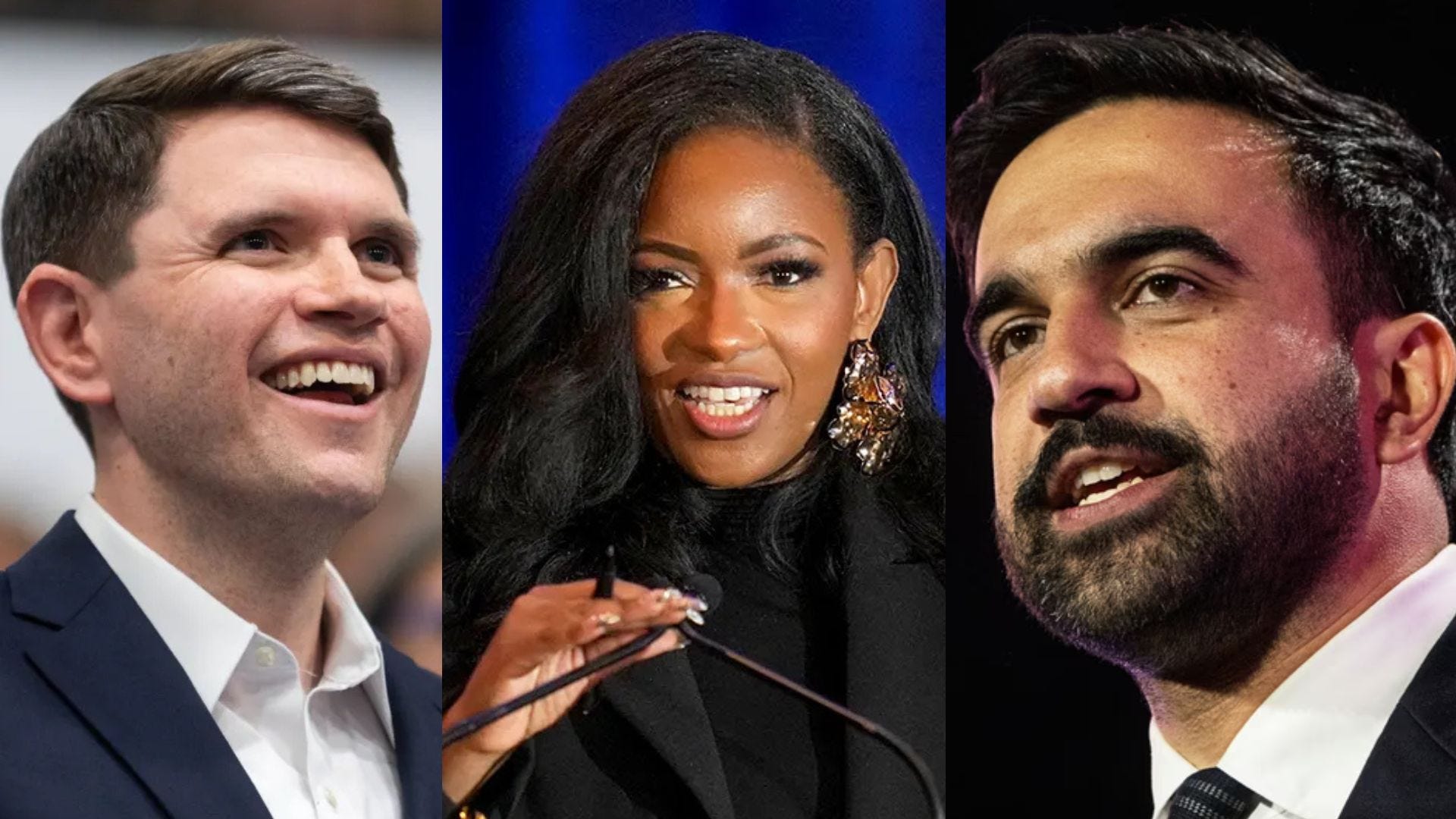
Ever since Donald Trump returned to power, the Democratic Party, in fervent anticipation of 2028, has anxiously searched for clues as to the mood of its angry, perpetually disappointed base. However, gauging voter sentiment from only a handful of elections — often shaped by hyper-local interests and regional nuances — let alone extrapolating broader implications, is difficult, if not impossible. Nonetheless, in the pre-midterm vacuum, two riveting and high-profile contests have stood out, defined by scores of national attention, record voter turnout, massive campaign spending, expanded electorates, and an incredibly diverse coalition of Democratic voters: the 2025 New York City Mayoral Primary and the 2026 Texas Senate Primary.
Any good argument acknowledges its limitations, and the State of Texas and the City of New York may appear to be an odd match for comparison. After all, New York City is entirely urban (despite pseudo-suburban swaths in Staten Island and Eastern Queens), whereas Texas is defined by increasingly sprawling suburbs and hundred-mile-long rural stretches. Hispanic voters (Mexican or Tejano, not Puerto Rican and Dominican) play a far greater role in Texas (~31% of the electorate), whereas the White (~45%) and Black (~21%) electorate in the five boroughs retains greater influence in shaping Democratic primary elections (although the city is on pace to be plurality Hispanic within a decade). Most notably, only one-third of Texans rent their homes or apartments, whereas close to two-thirds of New Yorkers give, in the words of their new Mayor, “a check to a landlord every month” — by far the highest rate in the nation. Yet, for the purposes of evaluating a primary electorate overwhelmingly indexed to a handful of metro areas, there is much to be gleaned from both the Lone Star State and the Big Apple about the future of the Democratic Party coalition.
In the New York City Mayoral race, the candidates — Zohran Mamdani and Andrew Cuomo — were polar opposites in almost every respect. Mamdani, a thirty-three-year-old Muslim democratic socialist, ran a campaign “relentlessly” focused on the cost of living, becoming a viral sensation ubiquitous among younger voters, seldom compromising his avowed left-leaning values (most notably his support for Palestinian human rights). Cuomo, the former three-term Governor, not only supported the pro-business, pro-Israel status quo, but embodied the institutional mindset of the Democratic Party establishment. While the insurgent Mamdani campaigned across the five boroughs, hoping to bring new voters into the process, the scandal-scarred Cuomo hunkered down and avoided public appearances. (Public polls, modeled on past Democratic electorates, showed Cuomo leading comfortably until the very end.) According to exit polling by Data for Progress, among voters who had participated in the previous Mayoral contest, Cuomo defeated Mamdani by 2 points. However, Mamdani won past “non-voters” by 40 points, fueling his dramatic upset.
The Mamdani–Cuomo voter coalitions were prescient in foreshadowing the rift afoot in the Democratic Party. Per the aforementioned polling, Mamdani won younger voters (under-45) by 48 points, college-educated voters by 36 points, and men by 17 points. According to precinct analysis, Mamdani also performed exceptionally well among renters (both market-rate and rent-stabilized) and South Asian voters — pronounced constituencies in New York City, yet seldom appealed to so directly. In contrast, Cuomo won Black voters by 26 points, older voters (over-45) by 21 points, and non-college-educated voters by 17 points. (Hispanic voters, primarily from the Caribbean Islands and South America, were split down the middle, stratified by age.)
In many respects, these outlines resembled the 2020 Democratic Presidential Primary between Joe Biden and Bernie Sanders. Except, Zohran Mamdani meaningfully improved upon Sanders’ past urban shortcomings on two crucial fronts: winning over middle-aged, college-educated liberals (mostly Gen X), while inspiring record participation from younger voters. Not only did Mamdani fundamentally reshape the electorate, he held his own in older and more affluent Manhattan and Brooklyn neighborhoods where left-leaning candidates have historically failed to gain traction. Analilia Mejia, the former national political director for Sanders’ second Presidential campaign, proved this was not a distinctly urban phenomenon by winning the Special Election for New Jersey’s 11th Congressional District (which included Essex County, where Hillary Clinton defeated Bernie Sanders by 47 points). Mejia, a tried-and-true progressive, won voters with individual incomes between $100,000 and $250,000 — the middle-aged suburban managerial class of homeowners that crushed Sanders in consecutive Presidential elections. Most importantly, in her base precincts, Mejia maximized her support to the fullest extent, just as Mamdani did; in Bloomfield Township, NJ-11’s largest and most racially diverse municipality, Mejia netted more than 1,600 votes above her closest rival, more than double her margin of victory. In both 2016 and 2020, these constituencies proved hostile to Sanders’ anti-establishment, class-based message; the Vermont Independent struggled mightily in middle-aged, well-educated, higher-income suburbia (DuPage County in Illinois, Middlesex County in Massachusetts, Collin County in Texas), which, when combined with his urban shortcomings (Chicago, Boston, Houston), doomed him in a handful of winnable primary states. Six years later, the electoral map may be redrawn entirely.
The Texas Senate Primary, pitting charismatic State Representative James Talarico against firebrand Congresswoman Jasmine Crockett, featured almost none of the sharp ideological contrasts that defined the New York City Mayor’s race. Style — Talarico’s “love thy neighbor” Christian populism versus Crockett’s “take no prisoners” unapologetic resistance — superseded substance in the Lone Star State, where Democrats have not won a statewide election since 1994. Still, there are remarkable similarities in how Talarico and Mamdani ran their underdog campaigns, compared with how Crockett and Cuomo — frontrunners flush with name recognition — failed to capitalize on their pronounced early advantages. These nuances, not explicitly ideological, translated into how their coalitions manifested: Crockett’s base (older, Black) mirrored Cuomo’s, whereas Talarico’s coalition (younger, college-educated, White, Hispanic, lower-propensity) is reminiscent of Mamdani’s.
Mamdani and Talarico combined style and substance. They consistently released algorithm-oriented vertical videos, becoming omnipresent in the feeds of younger voters. (Talarico has credited Mamdani’s “Halalflation” video for inspiring a similar spot on high prices at the Texas State Fair.) Each made a point to campaign seemingly everywhere, while making deliberate and nuanced outreach to lower-propensity voters. Both modeled a positive campaign ethos, rarely going negative on their opponents, while eschewing barn-burning rhetoric for inclusive and direct public addresses — neither ever raises his voice in speeches. Told to downplay their religion, neither Mamdani, a practicing Muslim, nor Talarico, a devout Presbyterian (and seminarian), obeyed such tired orthodoxy. Ahead of the Democratic Primary in June, Mamdani walked the length of Manhattan — a seventeen-mile sojourn — alongside his supporters; when first running to flip a state legislative seat from red to blue, Talarico crisscrossed the entirety of his suburban district on foot. But most importantly, these common aesthetics and values were paired with a unifying, class-based message: Mamdani’s articulation of the affordability crisis has been widely adopted (to varying degrees of success), but Talarico’s “it’s not left versus right, it’s top versus bottom” has emerged as a well-calibrated, swing-state adaptation.
In the words of Mamdani and Talarico, the billionaires and oligarchs are the common enemy. If the lessons of the former are plentiful, the latter has proved a quick study.
And, most important to the Democratic Party, this fusion of style (everyman ethos) and substance (positive populism) produced a remarkably similar voter coalition. The Texas equivalent of the “Commie Corridor” is Travis County (the Austin metro area), flush with college-educated Gen Z renters and higher-income Gen X suburbanites, who mirror the class and educational attainment of Brownstone Brooklyn. Talarico won 76% of the vote in Travis County, eclipsing 90% in precincts adjacent to the University of Texas, while earning more than 80% in tonier Westlake Hills, where the median home price exceeds one million dollars. Given Crockett’s pronounced advantage with Black voters and Talarico’s strength with White voters, the swing demographic in the Texas Senate Primary was Hispanic voters, who are disproportionately young and working-class. And, while Talarico won Hispanic Texans by a greater margin than Mamdani won Hispanic New Yorkers, the symmetry is strengthened by the details: the Hispanic electorate in Texas, particularly in the counties handily won by Talarico (Hidalgo, Webb, Cameron, El Paso), is among the youngest in the United States (99th percentile for Gen-Alpha, 96th percentile for Gen-Z), whereas the age distribution of Hispanic voters in New York City is noticeably broader. (Mamdani won Jackson Heights and Corona, where younger South American immigrants shape the electorate, but lost the South Bronx, where older Puerto Rican and Dominican voters are the majority.) Even South Asian voters — Indian American tech workers in Collin County, Pakistani homeowners in Fort Bend, and working-class Bangladeshis in the Bronx and Queens — heavily favored Talarico and Mamdani.
Nonetheless, absent a pronounced advantage among middle-class White suburbanites, Talarico would not have prevailed. Since 2020, the trend of urban professionals relocating to adjacent suburbs and exurbs has noticeably reshaped the political landscape of several metro areas. Among the towns in New Jersey where Analilia Mejia performed best, and the counties in Texas where James Talarico decisively defeated Jasmine Crockett, the vast majority had high percentages of newer residents, either from out of state or nearby cities. In Texas, such suburban settlement is a consequence of a robust jobs market, particularly in the Dallas–Fort Worth area; whereas in the Tri-State area (NY-NJ-CT), the affordability crisis and post-COVID transition to remote work has fueled these migration patterns, particularly among middle-aged families. In these key counties, the politics of residents have changed along with the composition of the residents.
Call it Realignment and Relocation.
Many political pundits have focused on the individual brilliance of Mamdani and Talarico, routinely at the expense of the voters who came together to support them both. In doing so, they have sorely underestimated the replicability of their respective coalitions elsewhere in the United States.
These currents promise to have profound implications for the upcoming Presidential Primary. For decades — exemplified by Bernie Sanders’ consecutive defeats — consolidating the Black electorate, dominant in the rural South and pronounced in the urban North, was tantamount to guaranteeing the Democratic nomination. Kamala Harris has the inside track to do just that, but will it be enough? The growing decoupling of Black voters (more institution-aligned and broadly moderate) from their White, college-educated (liberal-progressive) and working-class Hispanic (economic populist, culturally moderate) counterparts presents a grave danger to Harris’s prospects, and the Democratic establishment writ large. Harris, who endorsed Crockett last Friday, is far more cautious than her South Dallas ally, yet both suffer politically for a similar reason: the widespread perception of unelectability (Harris infamously lost every swing state; Crockett, in an R+12 state, expressed little desire to appeal to voters beyond her pre-existing base), which breeds scores of negative media coverage that multiplies like wildfire. Nonetheless, for the next Democratic nominee to upend this coalitional dichotomy — regardless of who emerges as the institution-friendly standard-bearer (Kamala Harris, Gavin Newsom, Wes Moore) — he or she will have to earnestly build a Talarico/Mamdani-esque coalition.
Not long ago, this potent cohort was largely confined to young, urban renters; shorthand for college-educated, professional-class (secular) Whites. Now, it includes middle-aged, suburban homeowners and working-class, devoutly religious Hispanic voters. This younger, anti-system coalition — inherently insurgent to the older Democratic Party establishment — uses the power of attention to overcome a deficit of institutional support. Democratic voters crave a more earnest resistance, and an affirmative vision for a post-Trump world. And right now, the populist left is the only faction in the Democratic Party rising to meet the moment.
Connect With Me:
Follow me on Twitter @MichaelLangeNYC
Email me at Michael.James.Lange@gmail.com
Something I noticed about the comparison between Mamdani and Talarico was that they both stayed almost uniformly positive in their campaign, focusing entirely on their own plans and policy and almost never negatively campaigning against their opponent unless something occurred that allowed them to do so while being seen as the attacked (Explicit racist attacks by Cuomo, Allred accusing Talarico of racist remarks).
Something that is generally true but often forgotten about Democratic primaries by us hyper-online factional types is that the primary electorate is not particularly factional itself. Outside of extreme cases ala Fetterman when he next comes up for election, they will generally enter the election booth liking all candidates on the ballot, and negative campaigning against another member of the party might bring down your opponent's favorables, but it is likely to damage you just as much, especially if you lack a smoking gun
Coming from deep in ATX, this is the only breakdown that I think accurately lays out what happened here! I’ve been going crazy watching people call Crockett a progressive and Talarico moderate when their policy positions are nearly identical, and Talarico has been building a coalition similar to very left democratic socialists (like Zohran), purely through some very good populist messaging. Not sure if it will be enough to pull out a win in November but being a dem in TX is all about getting your hopes up against all better judgement. Thanks for this!