

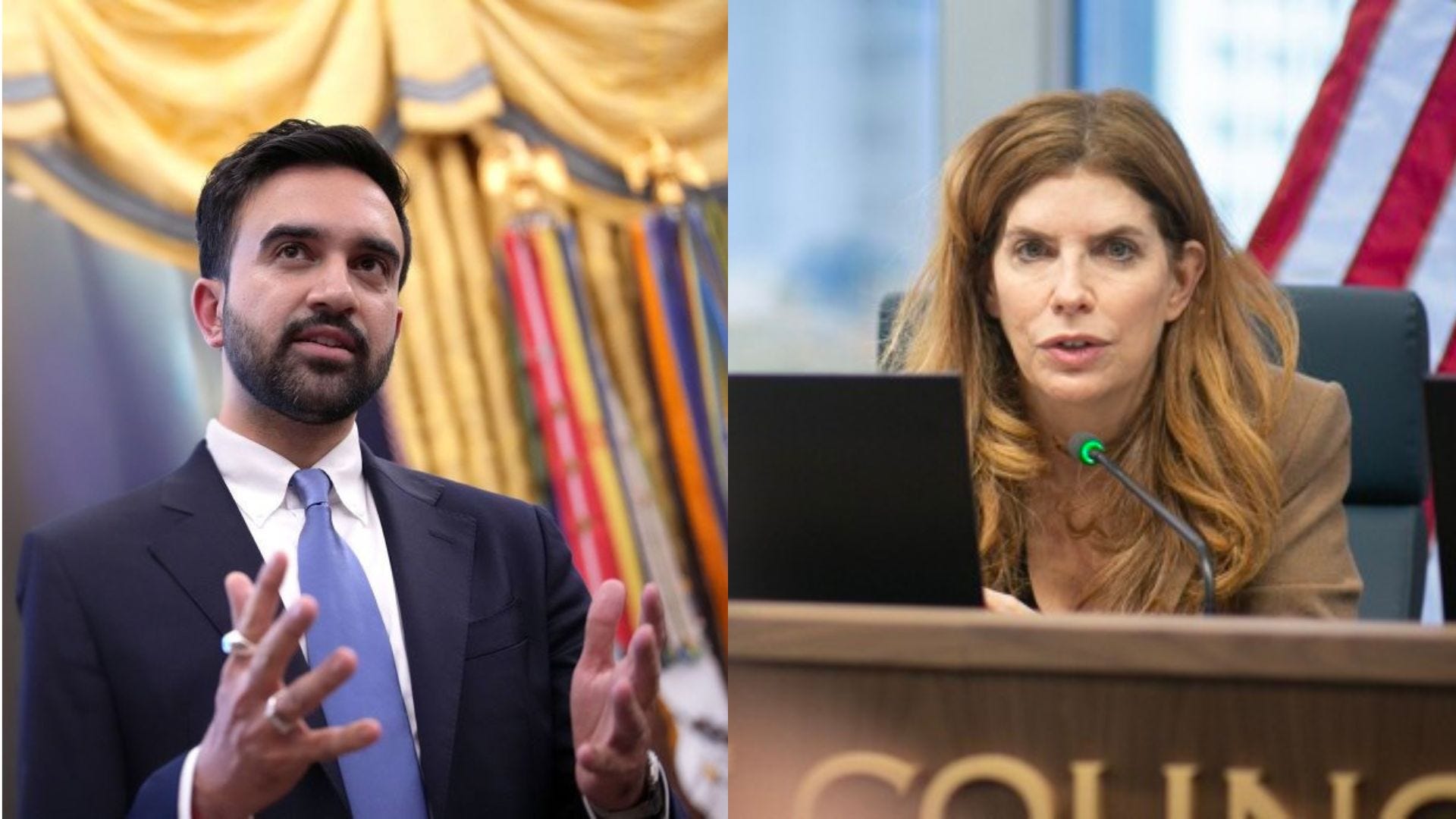
The hour was late.
Thanksgiving was fast approaching.
And with each day that she failed to secure the required 26 votes to become Speaker of the New York City Council, doubts about the fitness of her candidacy would grow.
Julie Menin, who had diligently campaigned for the second most powerful position in the five boroughs — hosting fundraisers, courting unions, charming colleagues — for the past three years, was only a couple votes away from realizing her ambition.
But those votes, from a handful of persuadable holdouts, would not come easily.
Pressure would have to be applied.
Thus, on the eve of the holiday, Menin and her allies pushed in their chips. They would shake the proverbial tree, and hope a few more “yes” votes would fall into their lap. Technically, they only needed four to lock in a majority; but in reality, given the official vote would not take place for almost two months, they needed close to a dozen: a statement of supermajority support.
As Council Members were contacted, the message was simple but effective. Menin already had more than twenty of their colleagues pledged to her. She had many of the largest unions behind her, such as 32BJ and the Hotel Trades Council, in addition to the publicly atrophying (but privately effective) Democratic machines in the Bronx and Queens. The following day, in advance of Thanksgiving, the frontrunner would release a letter to the press, detailing the breadth of her support. Did these members, many of whom were newcomers to the Council, want their names on the letter, so they could be part of the winning team (to the victor goes the spoils)? Or would they prefer, in the spirit of the season, to be left out in the cold instead, and risk power for principle? Speaker Julie Menin was inevitable — so her emissaries implied.
“The train is leaving the station. Get on board while you still can.”
This audacious plan, a concoction of gall and aggression, was typical of the behind-the-scenes “Speaker’s Race,” the pinnacle of insider baseball in New York City politics.
Would Menin’s bluff be called? Or had she played her hand perfectly?
What is the Speaker’s Race?
Certainly, that has been the question everyone was asking over the holiday weekend.
There are only 51 votes, one per City Council Member. There are caucuses (“Common Sense”, “Progressive”), county machines (the Bronx, Queens, and Brooklyn), and labor unions (Hotel Trades, 32BJ, 1199 SEIU, DC37) weighing in behind-the-scenes. Most of the consequential campaigning, absent a handful of public forums, is done outside the public eye. The mayor (or in this instance, mayor-elect) has considerable influence, but often eschews a back room knife fight to avoid the appearance of “defeat.” Relationships, more so than ideology, shape the whims of coalitions in the Speaker’s Race, which historically blends progressive, liberal, and moderate Democrats with Republicans. Almost always, there are twists and turns, last-minute defections and eleventh hour betrayals. Most importantly, one’s prowess navigating institutions and charming the insular “political class” does not neatly translate to appeal amongst the voters themselves — and vice versa.
Such were the terms of engagement pitting Julie Menin, a well-connected liberal moderate from Manhattan’s Upper East Side, versus Crystal Hudson, one of the leaders in the Progressive Caucus from Central Brooklyn. (Amanda Farias, Selvena Brooks-Powers, and Christopher Marte were also running, but failed to gain comparable traction).
Precedent, for better or worse, looms large in a contest of this nature — which only occurs once every four years. Given 35 of the Council’s 51 members were first elected in 2021, the previous Speaker’s Race, one of the more unique episodes in the Council’s history, weighed heavily on the minds of members this time around. Four years ago, the early favorites were Carlina Rivera and Justin Brannan, progressive-aligned members who had campaigned rigorously for the position across multiple years. However, newly-elected mayor Eric Adams made clear his opposition to both, strong-arming unions and persuadable members to deny them a majority. However, Adams foolishly propped up Francisco Moya, a close ally of his consultants, who was neither known nor liked by many of his colleagues. Had the mayor-elect, at the zenith of his political capital, rallied behind another candidate, the Speakership would have been theirs. Yet, this folly opened the door for Adrienne Adams — a lowkey, labor-aligned moderate from Southeast Queens — to emerge as a compromise candidate. In victory, the well-respected Adams threaded a coalition of the atrophying Queens Machine and the ascendant Progressive Caucus. The Mayor’s whims were defeated, and the labor unions had flexed their muscle.
The lessons (or false assumptions) were plentiful:
The Speaker’s Race was dynamic and fluid, with conditions ripe for sleeper and dark horse candidates to emerge in the latter stages.
Intervention from the Mayor was risky, and could lead to an early political “defeat” if executed poorly.
The slow paced race would inevitably drag into December, as it always had.
Four years later, ALL of those presumptions proved incorrect.
In 2021, there was a flurry of late movement as top contenders fell by the wayside, leading to a climactic battle between Adrienne Adams and Francisco Moya that produced an ideologically varied (majority) coalition for the former. In 2025, Julie Menin slowly and steadily amassed a considerable “lead,” leaving Crystal Hudson (and other non-Menin candidates) to increasingly rely on the Progressive Caucus. However, the votes of those twenty members, even if delivered uniformly, fell below the requisite majority, and could never seriously threaten Menin’s advantage alone.
For months, Menin, the sole contender not from the Progressive Caucus1, had the inside track with the nine members of the “Common Sense” Caucus, a collection of moderate Democrats (Darlene Mealy of Brownsville) to MAGA-aligned Republicans (Vickie Palladino of Whitestone, Inna Vernikov of Sheepshead Bay). The Bronx and Queens Democratic “machines” have historically moved as a united bloc, so as to maximize their influence. This race proved no different, as Menin was strongly supported by Bronx members Kevin Riley of Black-majority Wakefield and Co-op City, Eric Dinowitz of leafy and historically-Jewish Riverdale, and Oswald Feliz of lower-income Bedford Park. Menin was particularly strong in Eastern Queens, where members are far more ideologically moderate and the county organization retains considerable influence, banking the votes of Sandra Ung of Flushing, Linda Lee of Bayside, and James Gennaro of Fresh Meadows with ease (plus Lynn Shulman of Forest Hills and Kew Gardens). Their Queens colleagues, Nantasha Williams and Shekar Krishnan, core members of the Progressive Caucus, were also early and non-persuadable Menin supporters, evidence of the frontrunner’s ideological reach. Menin married this base with support from her Manhattan colleagues: Chelsea’s Erik Bottcher, fellow Upper East Sider Virginia Maloney, East Harlem’s Elsie Encarnacion, and Washington Heights’s Shaun Abreu. Here, Menin brokered an alliance with Upper Manhattan Congressman Adriano Espaillat, a local power broker of sorts, which proved integral in delivering the votes of both Abreu (a top Menin surrogate) and Encarnacion, a freshman. Of this cohort, Abreu, Dinowitz, Riley, and Lee are all expected to assume top leadership and committee positions.
As of last Tuesday, Julie Menin’s whip sheet added up to 22 members — 4 shy of the majority needed to clinch the vote.
The emergence of Zohran Mamdani, who won the Democratic Primary in stunning fashion this June, could have destabilized the Speaker’s Race, given the immense bargaining power that the incoming Mayor has at his disposal. However, despite greater ideological closeness to Crystal Hudson, Mamdani (juggling a transition to City Hall and several other behind-the-scenes machinations), kept his hands clean of the Speaker’s Race — publicly — in an effort to preserve his political capital. Following Mamdani’s ascendance, a handful of moderate members of the Council, previously pledged to Hudson, shifted their support to Menin, under the auspices that their Upper East Side colleague would be a more appropriate counterweight to the fresh-faced Mayor; repeating the “adult in the room” pitch used by Menin and her allies. Furthermore, absent midterm elections for Council members in 2027, and with two-thirds of the body term-limited in 2029, the progressive movement — whose political power is far greater at the ballot box — lacked the necessary electoral leverage to pressure legislators who eschewed their preferred candidate.
That left Julie Menin — who had tactfully passed key legislation favored by important labor unions, donated handsomely to the campaigns of her colleagues, and relentlessly worked the New York City political class for decades — with a significant head start against a field of progressives that failed to consolidate, whose most valuable chess piece remained on the sidelines. Peeling back Menin’s support, estimated as over twenty Council Members, would be challenging, but depriving her of a majority remained a possibility. For Crystal Hudson, this path ran through the Brooklyn delegation, home to the largest concentration of Progressive Caucus members, but historically less cohesive than their Bronx and Queens counterparts. In addition to her fellow progressives (Lincoln Restler, Shahana Hanif, Alexa Aviles, Jennifer Gutierrez, Sandy Nurse, Chi Ossé, Rita Joseph), Hudson needed to penetrate the borough’s more moderate enclaves. Specifically, she needed the votes of Chris Banks of East New York and Susan Zhuang of Bensonhurst — considered local allies of House Democratic Leader Hakeem Jeffries. However, this arrangement was complicated by Chi Ossé, widely seen as a top ally of Hudson (the two serve together on several committees), threatening a primary challenge to Jeffries, who has represented New York’s 8th Congressional District for over a decade. Hudson herself, elected with Jeffries’ support in 2021 (against a candidate endorsed by NYC-DSA) and viewed as an ally of the House Democratic Leader, was caught in the middle. While efforts to thwart Osse’s primary of Jeffries were ultimately successful (the mayor-elect even appeared at Ossé’s NYC-DSA endorsement forum), the episode was nonetheless an ill-timed distraction for Hudson. Further muddying Hudson’s path in Kings County was County Leader Rodneyse Bichotte, who endorsed Cuomo, but quickly shifted her allegiance to Mamdani following the former’s defeat in the Democratic Primary. Bichotte, unkeen on Hudson’s bid, even attempted to persuade longtime ally Farah Louis of East Flatbush into the race during the annual SOMOS retreat in Puerto Rico. Hudson’s play for the Speakership lived and died with a unified Brooklyn delegation, a hopeful marriage of ideologically varied members lacking an agent of consolidation, a slim path strained beyond repair under the weight of Ossé–Jeffries and the County Leader’s objections. Whereas in contrast, The Bronx, led by State Senator Jamaal Bailey, and Queens, helmed by Congressman Greg Meeks, remained in lockstep behind Menin. All the while, the anti-Menin coalition lacked consolidation: as Amanda Farias, Selvena Brooks Powers, and Christopher Marte remained in the race, convinced they could be a dark horse candidate. Thus, as her path to victory narrowed, Crystal Hudson was increasingly reliant on the Progressive Caucus — incoming members, longtime colleagues, and fellow candidates for Speaker — remaining united. Such was the backdrop for Tuesday, November 25th.
While Julie Menin needed only a handful of votes from her colleagues to reach 26 members, a majority of the Council, she needed a significant cushion to declare “victory,” a number so impressive as to discourage her opponents from any further attempts to peel off her supporters. Her opponents, too reliant on precedent, presumed that time was on their side, for the earliest a candidate for Speaker had ever clinched the votes was December 17th — several weeks away.
As Menin and her allies, specifically emissaries from influential labor unions, called around to persuadable Council Members, many of whom were green to the Speaker’s race, the urgency of the message, and the fear of emerging empty-handed (without a chairmanship, a position on the powerful budget and taxation committee, or even discretionary funding) proved devastatingly effective. This dynamic was especially pronounced with newer(ish) members: Yusef Salaam of Central Harlem, Shanel Thomas-Henry of East Elmhurst, and Ty Hankerson of Southeast Queens. Perhaps most devastatingly, Lower Manhattan’s Christopher Marte and Harvey Epstein, both members of the Progressive Caucus, had given their left-leaning colleagues an impression of openness to Hudson. Marte, as reported by City and State, even joined a conference call arranged by The Working Families Party “to discuss strategy and urge consolidation” among the non-Menin candidates, only to abandon the coalition in the days thereafter. The defection of Epstein, widely supported in a competitive primary by the city’s progressive institutions, was seen as particularly suspect. Hour by hour, as Menin solidified more and more commitments from her colleagues, Hudson’s already slim path evaporated entirely. Before the knowledge of her defeat became widespread, a handful of progressive, Hudson-friendly holdouts — Pierina Sanchez and Althea Stevens of the Bronx, and Kayla Santosuosso of Southern Brooklyn — received permission from Hudson and other stakeholders to place their names on Menin’s list, so as to extract whatever concessions remained.
All told, Julie Menin earned the support of 36 of the Council’s 51 members.
In many respects, the core of Julie Menin’s institutional coalition in the Speaker’s Race mirrored that of Andrew Cuomo in the Democratic Primary: labor unions, county machines, and (relatively) moderate members. That coalition, whose atrophication was exposed in the voting booth, still held considerable sway behind-closed-doors. Zohran Mamdani’s movement represents the inverse: movement politics practiced in public, outsmarting the traditional power brokers, and one million votes (not thirty-six).
As such, the tensions (or lack thereof) between Mayor Mamdani and Speaker Menin will shape the contours of New York City politics over the next four years. Since clinching victory, Menin has struck a conciliatory tone, praising Mamdani’s affordability agenda, while citing childcare as a natural point of collaboration, in an effort to temper down talk of ideological asymmetry. Asked whether she would primary challenge Mamdani in 2029, Menin unequivocally ruled it out. However, this episode belies the fact that Menin, prior to having clinched the Speakership, seldom mentioned the mayor-elect, much less in a positive light. In advance of the General Election, Menin declined to endorse Mamdani, the Democratic nominee. The party boss instrumental in Menin’s speakership bid, Rep. Gregory Meeks, a longstanding ally of the pro-Israel lobby, also eschewed endorsing Mamdani. On the eve of her victory, The New York Daily News reported that Menin, in private conversations, had “floated bringing back use of the chamber’s subpoena power, a tool that could be a check on incoming Mayor Zohran Mamdani’s administration.” The sources also reported that “Menin has privately affirmed she would not as speaker simply be a rubber-stamp on the Department of Community Safety, a $1 billion agency Mamdani proposes to launch to take over certain responsibilities from the NYPD,” indicating she would not green-light the agency’s launch without “serious deliberation.” Simply, Menin and Mamdani are not aligned on several political matters, and will likely encounter points of tension with respect to Israel–Palestine (Menin reportedly “urged City Hall to intervene” and cancel the SummerStage concert featuring pro-Palestine R&B singer Kehlani) and the NYPD (see: Menin’s hesitation with respect to the Department of Community Safety). Menin is one of the wealthiest member of the City Council, the wife of a prominent Real Estate developer, and represents much of old-moneyed Upper East Side; whereas Mamdani disavows donations from corporations and developers, remains a card-carrying member of the Democratic Socialists of America, and has cut-his-teeth in outer borough politics. To paraphrase a quote from Alexandria Ocasio-Cortez (describing her orientation towards Joe Biden), in any other country, Menin and Mamdani would be in separate political parties. Menin’s allies, well-represented throughout the political class, exhibit angst when these well-known facts are recited, and are quick to deride any criticism as borne solely of ignorance.
I expect Mamdani to approach the next Speaker’s Race, timed for his re-election in 2029, much differently. The mayor-elect has shown no qualms with getting involved in internal elections, evidenced by his maneuvering to kill NYC-DSA’s endorsement of Chi Ossé, particularly when the outcome, in Mamdani’s estimation, poses a threat to his affordability agenda. For decades, the political left in New York City has sorely lacked an organizer-in-chief, a concentrated center of power capable of aligning (or strong-arming) legislators, marshaling public support, brokering agreements between interests groups, and executing a coherent medium-term political vision. Mamdani has both the orientation and instinct to be just that leader. Given the plethora of stakeholders across the progressive left, broad coalitional buy-in will be necessary on many occasions, but much decision-making and maneuvering will be left to Mamdani, the most powerful figure in New York City. How Zohran Mamdani balances the movement and the machine will be one of the most telling storylines of his first term.
Nonetheless, despite their ideological distance, the Mamdani–Menin partnership will not inevitably be doomed to infighting. Menin, a shrewd operator in her own right (one does not lock up two-thirds of their colleagues, in record time, if not), knows that any opposition to Mamdani, real or perceived, will invite a torrent of outrage. Multiple Council staffers told me that their offices, upon the news breaking that Menin had clinched the Speakership, received a flurry of phone calls from constituents asking “what could be done to change the outcome?” — the day before Thanksgiving no less. Indeed, the days of the general public being agnostic to the affairs of the New York City Council died alongside Andrew Cuomo’s political career. Mamdani, the incoming Mayor who humiliated and charmed the city’s political class on his way to a historic victory, is at the zenith of his political power. To challenge or undermine him now would be short-sighted and foolhardy, a dynamic well-understood by Julie Menin. Mamdani, robustly popular with his hyper-engaged and loyal base, may have the natural talent and political savvy to sustain his larger-than-life standing in the modern Democratic Party throughout his first term; and as such, de-fang the most fervent opposition. However, were the inertia of governing to weaken Mayor Mamdani over the course of months and years — particularly on all the thorny issues where his political capital is less pronounced — how would Speaker Menin, amidst a fever pitch of whispers from the (momentarily silent) Mamdani skeptics, respond?
Perhaps now, she will think twice.
Connect With Me:
Follow me on Twitter @MichaelLangeNYC
Email me at Michael.James.Lange@gmail.com
Save for late entrant Selvena Brooks-Powers
Why does all this remind me of the story of Gideon Jackson, in Howard Fast's novel "Freedom Road?" Jackson is a smart, articulate, charismatic former slave during Reconstruction and a recently elected politician, the first of his kind. Rather than taking him on openly, his opponents make a point of "co-operating" with him, the better to take him down.
Menin is a snake and an AIPAC flunkie. She's never been one to go for "open and fair" when backstabbing and backroom dealing will do. Only a few weeks ago she was openly campaigning as an AAS (anti-anti-Semite, read, Islamophobe). I know. I'm one of "her" constituents. Not that I've even had much of a chance to vote against her, open elections are not her forte.
Those who end up voting for Menin will rue the day. OTOH, I'm not as confident as you, Michael, that she's got it all sewn up. Sometimes a human spider gets tangled in its own web.
She's evil. You can see it in her bogged face and in her eyes.