

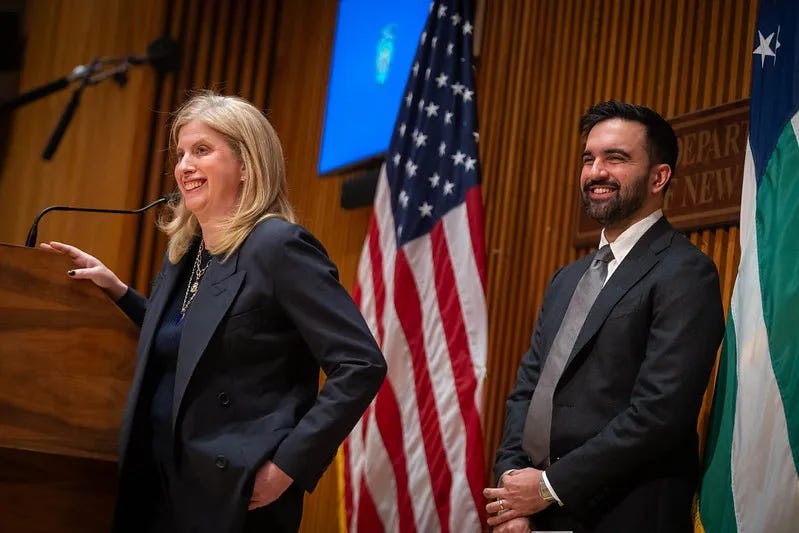
There was one question in the 2025 mayoral election on which all major candidates agreed: the next administration’s retention of NYPD Commissioner Jessica Tisch.
Brad Lander made the promise first, pledging at a February press conference outside One Police Plaza that the Adams appointee would keep her job. Andrew Cuomo, fighting in vain for his political life during the final weeks of the campaign, praised Tisch for doing “a really, really good job,” before adding that he would “ask her to stay.” Even Curtis Sliwa, a quixotic former vigilante with no love for the billionaire class that produced the heiress police commissioner, agreed that she should remain in charge. And during the final debate, Zohran Mamdani, then the Democratic nominee, committed to keeping Tisch atop the NYPD, a move his campaign had deliberated since before the primary. Cuomo, standing a few feet away, called their philosophies “totally incongruous“ and predicted Mamdani would break the promise.
Mamdani, a cadre member of NYC-DSA who had campaigned on defunding the police when he ran for State Assembly in 2020, at the height of the Black Lives Matter movement, had come to the same conclusion as every other candidate for mayor.
Last fall, New Yorkers voted on a rent freeze, whether Israel would be the next mayor’s first international destination, a future of free buses and city-run grocery stores, and if a democratic socialist could be trusted to govern the city. Twelve years after Bill de Blasio built a multiracial coalition on the rejection of Michael Bloomberg’s stop-and-frisk policies, the question of who would run the NYPD was settled before the first vote was even cast. Policing was not on the ballot.
Now, NYC-DSA and seventeen of its current and future electeds are demanding Mamdani consider firing Tisch over the NYPD’s conduct after last Thursday’s ICE shooting in Marble Hill. Hours after a federal agent shot Oscar Belgal in front of his five-year-old son, police shoved protesters along Broadway outside Allen Hospital, knocking Darializa Avila Chevalier, the Democratic nominee for Congress in that very district, to the ground on camera. The NYPD then rushed the crowd so that eight unmarked federal cars could leave the hospital without conflict. To the activists who spent the evening behind barricades in the shadow of the subway’s elevated tracks, the police department of a sanctuary city had safely escorted out the fascist agency that pulled the trigger on one of their fellow New Yorkers, all while the commissioner read Belgal’s criminal record aloud from the press conference podium.
Mayor Mamdani holds Jessica Tisch’s fate, but pretending the decision to keep her was his alone, made in a vacuum, does no one any favors — least of all his base on the Left. To reckon with the forces that produced Tisch is to acknowledge that, at least in the near term, she is not going anywhere.
The knee-jerk fear is that firing a police commissioner provokes the rank-and-file, prompting sick-outs and slowdowns, leaks to the press, and a scourge of New York Post covers hailing Tisch as the first martyr of the “radical left” Mamdani administration. It has happened before, most memorably to Bill de Blasio when officers turned their backs on him at two funerals and staged a weeks-long slowdown after the murders of Officers Rafael Ramos and Wenjian Liu. The episode, which irrevocably diminished the Mayor’s political capital, still looms large for reformers.
The NYPD did not anoint Jessica Tisch. She came up through the department’s counterterrorism bureau and led the Sanitation Department. Her relationship with the department is managerial: she pushed out its corrupt upper echelon under Eric Adams, but has never walked the beat. The force has outlasted forty-seven commissioners and would outlast a forty-eighth. Despite leading the largest municipal PD in the country, most of Tisch’s power comes outside the institution she oversees.
Had Mamdani not kept Tisch to begin with, the force would have navigated the transition as it had done four times under Eric Adams. What the unions would object to now is circumstance: a commissioner removed solely at the behest of the Left.
Kathy Hochul all but made Tisch’s retention a condition of her endorsement. Before backing him last September, Hochul told The Atlantic, she “implored” Mamdani to keep Tisch, and pressed the point home in conversations through the summer and fall (”It was important to me”). When Mamdani made the choice public several weeks later, he called Hochul to give the Governor a heads-up (”I heard you on that,” he told her). Kathy Wylde and the Partnership for New York City, the influential civic and business consortium, also pushed for Tisch to stay on. So did Hakeem Jeffries, the House Democratic Leader and Brooklyn Congressman. UJA-Federation and the Jewish Community Relations Council called the continuity “reassuring.” The editorial boards of the New York Times and the New York Post, which agree on almost nothing, praised the technocratic scion of the Loews family fortune. In the Oval Office two days later, President Donald Trump, who earlier assailed Mamdani as a “communist” and teased a federal invasion of the five boroughs, called Tisch’s re-hiring “a good sign,” before noting she was friends with his daughter, Ivanka.
The terms of this political marriage were simple: Mamdani would be allowed to govern on the issue — affordability — that he campaigned, and was elected, on. Policing, once the Left’s foremost political issue in New York City, would be left to Tisch.
The business community received continuity from one of its own; Jewish institutions were blessed with a proud Zionist at One Police Plaza; the President found a known quantity in the Mayor’s orbit who earned rave reviews from his friends back home (“they say she’s really good, really competent”); the Post exhaled that broken windows policing had prevailed over decarceration; and the Governor rejoiced that the democratic socialist executive chose realism over idealism. And still, the greatest beneficiary of this arrangement has been Zohran Mamdani.
Eight days into his term, Hochul stood alongside the new Mayor at the Flatbush YMCA and committed the state to financing the first two years of free child care for the city’s two-year-olds, delivering Mamdani an early victory that was fundamental to his brand and storytelling. Hochul has credited Tisch’s presence for helping her case to Washington that the city was “going to be fine,” and that the National Guard “could be better used elsewhere.” Crime has kept falling and the Mayor has shared the credit, and her success has become his. Every day the NYPD stays out of the headlines, for blood or scandal, is a day Mamdani can control the narrative and focus on the cost of living, the political terrain of his choosing.
According to a recent poll by Suffolk University, 64% of Democrats believe that Mamdani’s retention of Tisch showed “pragmatic leadership,” compared to only 19% who deemed it “a contradiction.” Respondents who approved of Mamdani’s job performance were the most pleased with his partnership with Tisch. The desire to remove her, by definition, is a minority position within the electorate, let alone Mamdani’s own base, which has swelled to encompass far more than just the activist left and NYC-DSA. Perhaps the greatest evidence that Mamdani views Tisch as a genuine asset to his governance is the Mayor’s willingness to withstand outrage from his left flank. Even among socialists and progressives, building momentum for police reform is difficult. “We’ve seen a lot of movement around Palestinian liberation, on antiwar organizing, and taxing the rich,” Tiffany Cabán, one of four democratic socialists on the City Council, recently told The New York Times. “Policing is just hard.”
The power map of governance looks nothing like that of a primary. The movement built its power for electoral politics, and did so masterfully: shifting outcomes, and the city’s sense of what was possible, with determined volunteers and charismatic candidates one door at a time. But the challenge before Mamdani’s restless allies on the Left has changed. Most of the institutional actors in this story can impose a fiscal cost on Mamdani, potentially derailing the Mayor’s ambitious agenda, inextricably tied to the fate of the organized left. The movement has never been more powerful at the ballot box, but how much independent leverage does it have, right now, over Mamdani, thirty-two months from his re-election? And how can that ever compete with Kathy Hochul, who writes the checks for their signature childcare program? Press releases and protests can only do so much besides feed the mutually destructive “infighting” narrative that animates editors at the Times and the Post.
Albert Hirschman’s terms for this dynamic are voice and exit. The base has voice, and a lot of it, whereas the institutions have exit. And in a governing power struggle, exit prevails: the Mayor can survive being yelled at, but not losing funds for his initiatives.
Every mayor of New York City faces at least one major crisis.
Some crises, like the terrorist attacks on September 11th or the coronavirus pandemic, inspire unity; others, such as the Crown Heights riots or the Ocean Hill-Brownsville teachers’ strike, bitterly divide New Yorkers. The mayor may receive his crisis in the final year of his final term, or one month before a tight re-election. John Lindsay, who presided over the city during one of the most tumultuous periods in American history, suffered so many crises they were compared to the “Ten Plagues.”
Jessica Tisch’s value to Mamdani is in the crisis that has not happened yet.
Most importantly, many of these crises involve the NYPD in one way or another. It is likely, perhaps inevitable, that some day in the next few years will produce an event that shakes the Mamdani mayoralty. And when that solemn day comes, many opponents of the democratic socialist mayor will rush to blame him. But were Mamdani flanked by the police commissioner — whom Adams, Lander, Cuomo, and Sliwa all pledged to retain; a darling of the Times and the Governor; who presided over 203 murders through September, the fewest ever recorded — the unfolding story will be spun differently than if a reformer were in charge. Or what if the next crisis is a police killing, another Amadou Diallo or Eric Garner, and calls for change atop the NYPD reach a fever pitch? Dumping Tisch then would have greater utility, as Mamdani would have a more explicit rationale. Keeping her is a hedge against both scenarios.
Firing her now would amount to a waste. Worse, it would expend this insurance on exactly the terms the opposition would choose: a socialist mayor removing his well-respected commissioner because his radical base told him to. The Mayor will disband the SRG and review “use-of-force practices,” but he won’t touch Tisch.
The fight over Tisch, percolating beneath the pavement for months, exploded on October 8th partly because the real perpetrators were out of reach. Mamdani spent two hours on the phone with the President and Homeland Security Secretary trying to negotiate Belgal’s release. The White House’s only offer was to release into NYPD custody, and the Mayor refused: there was no warrant or legal basis for an arrest.
The movement cannot fire Markwayne Mullin, remove Donald Trump, or banish a rogue agency from the streets of Upper Manhattan. What it can do is make demands on the police commissioner who answers to the man the Left elected. The calendar is bare: there are no primaries for the foreseeable future, nor has the legislative session in Albany begun. When a movement built on mass politics has nothing to canvass for, it takes to the streets, where, almost by definition, the NYPD becomes the opponent. “She’s had 10 months,” said Grace Mausser, the co-chair of NYC-DSA, referring to Tisch’s tenure with an air of diplomacy and frustration.
Both conflicting emotions are common among the socialist rank-and-file these days: diplomacy, because among the electorally minded who dominate the New York City chapter of DSA, there’s widespread recognition that picking public fights with the leading avatar of their project is a slippery slope; frustration, because broken windows policing has continued under a democratic socialist mayor, cronies at the Civilian Complaint Review Board dismiss the findings of their own investigators, and the SRG and the gang database remain as intact as they were under Eric Adams. NYC-DSA no longer has the luxury of hashing out these deliberations in private. And, in an arena dominated by optics, when the organization Mamdani has called his “political home” attacks him publicly and the Mayor doesn’t budge, the former appears weak while the latter emerges even stronger. Nor is NYC-DSA a monolith: the “mass politics” factions of the organization which control the chapter leadership committee — feeling pressure from “ultra-leftist” factions hoping to gain influence at the upcoming city convention election by aggressively pushing police reform — may be inclined to take a harder line on Mamdani and Tisch, to refute the common charge they are too deferential to electeds. (The socialists are in an election year, too.)
The movement that elected Zohran Mamdani did so with discipline, as Eli Miller argued this week, eschewing unpopular rhetoric around police reform in favor of bread-and-butter economics. And it worked. Working-class New Yorkers who, only four years prior, spoke of crime and disorder and cast ballots for a former cop that promised law-and-order, came to rank the cost of living as the most important issue of last year’s election, delivering their votes to democratic socialist who talked about rent and groceries and taxing the wealthy: the terrain Mamdani identified, from the infancy of his campaign, as ground he could win on.
The cost of that discipline was Jessica Tisch. Now, ten months into his administration, the movement is demanding Mamdani make the NYPD the story, the one thing the Mayor has repeatedly shown an unwillingness to do. The Left’s electoral power has never been greater, but its influence over the government it helped create still cannot match the institutions who control the purse. And every pressure point of change runs through the executive whose success the movement has deemed, in no uncertain terms, as “existential.” When the Left spends its leverage against Mamdani, it spends it against itself, forcing both parties to talk about the very issues, crime and policing, that they co-signed as third rails as recently as last year.
There is no doubt in my mind that Zohran Mamdani — the Assemblymember — would have taken to the streets and immediately called for Tisch’s removal. But Mamdani’s constituency is no longer solely the People’s Republic of Astoria, or the people who knew him as “Z” before the world learned his name. Zohran Mamdani — the Mayor — answers to the activists who want Tisch gone, the majority of Democratic voters who support the arrangement, and the hundreds of thousands more who spent the evening prior to the shooting watching the Tampa Bay Rays sweep the Yankees, unaware that a proxy war over the police commissioner was about to begin.
On Tuesday, when asked for the first time whether he would fire Tisch following backlash from his base, the Mayor not only affirmed his support for his police commissioner, but enthusiastically praised her — their — record together.
“We have delivered the lowest recorded number of murders in our city’s history.”
Connect With Me:
Follow me on Twitter @MichaelLangeNYC
Email me at Michael.James.Lange@gmail.com
Very well said and great read again! I like to think I’m pretty left as I’m coming from NY-13 and voted for Darializa Avila Chevalier, but I’m not sure removing Tisch is the hill I’m willing to die on, especially when it feels like the movement is making so much progress this year and this would derail that. It almost like the DSA has forgotten why they actually got popular in the first place and this position they’re taking on this is making me question where I truly stand with the party
Michael, passionate, perhaps you can negotiate the increasingly yawning abyss… there really is no choice, the uber DSA bros owe their new found political power to Z … and when faced with a choice, an easy choice, Jessica (and her mom) is the choice. The Tisch family are major players in NYC/NYS politics, Merryl heads the SUNY board, formerly led the Board of Regents… and a leading advocate for John King, currently SUNY chancellor and politically ambitious.
As a student of the history of the left I reminded of Lenin/Trotsky/Stalin …
Jessica, maybe a future mayoral candidate, is far more important to Z than his SDA bros, he has to step away from them and establish his own island.