

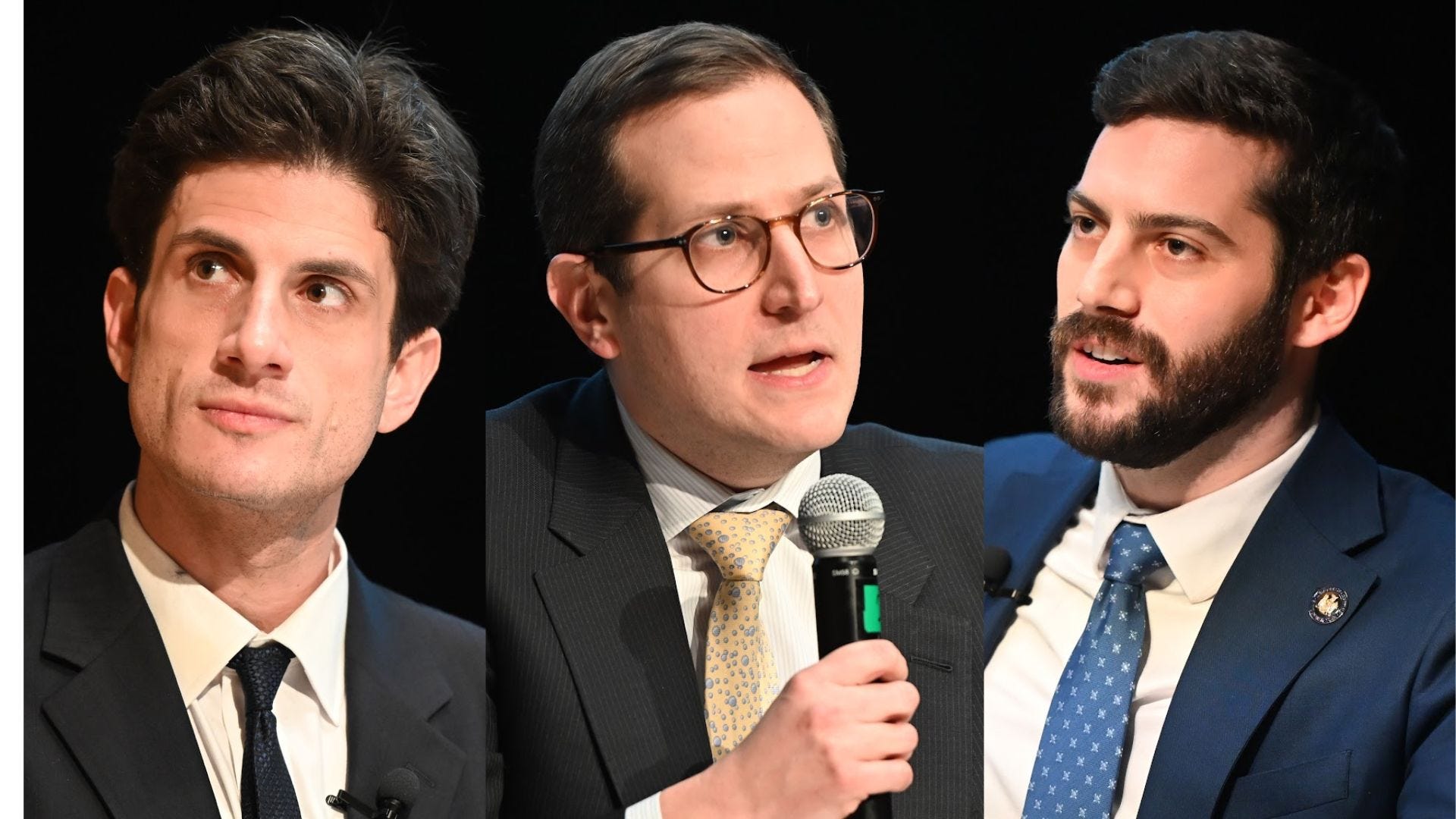
Two weeks ago, I served as the moderator for a candidate forum for New York’s 12th Congressional District, a two-hour discussion at Bank Street College.
Forums, hosted in-person by local political clubs, were once a time-tested tradition of the Democratic Party, a synthesis of organizing and community. Now, these erstwhile neighborhood rituals are diminished (or even non-existent) in many corners of the five boroughs, let alone the country. However, in New York’s 12th Congressional District, which contains perhaps the densest concentration of such “clubs” in America, such an ethos remains alive and well. This event was co-hosted by three such clubs: Broadway Democrats, Columbia University Democrats, and Hell’s Kitchen Democrats.
While all of the aforementioned clubs hail from up-and-down the West Side (an important distinction I will discuss later), New York’s 12th Congressional District straddles both sides of Central Park, stretching as far south as 14th Street. Jonathan Chait, a centrist commentator for The Atlantic, wrote that the Manhattan-based district “probably has more Democrats qualified to serve in national leadership than any congressional district in America.” While such a sentiment is rife with elitism, NY-12 is undoubtedly the epicenter of THE ELITE: home to The New York Times headquarters, Billionaire’s Row, and Museum Mile. Of all the 435 Congressional Districts in the United States, New York’s 12th ranks 1st in both individual income and educational attainment. The sheer scale of affluence — eight-figure penthouses, doormen lining avenues and side streets, three-piece suits and SUVs with tinted windows — is both intoxicating and numbing, particularly in such close proximity to the working-class precarity of the South Bronx, less than 15 minutes away by public transit. Wealth breeds health and longevity: not only is the 12th District the healthiest in the nation (dead last in most diseases and disabilities), it ranks in the 95th percentile with respect to its share of residents from the Silent Generation (over 80 years old). The top eight districts for the Silent Generation are all in Florida, so imagine segments of NY-12 as their political kin folk, just those who prefer to spend 183 taxable days in New York City. Unsurprisingly, NY-12 has the lowest percentage of Gen Z residents (14 to 29 years old) in the nation, a consequence of the highest market-rate apartment prices in America, which has proven unattainable to most recent college graduates. Most of the leading candidates in the congressional race are Millennials (30 to 45 years old), who are competing to succeed the 78-year-old retiring Rep. Jerry Nadler. Perhaps that is why a Gen Z moderator was recruited…
As someone who was born and raised inside New York’s 12th Congressional District (formerly Roosevelt Hospital, now Mount Sinai West), attended middle and high school there, and still worships within its boundaries (Church of the Blessed Sacrament on West 71st), I want to color in some of the aforementioned statistics. For almost the entirety of my entire life, up until sixteen months ago, I lived in NY-12. In spite of its affluence and education, this is a district that contains nuance too, particularly with respect to class, neighborhood history, and political persuasion. Indeed, for as many second home owners who abscond to the Hamptons come Memorial Day weekend, there are even more seniors on fixed income, Mitchell-Lama tenants, young professionals, and upper middle class families, who collectively relish their public parks and walkable streets. Politically and culturally, the district is anchored by both the Upper West Side and Upper East Side — residential neighborhoods which, for decades, were deliberately placed in separate congressional districts. The West Side, historically Jewish, is decidedly more liberal (and overwhelmingly Democratic). The East Side, historically WASPy and old moneyed (with many ancestral Independents and Republicans) is more moderate; “Oligarch Alley,” my father’s coinage for the uber-wealthy stretch between Park and Fifth Avenue adjacent to Central Park (a naturally occurring retirement community), was once the heart and soul of Silk Stocking Republicanism and Gloria Steinem’s Radical Chic. As time has passed, and the Democratic Party has realigned towards the well-educated and affluent, these subtle distinctions have blurred. Home to more Jews than any other congressional district in the United States, support for Israeli Prime Minister Benjamin Netanyahu’s regime is eroding by the day, but the Jewish State’s right to exist is never questioned. Nonetheless, the divisions between the East Side and West Side are critical to understanding the contours of what will be one of the most consequential contests in the country. During last year’s Democratic primary for mayor, NY-12 was the most divided of any congressional district in New York City, with Zohran Mamdani ultimately prevailing by less than 200 votes (out of more than 155,000 cast in total). Writing about NY-12 is not ideal for Twitter engagement, given the population’s average age, but it is excellent for pageviews and subscribers, because older voters love using their email. (For the most consistent coverage of NY-12, I recommend Eli Miller’s blog).
As I stood behind the podium, the candidates fanned out across the stage and took their seats. This was the first time they would all appear together, as previous forums opted for the more mundane, one-at-a-time approach. Seated left to right were: Jack Schlossberg, a political commentator and grandson of former President John F. Kennedy; George Conway, a media-savvy lawyer and former Republican who was once married to Donald Trump’s 2016 campaign manager; Laura Dunn, a civil and victims rights attorney; Micah Lasher, the state Assembly member for the 69th District on the West Side; Nina Schwalbe, a well-respected public health researcher who specializes in vaccines; Micah Bergdale, an entrepreneur with a background in public transit and electric vehicles; Jami Floyd, a legal analyst for ABC News who co-chairs the transportation community on Manhattan Community Board 7; Mathew Shurka, an LGBTQ+ rights activist who has worked to ban conversion therapy in countless states; and Alex Bores, the state Assembly member for the 73rd District on the East Side. Almost all have Wikipedia pages and advanced degrees.
If you’re thinking, “cool story bro, but I haven’t heard of most of these people,” that’s perfectly normal. Before last week, neither had I. The median voter, even in the epicenter of civic engagement, has more present concerns: Trump, ICE, Israel and Palestine, affordability, artificial intelligence. The two-hour forum sought to delve into those concerns and relate them to the district’s future representative. Each candidate began with a two-minute opening statement and ended with a one minute closing statement. In between, the candidates were questioned on a range of issues and given sixty seconds to respond. Some questions were answered by all, while others were only poised to three at a time. (With nine candidates, which is divisible by three, the format was smooth, ensuring equal opportunity and a wider breadth of topics).
For a full recording of the forum, click HERE.
Although the less well-known candidates (those outside of the Lasher, Bores, Schlossberg trio) will be hard pressed to accumulate a critical mass of attention between now and June 23rd, their presence on the stage was a testament to the depth of the 12th Congressional District’s talent. Laura Dunn stood out for her sharp delivery and unapologetic progressivism on a variety of issues, a talented public speaker unafraid to challenge the district’s ideological median. Micah Bergdale was compelling and thoughtful, marrying a compelling backstory with strong policy analysis. Dr. Nina Schwalbe, particularly to those unfamiliar with her campaign, stole the show on multiple answers, offering interesting and nuanced perspectives on public health (a top reporter at a very influential outlet pointedly told me afterwards that Schwalbe was “impressive”). Matthew Sherka, even in a moment of fervent polarization, recounted his successful efforts passing bi-partisan legislation banning conversion therapy. Jami Floyd, the self-styled “radical moderate,” would ultimately drop out of the race days later. In her closing message, she bemoaned “party insiders” and “political celebrities” having the upper hand, an advantage too great for lesser known (and lesser funded) candidates like herself to overcome.
Floyd is not necessarily wrong, either. But not exactly for the reasons she outlined.
One might think New York’s 12th Congressional District, as a union of the well-educated and wealthy at the heart of the nation’s media capital, is readymade for a political outsider. But the exact opposite is true. Insurgents thrive in places where the establishment is weak and political networks are scarce. But NY-12 is a testament to relationships and institutions; it’s not just what you know, but who you know.
Which bodes poorly for George Conway.
Last Thursday was Conway’s first appearance at any candidate forum, a point of intrigue among the regular attendees as well as the organizers, who prided themselves on securing the former “Never Trump” Republican and Lincoln Project acolyte. At 63, Conway was the oldest person on the stage, having recently moved back to Manhattan to run for Congress. He has pledged to serve no more than two terms, with a laser focus on removing President Trump from office. Little else matters, Conway implies, so long as a fascist remains in the White House. Undoubtedly, almost all aspects of Conway’s life have revolved around Donald Trump for the past decade, for better or worse. His marriage to Kellyanne Conway publicly imploded after she helped guide Trump to victory in 2016. And in 2024, Conway donated more than one million dollars to Kamala Harris’ failed White House bid. During the forum, his anti-Trump experiences came across, but little else did. One could not escape the feeling that, in a room pulsing with Trump 2.0 energy — an angry Democratic Party base eager for an affirmative post-Trump vision — Conway was moored to the substantively shallower “resistance” of Trump 1.0. Even lighthearted lightning round questions (best pizza? favorite subway stop?), appeared to stymie Conway, who defaulting to “Rays” and the #7 train station in Hudson Yards. Laura Dunn turned to him, quipping “spoken like someone from D.C.”
The voters of the 12th Congressional District not only relish scores of substance, they demand it.
Which presents a challenge for Jack Schlossberg, who at age 33 is the youngest candidate in the field. The son of Caroline Kennedy, Schlossberg is a graduate of Yale University and Harvard Law School who served as a Vogue correspondent during the 2024 presidential election after passing the bar exam. A digital native with the most famous family in American politics, Schlossberg has millions of followers across social media. Earlier this month, he was endorsed by House Speaker Emerita Nancy Pelosi, a longstanding ally of the Kennedy clan, who lauded Schlossberg as the voice of the next generation. But is Schlossberg’s voice truly in step with his generation?
Consider his response to my question about how he would “curtail illegal settlements in the West Bank that violate international law.” From the outset, Schlossberg appeared nervous, his voice halting: “Any funding the United States is providing Israel, which I don’t think we should abolish entirely, but I think we have to look at it very carefully. As long as [President Trump and Prime Minister Netanyahu] are in power, I would look very very carefully at the funding and weapons assistance the United States is providing … Israel is a democracy and in a very tough neighborhood.” Over the course of his answer, Schlossberg never mentioned the West Bank, despite the specific prompt. His lackluster response, unsurprisingly, prompted boos from some of the younger attendees. The contrast in quality was magnified by a far sharper answer from Assembly Member Micah Lasher, who asserted he would immediately re-introduce Rep. Jerry Nadler’s bill to sanction West Bank settlers, saying “I believe there is no path to a resolution of this conflict with the size and scope and expansion of settlement activity in the West Bank and the violence being committed against Palestinians there.” Schlossberg, who had failed to mention the Palestinian plight previously, then interjected upon the conclusion of Lasher’s answer to affirm his support for conditioning aid and express horror at the “human atrocities in Palestine.”
No matter where one stands with respect to the war in Gaza, West Bank settlements, and Israel’s right to exist, Schlossberg appeared, at best, unsure of himself on a crucial federal and international matter, and at worst, untethered to principle and attempting to play both sides of a contentious issue. Contrast Schlossberg with another Millennial politician who also came from economic and cultural privilege: Mayor Zohran Mamdani, the son of acclaimed filmmaker Mira Nair and respected academic Mahmood Mamdani. Mamdani, a democratic socialist and avowed supporter of Palestinian human rights, is somewhat of a third rail in NY-12; narrowly winning the district in the Democratic Primary but losing the General Election by five points. Though NY-12 has a disproportionately small Millennial population, Mamdani was able to compete throughout the most affluent and educated blocks in the nation because he relentlessly engaged these younger voters — not just with slick slogans and short-form videos, but with genuine substance. If Schlossberg is truly the voice of the next generation as Nancy Pelosi proclaims, he will be able to activate this cohort, as Mamdani did the year prior. Opponents accuse Mamdani of many things, but “playing it safe,” lack of preparedness, and no core ideological foundation are not among them. This explains Mamdani’s success, and Schlossberg’s lack thereof, far better than anything to do with social media.
Jack Schlossberg’s campaign slogan is “BELIEVE IN SOMETHING,” a rallying call to the young and disillusioned. But what, exactly, is President Kennedy’s grandson asking them to believe in, besides his family’s legacy?
Absent “a record of public service or public accomplishment,” which Nadler has asserted Schlossberg “does not have,” the 33-year-old will have to innovate and become a political entrepreneur: someone who can not only ride the crest of the social forces, but turn them in their direction. Once upon a time, the neighborhoods of New York’s 12th Congressional District molded such political pioneers, spawning not only mayors and governors, but national leaders of both the Democratic and Republican parties. Now, the political entrepreneurs come from other places in the five boroughs. They may work in the NY-12, perhaps at a taqueria in Union Square, but they live somewhere else far more affordable, like the Bronx. Even those fortunate enough to grow up here (a certain Bank Street alum raised in Morningside Heights comes to mind), will find their breakthrough opportunities elsewhere, in working- and middle-class neighborhoods like Parkchester, Astoria, and Bay Ridge. What has atrophied and eroded the political entrepreneurship of the 12th Congressional District?
The simple answer is that it’s easier to “make it” literally anywhere else. The competition for political office at the heart of Manhattan is fierce, defined by an abundance of ambition, credentials, and money (even races for Democratic district leader, an unpaid party position, are polarizing and fraught). In other parts of the city, there is often a sole interest group that dominates civic culture that one must appeal to. But in the neighborhoods of the 12th Congressional District, the array of institutions is vast, but – save for The New York Times – none are overwhelming enough to singlehandedly tip the scales. When combined with a relatively homogenous racial and class character, political preference often reverts to the mean of technocratic liberalism. As such, there is less ideological and political differentiation between elected officials across the 12th Congressional District than in any other congressional seat in New York City. One would think such robust competition would breed a plethora of political mavericks, but instead most candidates choose to play it safe and are thus relatively unknown outside of their immediate neighborhood. Even incumbent Rep. Jerry Nadler, a beloved liberal with an impressive and substantive legacy, is not considered a national leader of the Democratic Party.
Alex Bores, for one, is hoping to change that. Bores fits the “ladder climber” archetype that is a pre-requisite for success in the 12th Congressional District. He was a district leader on the Upper East Side, aligned with the influential and progressive-leaning Four Freedoms Democratic Club, before winning a bitterly contested race for an ultra-rare open Assembly seat in 2022. In the State Legislature, Bores represents many of the wealthiest communities in New York City: “Oligarch Alley,” along with tony Sutton Place and quasi-hip (but still expensive) Murray Hill, all on Manhattan’s East Side.
In a contest of this nature — regardless of nuance, qualification, or ideology — political geography often carries the day, pitting the West Side against the East Side. There are more votes to be had on the West Side, and the political institutions on that side of Central Park are more cohesive (i.e. all political clubs and elected officials typically move together). Micah Lasher, homegrown in the neighborhood, is the West Side candidate, blessed by their standard-bearer, Jerry Nadler. And the West Side always beats the East Side. (Just ask Carolyn Maloney, the former East Side congresswoman who lost badly to Nadler in 2022 after the two veteran congressmembers were both drawn into NY-12 during redistricting.)
But what if Bores could transcend geography, or at least mitigate it? He would need a potent wedge issue, a means to distinguish himself from the crowded field. Such a wildcard would have to be universal and existential, while increasingly commanding attention in the psyche of the district’s hyper-engaged electorate. Bores would need to be an expert on this emerging threat, even more than the notoriously wonky Lasher.
The ability of artificial intelligence, and its profound and escalating implications on white-collar employment and mass surveillance, to rupture the historic West-East electoral paradigm is the thesis on which Alex Bores has staked his campaign. And there is a bullish case why that could work. As data centers occupy rural communities and consume natural resources, anxiety increases about what artificial intelligence means for our collective future, particularly amongst the well-educated classes — also known as New York’s 12th Congressional District. Many are even saying “AI Pacs are the new AIPAC.” However, AIPAC’s financial resources, vast and not to be underestimated, are still more finite than that of the sprawling tech oligarchy.
Already, independent expenditures tied to AI behemoths have identified Bores as a target (or potential ally), flooding NY-12 with seven-figure ad buys months before the election. This onslaught has even further raised the salience of AI and placed Bores at the center of the conversation, a potent position in the attentional economy of politics, if harnessed correctly. Bores has parlayed this moment into several primetime hits on cable news and field-leading fundraising, complementing style with substance (his AI regulation plan, announced the morning of the forum, was well received). In making the case to the district’s voters that he is best equipped to be their representative, Bores leaned into the argument that “we will vote the same way 90% of the time,” but that the election is about “bringing a knowledge or experience that is different from what exists in [the Democratic Congressional Caucus].” This is undoubtedly compelling, but is it enough to overcome decades of relationships and institutions in a matter of months? And, even if artificial intelligence swiftly and ruthlessly automates away early career and mid-level white-collar jobs, wouldn’t the residents of NY-12 — older, more affluent, more educated — be among the most insulated from such havoc? Political outcomes, oftentimes reduced to talent and sweeping ideological implications, are shaped by luck and timing as much as anything else. And there’s one variable that weighs on the collective psyche of New York’s 12th Congressional District even more than the rise of artificial intelligence: Donald Trump.
Bores’s top rival is betting that Democrats in NY-12 will not stray too far from their priors, and that President Trump, and the daily chaos emanating from his administration, will still dominate the zeitgeist of Manhattan voters over the next four months. These anxious and informed liberals, in a moment of peril, will seek continuity from the previous, respected and beloved tenure of Rep. Jerry Nadler, and turn to his well-prepared political protégé. So the thinking goes, at least.
That candidate, Micah Lasher, is no ordinary first-term Assembly member. He boasts an impressive résumé in New York politics spanning two decades, including stints as the policy director to the governor, chief of staff to the state attorney general, and chief Albany negotiator for the mayor. However, Lasher cannot be pigeonholed as a government bureaucrat naive to the dark arts of political power, for the West Side native has steered winning campaigns across New York since he was a freshman in college (even writing a book on magic tricks when he was fifteen). A savvy and sharp political operative, Lasher knows every trick in the proverbial playbook and has some of the most powerful politicians in Manhattan on speed dial. Case in point, during a surprisingly competitive campaign for Assembly in 2024, public defender Eli Northrup appeared to be gaining ground on Lasher, the prohibitive favorite, after the progressive insurgent sent a negative mailer attacking the frontrunner’s past support for charter schools. While the West Side traditionally adheres to a “gentleman’s game,” Lasher hit back, phoning both Rep. Jerry Nadler and former Manhattan Borough President Ruth Messinger (the two also ran for Assembly against one another in 1976), who co-signed a letter admonishing the negative campaigning (“Eli Northrup should be ashamed of his dishonest, meanspirited attacks”), which included an image of a salt shaker (“Democrats should take them with a FULL shaker of salt”). The infamous “salt shaker” mailer immediately stalled Northrup’s momentum, and Lasher coasted to victory. But did he need to pull the Nadler–Messinger card to win?
Of course not. Micah Lasher sent that mailer because he could.
However, the generational opportunity that lays before him today almost never came to fruition. For close to a decade, Lasher’s career was defined by a series of what ifs and near misses: a shoe-in for City Council in the late 2000’s, term limit extensions foiled his plans to run; campaigning for a highly-coveted state Senate seat along the West Side several years later, Lasher fell short by less than 300 votes; a key adviser to both Scott Stringer and Eric Schneiderman, a top position in City Hall or Albany was inevitable, until personal scandal leveled both of their careers. Now, the path is finally clear, with Lasher on the precipice of his political dream. Can he realize it?
So far, Lasher is leaving nothing up to chance. Another West Side candidate, City Council Member Erik Bottcher, was also supposed to run for NY-12. He announced last fall and raised an impressive sum of money, more than three-quarters of a million dollars on the first day. However, over the holidays, Bottcher abruptly dropped out of the Congressional race to run for a vacant state Senate seat on the Upper West Side, formerly held by Manhattan Borough President Brad Hoylman-Sigal. Immediately, Lasher’s longstanding West Side allies, Nadler and Hoylman-Sigal, endorsed Bottcher, which promptly boxed out other potential Senate contenders, such as Assembly Members Linda Rosenthal and Tony Simone. Overnight, Bottcher found a soft place to land and Lasher became the only West Side elected official running for Congress. Another magic trick, perhaps?
But if Lasher is a smooth and well-connected operator, he is an even more prolific legislator. Already, Lasher has sent booklets (“The Fight Back Blueprint”) about his work to “Trump-proof” New York to thousands of households, specifically targeting East Side Democrats who are less familiar with his legislative record. These are not your traditional mailers. Rather, they are multi-part briefings (“Part II: A Roadmap for Congressional Oversight and Investigations” arrived recently), totaling four pages, stapled and double sided. (The specific content of these blueprints can also be found on Lasher’s Substack, fittingly named “Into The Weeds”). Such blueprints are paired with a “Dear Neighbor” letter from a current or former Manhattan borough president (Mark Levine, Brad Hoylman-Sigal, Gale Brewer) whom East Side voters would be better acquainted with. This attention to detail has helped Lasher peel off two clubs from the East Side, Eleanor Roosevelt Independent Democrats and Samuel J. Tilden Democratic Club. While the political power of each individual club varies significantly (and, to some extent, is diminished from the halcyon days of local organizing), the early East Side inroads bodes well for the West Side’s favored son.
But every time Micah Lasher looks over his shoulder, he still sees Alex Bores. Barring a minor miracle, the race will come down to these two men. The gloves may not be all the way off yet, but it’s only a matter of time. Already, they have traded multiple barbs in the press, with Lasher highlighting Bores’ past work for Palantir, whose facial recognition software has been controversially used by the Department of Homeland Security and Immigrations and Custom Enforcement (Bores left the company in 2019). Bores countered that Lasher originally hedged when asked whether he would call for the abolition of ICE, a position that is almost uniformly supported by the 12th Congressional District’s Democratic candidates (after the murder of Alex Pretti, Lasher went to Minneapolis for several days). Israel-Palestine, while a fault line and source of sense of tension throughout NY-12, is not widely viewed as a discernible differentiator between Lasher and Bores (both have sworn off contributions from AIPAC-adjacent PACs).
Thursday’s forum was their first moment sharing a stage together. Asked about “one thing they would do differently from Rep. Jerry Nadler,” both showcased their respective strengths: Lasher, despite his close relationship to the incumbent, did not attempt to deflect whatsoever, instead harkening back to the Glass-Steagall legislation of the late 1990s, which deregulated financial markets and contributed to the Great Recession. Bores charmingly quipped “first, I would endorse differently,” which elicited laughs from the audience. As Schlossberg stumbled and Conway choked, Bores and Lasher lived up to their reputations. For close to 90 minutes, the two ambitious frontrunners, representing Manhattan’s Upper West and East Sides, refrained from poking one another. But a climactic confrontation was inevitable.
Questioned on the “costs and benefits of artificial intelligence” and the “steps Congress should take to implement proper safeguards to protect workers and livelihoods,” Lasher began by praising his main opponent: “I was proud to co-sponsor Alex’s very good bill on catastrophic risk, that is something the federal government should take on.” Nonetheless, the good vibes swiftly came to an end. Lasher proudly listed the other artificial intelligence regulation bills he co-sponsored (on issues like employment, lending, displacement), each time repeating, “and I was surprised that Alex was the lone Democratic vote against that bill.” To further twist the proverbial knife, Lasher added that “you’re not gonna see either of the two major AI companies proposing a Super PAC to support my candidacy.” (Through affiliated Super PACs, OpenAI has spent heavily against Bores, while Anthropic has spent in support of him).
The open-endedness of Lasher’s assertion left the audience in limbo, with more questions than answers: Why did Bores vote against those bills if all of his colleagues did not? Does he have something to hide?
Bores, one hand in the air, aware that a blow had been struck, politely asked the moderator for an immediate rebuttal. The moderator smiled, but nonetheless declined: “You’ll get your minute, we’re not NY1.” Had Bores responded immediately, fresh off the personal challenge from his rival, perhaps his answer would have been more hurried or emotional. Instead, as the Q&A made its way from right to left, the East Side Assemblyman was blessed with another 240 seconds to strategize and answer. What came next was not a fiery rebuke, but a measured response. Prior to addressing his opponent, Bores began by touting his own AI regulation plan, released the morning of the forum to rave reviews. Then, he sought to draw a distinction between individual donations from the employees and engineers of AI firms (Bores has raised close to one million dollars in campaign contributions from California) and dark money PACs (whose donations are unlimited and donors are hidden). “I understand Trump megadonors want a say in this race, but I am disappointed that a Democrat would give them more airtime,” he said. In the Upper East Sider’s telling, his Upper West Side rival was not only “ignorant,” but “spreading misinformation.” The bespectacled Lasher, always mild-mannered and reserved (but armed with an occasionally short fuse), did not take kindly to Bores’ charges. Even before Bores finished speaking, Lasher reached for the microphone. “I’ve condemned BOTH of the Super PACs,” Lasher asserted, “and just today, $20 million by the PRO-BORES Super PAC to Senate Republicans,” his voice rising with every syllable. “There are two companies fighting a war, and Alex is right in the middle of it,” he declared. Bores’ chief of staff, sitting in the front row, yelled at Lasher.
A gentleman’s game had become a cage match.
Such an interaction, beyond legislative sponsoring or Super PAC ethics, belied the emotional current pulsing inside both men. Lasher was the guarded favorite, protecting his flank, unwilling to let any encroachment go unchallenged; Bores the persistent underdog, relishing the chance to get under his opponent’s skin.
Next January, the victor will be furnishing their new office on Capitol Hill, carrying bills alongside Senator Jon Ossoff, crafting legislation with Rep. Alexandria Ocasio-Cortez, and fielding calls from potential House Speaker Hakeem Jeffries and Senate Leader Chuck Schumer. For those whose ambitions outstrip our own, entering Congress in 2027, right as Democrats retake Congressional majorities and the Trump regime starts to buckle, is tantamount to political nirvana. Inevitably, the next representative of New York’s 12th Congressional District will be at the center of everything.
The loser will be cleaning out their desk in Albany, bidding farewell to departing staff, and waiting alone on the Amtrak platform, bracing for their final commute home. In these moments of silence, numbed by the unforgiving winter of Upstate New York, their bruised ego and brilliant psyche will regretfully and endlessly replay their fate.
What could I have done differently?
Connect With Me:
Follow me on Twitter @MichaelLangeNYC
Email me at Michael.James.Lange@gmail.com
This contest is a bellwether for the soul of the Democrat Party because it forces a choice the party keeps trying to avoid. Is the path forward endless anti-Trump resistance, insider institutionalism, and donor-class technocracy? Or is it a sharper, more defined vision about economics, technology, Israel, immigration, and the direction of American power? Manhattan’s 12th is elite, affluent, and hyper-engaged—exactly the coalition that now defines modern Democrats. If even here voters are restless, divided, and searching for clarity, that signals something bigger than one congressional seat. It signals a party still deciding what it believes after Trump—and whether it believes in anything at all.
The writing craftsmanship. The flow. The personal touch. The story structure. Very persuasive presentation. You convinced me.