

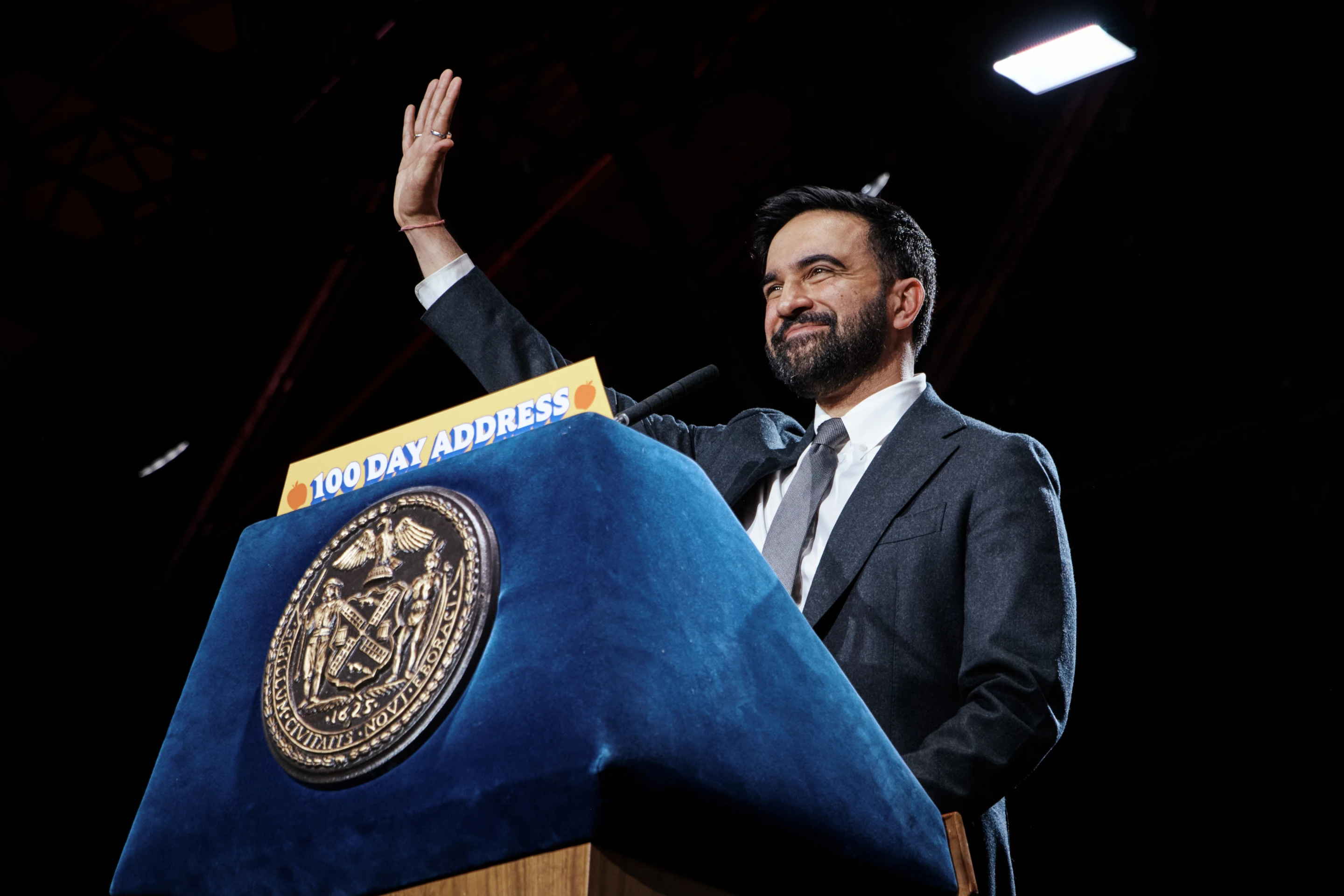
“We have done an incredible thing… and somehow we have more work to do.”
On Sunday, April 12th, Zohran Mamdani took to the stage at Knockdown Center, a former glass factory turned music venue in Maspeth, Queens. The festive evening had the air of one of Mamdani’s former campaign rallies — only now he was the Mayor of New York City, the dream finally realized. Supporters had traded their “Freeze The Rent” and “Fast and Free” signs, the erstwhile markers of ambitious insurgency, for slogan of “Pothole Politics,” a movement maturing for the governance that lies ahead.
Mamdani’s whirlwind campaign — from the viral videos that defined the democratic socialist’s swift rise to the entrenched and bitter opposition of the city’s political class — never truly abated during his first 100 days. Nor will it over the next 45 months.
But a permanent campaign requires more than raucous energy and righteous indignation — it demands a governing vocabulary and theory of change, one that translates movement politics into the unglamorous language of municipal services.
To his credit, Zohran Mamdani recognized this immediately.
The Mayor clearly believes in the power of deliverism, or in this case, sewer socialism: the notion that voters tend to support candidates or parties not just on their promises, but on their track record of delivering on those promises, while providing administrative function and constituent services. Policy implementation, as borne out by the failures of the Biden administration, must be paired with an equally robust communications arm to sell said successes. Hence, Mamdani has placed a high priority on making the nuts and bolts of municipal government visible: paving over a stubborn bump on the Williamsburg Bridge bike path, clearing the streets efficiently during two consecutive snowstorms, while filling 100,000 potholes since the new year. Fittingly, he spent his 100th day in office picking up trash in the Soundview section of the Bronx. His plan for one municipal grocery store per borough is already off the ground, headlined by a flagship store at La Marqueta (a stretch of city-owned land under the Metro North tracks) in working-class East Harlem. These stories and accomplishments, predictably, are told through video, Mamdani’s most potent medium, which often features the Mayor, front-and-center, doing the work: shoveling snow alongside the Satmar, answering 311 calls at the command center, paving potholes on Staten Island’s country roads. This is both the storytelling of sewer socialism and a prime example of how Mamdani, perpetually smiling, has eagerly picked up many of the easy wins his slothful and corrupt predecessors neglected. Your accomplishments are only as good as voters’ ability to recognize them as yours.
Undoubtedly, the elbow grease is paying off. According to polling from Marist College, “74% of New York City residents say Mayor Mamdani is working hard,” including 82% of Democrats, 65% of Independents, and 48% of Republicans. While the numbers validate pothole politics, governing effectively requires not only constituent services, but navigating Albany. Even as a new Mayor, Mamdani has still eagerly extended his political capital to the realm of electoral politics, with one noticeable exception: Governor Kathy Hochul. Mamdani, wary of the pernicious power dynamic that has haunted Mayors past, has been rather deferential to the Governor, despite Hochul’s consistent resistance to raising taxes on the wealthy. The leftist leader, in an attempt to curry favor with Hochul, went so far as to personally (and publicly) quash the flailing bid of her former opponent in the Democratic Primary, Lieutenant Governor Antonio Delgado, eliminating one of the increasingly scarce points of leverage for the “Tax The Rich” movement (albeit a weak one at that). Does the ascendant left have second thoughts about the Governor’s race, where the challenger terrain was ceded to Delgado only for him to abandon his bid at the most inopportune time? Absolutely.
Still, the Mamdani–Hochul partnership has not all been for naught; a $4.5B expansion of 2-K childcare, across many of the city’s working-class neighborhoods, was announced to great fanfare within the first week of the new administration. For Mamdani to deliver a piece of this plank, the most ambitious of his agenda, was a tremendous accomplishment and boon to the notion that the socialist Mayor can deliver. Now, with New York City staring down a five billion dollar budget shortfall, Mamdani is holding his tongue, keenly aware of the fruit his more cautious approach has already borne, going so far as to skip a Tax The Rich rally in the Bronx hosted by Bernie Sanders (his political idol, rallying on his platform, in his city). At least for now.
Instead, the Mayor has trained his fire at City Council Speaker Julie Menin, who, with much of the Council behind her (including many of the Mamdani’s progressive allies), has insisted that New York City need not raise taxes on the wealthy nor impose austerity measures to slash five billion dollars from the city budget.
These dubious accounting practices, in part, are what landed the five boroughs in this current budgetary debacle, and Mamdani, whose tenure could stretch to 2033, is wise to not kick the can down the road. The Speaker — Pro-Israel, uber wealthy, ideologically moderate, from Manhattan’s Upper East Side — represents a sharp political contrast to the Mayor. Menin, ambitious and adept at leveraging institutional power, is advantaged in the budget fight, an insider’s game; whereas Mamdani’s greatest strength, shaping the views of voters and the public writ large, has diminished potency behind closed doors, particularly with respect to a two-thirds, term-limited City Council and a Governor unopposed in the Primary. “The ethos of this campaign,” Mamdani’s top political advisor, Morris Katz told Erroll Louis, “was ‘we’re not gonna be like every other politician who might acknowledge an issue but refuses to name the villains responsible for making this an issue. I think you can’t tell someone ‘You’re being screwed’ without telling them who’s screwing them.”
Herein lies the tension inherent to The Permanent Campaign: the base remains energized and engaged, but it requires a degree of antagonism towards the institutions governing alongside you. So far, the “you’re being screwed” rhetoric has been directed solely at Speaker Menin and the City Council. But functionally, the body is just as helpless in solving the matter as the Mayor. Whereas the Governor, on track for a landslide re-election amidst the cresting blue wave of Trump’s second midterm, can. In fact, millionaires across New York State, at the behest of the President’s tax cuts, are saving an estimated twelve billion dollars in federal taxes. Such a detail, when combined with the fact that 69% of Democrats statewide and 64% of New York City voters support a millionaires tax, would be potent in the hands of the best communicator in American politics. On the campaign trail, Mamdani had Andrew Cuomo, a perfectly cast relic of the out-of-touch establishment, as his foe. Now, the Mayor has colleagues he must appease rather than competitors he must crush.
With Cuomo no longer the atrophying avatar of the anti-Mamdani resistance, the opposition has lost its center of gravity. This increasingly diffuse cohort — business-friendly, real estate-aligned, avowedly pro-Israel, homeowner-heavy — is flailing in the wind, less tethered to the oxygen of power than ever before. They have tried to make hay of Mamdani’s missteps (20 snowstorm deaths, old problematic tweets from top aides, budgetary disputes that complicate the narrative), but have struggled to gain traction beyond a single news cycle. Absent The New York Post, they lack the institutional heft to inflict real damage. Cuomo, diminished from the scandals that expelled him from office, was still a multi-decade institution, capable of cohering a loose (but diminished) coalition of older Black and Hispanic voters, ultra-orthodox Jews and hardcore zionists, and Bloomberg Democrats and Trump Republicans locked out of power. The campaign season was conducive to this consolidation, a shotgun marriage of convenience to stop Mamdani. Now, these groups are rudderless. They strive to “organize” against the Mayor, but lack the affirmative vision to do so effectively, defaulting to grievance politics. These alleged movers and shakers are used to throwing money at their problems to make them go away.
But money can’t buy a movement.
For a Mayor in office for only three months, Zohran Mamdani’s coalition is remarkably baked in — on all sides — the consequence of a polarizing campaign where tens of millions were spent to tarnish the insurgent democratic socialist, and an unprecedented and evolving earned media environment (that insulates Mamdani from the left, and scapegoats him on the right). The Mayor’s base (younger, college-educated socialists and progressives; South Asians, Arabs, and Muslims oft-overlooked by the political class) is, quite literally, growing by the day: a consequence of Trump-era realignment within the Democratic Party and the demographic trends of the five boroughs. Mamdani has close to an iron-clad grip over this constituency, as evidenced by their persistent loyalty (and lack of public outcry) with respect to a handful of potentially fraught decisions: the early retention of Police Commissioner Jessica Tisch, a billionaire heiress with universal support from the city’s media and business elite, but a noticeably more carceral approach to policing than the Mayor; uneven statements with respect to two separate “officer involved” shootings in January (the latter of which, the shooting of 22 year old Jabez Chakraborty, was condemned by DRUM); and the aforementioned deference to Governor Hochul. Mamdani, dare I say, is incapable of truly alienating his base; for the Mayor is armed with genuine core principles and a coherent, democratic socialist worldview that anchors him through storms. However, as one can glean, the real “risk” lies with disillusionment, which would stem from the perception of indefensible compromise with an untrustworthy establishment. But, as the Mayor’s array of opponents attempt to manufacture controversies, his supporters, steadfastly loyal to the man who sparked hope in their hearts and overcame the odds, rally even closer to his side.
The Mayor’s emphasis on pothole politics has further endeared him to technocratic and affluent liberals, whose greatest electoral reservation about Mamdani concerned his lack of experience. Still, a majority backed the fresh insurgent over the tired establishment last June; and so far, Mamdani is validating their faith. After twelve years of Bill De Blasio and Eric Adams, the new Mayor’s work ethic is a welcome change. Pointedly, in New York’s 12th Congressional District — the city’s wealthiest and well-educated neighborhoods — Democratic voters gave the Mayor robust marks of favorability (+30). And, while The New York Times, the most powerful media organ of these civically-engaged and well-heeled constituents, remains broadly skeptical of Mamdani’s ability to enact his agenda, the Gray Lady is not hostile to him.
Among the bloc-voting Orthodox and Hasidic sects of Brooklyn and Queens, Mamdani enjoys infinitesimal support, and was subjected to an electoral avalanche in both the Democratic Primary and General Election. Still, to the descendants of Abraham horrified by the bloodshed in Gaza and lawless annexation of the West Bank, Mamdani is not only an ally, but a moral leader in a Democratic Party compromised by complicity. And yet, the Mayor’s most enduring challenge will be keeping those in the proverbial middle, liberal zionists who abhor the Netanyahu regime but believe in Israel’s right to exist as a Jewish state (the Micah Lashers and Jerry Nadlers of the world), in his corner. While many of these voters have strong feelings with respect to the Middle East, geopolitics did not factor decisively into their choice of a municipal leader. Historically, these voters have oscillated between the city’s progressive-left coalition (John Lindsay, David Dinkins, Bill de Blasio) and the more centrist backlash (Ed Koch, Rudy Giuliani, Michael Bloomberg). Last November, this heavily-Democratic bloc made up a key piece of Mamdani’s coalition in the General Election: among voters in Jewish surname (10%+) precincts that voted for Kamala Harris (60%+) — i.e. Jewish Democrats — Mamdani ran less than three points behind Cuomo: 47% to 49.5%. Here, Mamdani’s fast and ambitious start will pay its greatest dividends, so long as the budget fight does not prove too fraught. While Mamdani is often criticized by opponents for his lack of Jewish support, this critique fails to grasp that, if the Mayor so much as retains his current level of support from Jewish Democrats, unseating him in 2029 will be almost impossible. Without a doubt, Mamdani has completely re-shaped New York City’s political geography.
Yet, while the city’s Jewish electorate gets considerable media attention, the numerically decisive constituencies lie elsewhere. In the Mamdani era, Black (~21%) and Hispanic (~17%) voters — stratified by generation, lukewarm on Mamdani in the Primary, but more supportive in the General — will be the crucial swing constituencies of Democratic politics in the five boroughs. Mamdani, armed with the attentional hegemony of the mayoralty and a celebrity that feels omnipresent, is viewed rather favorably by working-class Black and Hispanic voters, and now has full access to the institutional elements (churches, senior centers, cookouts, ribbon cuttings, parades) that so often shape the whims of politics at the neighborhood level. This is why Menin, floated as a future challenger to Mamdani, would be a poor choice; sure, she might win Manhattan, but Mamdani would crush her in Brooklyn, Queens, and the Bronx. Still, the Mayor gave the Speaker (and other foes) fodder when he abruptly threatened to raise property taxes by 9.5% to close the previously mentioned budget deficit, an increase that would be disproportionately painful to cash-strapped (non-white) homeowners in the outer boroughs. Strategically, this was the new Mayor’s most pronounced misstep of his brief tenure; for once, Mamdani lost control of the narrative, as backlash to his proposed hike overwhelmed the other pieces of his argument. Outer boroughs electeds, particularly Black leaders, were incensed; to the point where Mamdani had to gather officials at City Hall to mitigate the damage. Nevermind that Mamdani had no intention of actually raising property taxes (and even if he did, the City Council would soundly reject him), the doomsday scenario for working-class homeowners, blared across local news ad nauseam, was laid at his feet; and the Mayor only had himself to blame. According to monthly polling from Siena College, Mamdani’s favorability among Black voters fell 18 points between late February and late March. And still, his 60% favorability was the highest mark among Black voters of any Democrat in New York State, evidence of Mamdani’s incomparable popularity; (Siena rarely polls Alexandria Ocasio-Cortez and Bernie Sanders, but routinely gauges the favorability of Chuck Schumer, Kirsten Gillibrand, Letitia James, and Kathy Hochul). Such is the Mamdani paradox: even the Mayor’s mistakes reveal the depth of the goodwill he has accumulated, a reservoir that cannot be captured by any single poll, nor depleted by any one controversy.
However, the act of political coalition building is not monitoring numbers on a spreadsheet from one month to the next month, but an intensely active, deeply emotional, and all-consuming endeavor. The rare politician that doubles as a brilliant tactician and creative communicator, Mamdani understands this subtle and beautiful art better than his contemporaries, evidenced by his rise to power over the last year.
Even now, the Mayor treats each interaction as though it is a first impression, because those moments, fleeting anecdotes to Mamdani, are durable memories etched in the minds of individuals. But those finite memories add up, piece by piece, until they build a seemingly infinite mosaic: a gorgeous tapestry known as the five boroughs.
For the first time in decades, New Yorkers, nature’s most prideful creatures, find themselves believing earnestly in something far greater than themselves. New York City not only feels like the center of American politics, it objectively has been during Donald Trump’s second term: a hopeful municipal alternative to federal tyranny. Unlike his predecessors, Mamdani does not mistake hard work for boastful bluster; eschewing the allure of Manhattan’s trendy nightclubs for picking up trash in the South Bronx. For many lifelong New Yorkers, pride in their Mayor, deferred for a generation, has been restored; among the young and disillusioned, an unfamiliar optimism burns inside their beleaguered psyche. Mamdani is both the symbol and engine of this civic revival. And while the Mayor may not be able to deliver every promise, that will not be what most voters ultimately judge him on (despite the protests of the chattering class). The inertia of the mayoralty, the second hardest job in America, is designed to grind even the most earnest reformers into dust. For months on end, eight figure advertisements pilloried Mamdani, castigating him as a dangerous radical that would inevitably return Gotham to the crime-ridden city of yore. The young Mayor has not only withstood such attacks, he endured them; inspiring masses of ordinary people along the way. These emotional undercurrents that underpin Mamdani’s resonance are far more powerful than any sole news cycle.
Zohran Mamdani’s day job may keep him from walking the length of Manhattan, the inspiring closing act to his insurgent campaign. Yet whenever he so chooses, the Mayor can pace the six mile trek home from City Hall to Gracie Mansion. The contours of both journeys, from that humid summer night down the West Side to the recent brisk evening stroll up the East Side, are markedly different, from the surrounding faces of the security detail protecting the Mayor to the staffers flanking their principal. But two things have not changed. The joyous reception that greets Mamdani, from everyday people on the street, themselves also on their way home from work, reflects the same authentic mix of hope and astonishment that has made the Mayor into a political and cultural figure. Nor has the man himself, now blessed with exponentially more fame and power, compelled by circumstance to compromise, departed from the worldview that defined his rise. To his core, the Zohran Mamdani you see — the self-deprecator, earnest hand-shaker, omnipresent innovator, and tireless worker — is the one we have always known. And for most people, that is more than enough.
Connect With Me:
Follow me on Twitter @MichaelLangeNYC
Email me at Michael.James.Lange@gmail.com
This is a clean power struggle—movement versus machine. Mamdani and the DSA are betting that energy, demographics, and narrative can overpower the old levers of control. Menin and the establishment are betting that budgets, institutions, and quiet influence still decide outcomes. Both are right, which is why this fight matters. You can win elections with momentum, but you govern with structure. The risk for Mamdani is overpromising and colliding with reality. The risk for the old guard is underestimating how much the ground has shifted. This isn’t just New York politics—it’s a preview of where the Democratic Party is heading.
A little early to declare Z the winner of 2029 mayoral election.
Attacking Menin, and btw her Council makes the battle over the budget contentious… the usual June handshake may ebb into July.
If Tisch continues to follow her own path and Z’s SDP bros continue to attack her she may bail, with unlimited $$ could become a 29 candidate? Menin is already beginning her mayoral campaign and let’s not ignore AOC, who is waiting to run for the Schumer seat, or if Z stumbles …
And, of course, the budget may be even worse, layoffs??
Filling potholes is fine, reeling in teachers and parents, who feel betrayed over his mayoral control flip flop.
If he decides to divest himself of Jessica he faces the wrath of Merryl …
Let’s wait for two or three budget cycles before we raise Ms hand in victory