

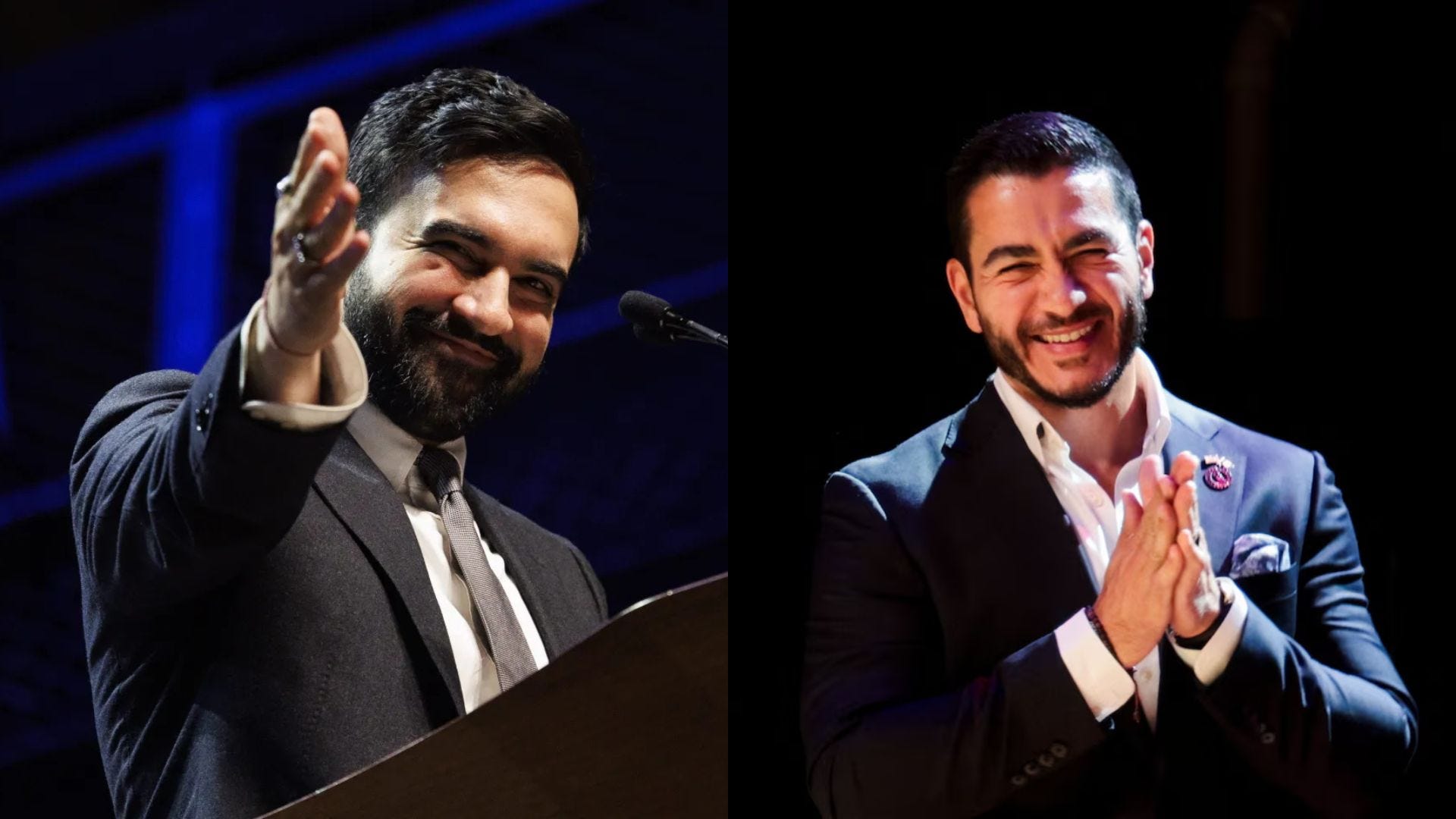
The Mamdani Coalition: A coherence of Democratic voters — young people of all races, socialists, progressives, pacifists, tenants, millennials, South Asians, Arabs, Muslims, college-graduates, “No Kings” boomers, the children of immigrants, the cost-burdened (working families, fixed-income seniors, mortgaged homeowners) — that is taking the party establishment by storm.
For the past decade, the American Left was defined by a series of profound political inroads, but a ceiling of electoral support. The movement led by Bernie Sanders and Alexandria Ocasio-Cortez, two self-identified democratic socialists, successfully elected a handful of members to Congress and dozens of state legislators. Still, Sanders ran for President twice, pushing Hillary Clinton in 2016 and Joe Biden in 2020, but fell short each time. And for every AOC, a charismatic former bartender who became an enduring and nationally popular voice, there were the cases of Jamaal Bowman or Cori Bush, elected in a flurry of anti-establishment backlash only to lose re-election shortly thereafter. Democratic socialism, and The Left more broadly, was a faction of the Democratic Party, but one with a defined coalition that could not seriously contend in larger primary races, let alone general elections.
So they said.
Then last year, Zohran Mamdani won the mayoralty of New York City, which prompted a re-examination of this coalition—and its alleged ceiling. If Mamdani could cohere a young, racially diverse, and expanded electorate, could other democratic socialists and progressives, both in New York and across the country, do the same?
The results of one election, particularly when the outcome is damning to the political establishment, can be waved away: from Mamdani’s unique intangibles (charisma, work ethic) to Andrew Cuomo’s damaging scandals. However, it is far more difficult to ignore a movement that transcends a singular avatar. And so, in Democratic primaries across the country this year, democratic socialists and their allies won open seats and felled entrenched incumbents in Philadelphia, Washington, D.C., Denver and New York City. The coalition that elevated Mamdani to City Hall — younger, multi-racial, disproportionately renter, college-educated, and furious at both Donald Trump and the Democratic establishment that kept losing to him — was transferable.
There may be only one Commie Corridor, but every large metro in America has an untapped electorate — of millennials priced out of homeownership, of families struggling to find affordable childcare, of young people disillusioned by the economy — that is increasingly drifting to the left.
Now, this coalition has successfully re-drawn the political map: first in urban and metro areas, where the Democratic base is young and diverse; then in suburbs and exurbs (commuter corridors), among older Gen-X voters who are higher-income and better-educated. And now, most importantly, across swing states like Michigan.
In Philadelphia, State Representative Chris Rabb won the Democratic primary in Pennsylvania’s Third Congressional District, rated as the bluest district in the country, with 44 percent of the vote, defeating State Senator Sharif Street and pediatric surgeon Ala Stanford. Rabb, who joined the Democratic Socialists of America and ran with the endorsements of the Working Families Party and Rep. Ocasio-Cortez, won by running up the score with younger, college-educated liberals and progressive strongholds while his opponents split the older, homeowning Black establishment vote. His campaign’s coalition knocked, by its own count, roughly 120,000 doors. In Washington, D.C., Council member Janeese Lewis George, another democratic socialist, won the mayoral primary with 53 percent of the vote — the most commanding showing in a District of Columbia mayoral race in a generation. The ward where Lewis George performed best was the city’s youngest, and two-thirds renters; her worst was the wealthiest, which also had the highest percentage of homeowners.
In New York City, one year after Mamdani’s triumph, his movement swept without him on the ballot. Claire Valdez, an organizer with the United Auto Workers and NYC-DSA member, won New York’s Seventh Congressional District — the heart of the Commie Corridor — by a twenty-point margin over Brooklyn Borough President Antonio Reynoso, a well-respected progressive born-and-raised in the district. In Upper Manhattan and the Bronx, in the Thirteenth Congressional District, Darializa Avila Chevalier, a 32-year-old community organizer, ousted Representative Adriano Espaillat, the chair of the Congressional Hispanic Caucus and dean of Dominican politics, by four points. And a week later in Denver, Melat Kiros, a 29-year-old democratic socialist endorsed by Sanders, defeated Rep. Diana DeGette, who had held the seat since 1997 — the year Kiros was born.
What instructs most is their voter coalitions, and how the movement once led solely by Bernie Sanders has quietly made remarkable gains over a decade.
Age is the most important variable.
The spine of The Left is the millennial generation, those roughly between the ages of 30 and 45. Millennial voters are old enough to remember the Iraq War escalation of the early 2000’s, while many entered the workforce in the wreckage of the 2008 economic crash. They earnestly believed in the promise of Barack Obama and felt disillusioned by his institutional limits, before rekindling that inspiration later through Bernie Sanders’ Presidential campaigns; which, when combined with the chaos of the Trump era, hardened their distrust of the political establishment and its attendant institutions. In today’s economy, age oftentimes reflects housing: younger people, particularly in urban areas, are more likely to be renters. And renters are the front line of The Left coalition because they are the front line of the affordability crisis.
While many of these candidates embraced the democratic socialist mantra, each ran an affirmative campaign centered on the costs of living message that has defined the post-Mamdani political era. Both Kiros and Rabb enthusiastically campaigned on Medicare for All, a longstanding staple of the Sanders movement; Lewis George, like Mamdani, focused her campaign on urban un-affordability, from housing to childcare; Avila Chevalier’s slogan was “fund babies, not bombs.” The core of their messages did not change from one city to another because the underlying plight, an economy squeezing the next generation of Americans, was universal. Nor is it a coincidence that, according to Urban Stats, which compiles Census information, CO-01 ranks in the 99th percentile for millennials (4th nationally), NY-13 ranks in the 99th percentile for renters (1st nationally), and NY-07 ranks in the 99th percentile for both.
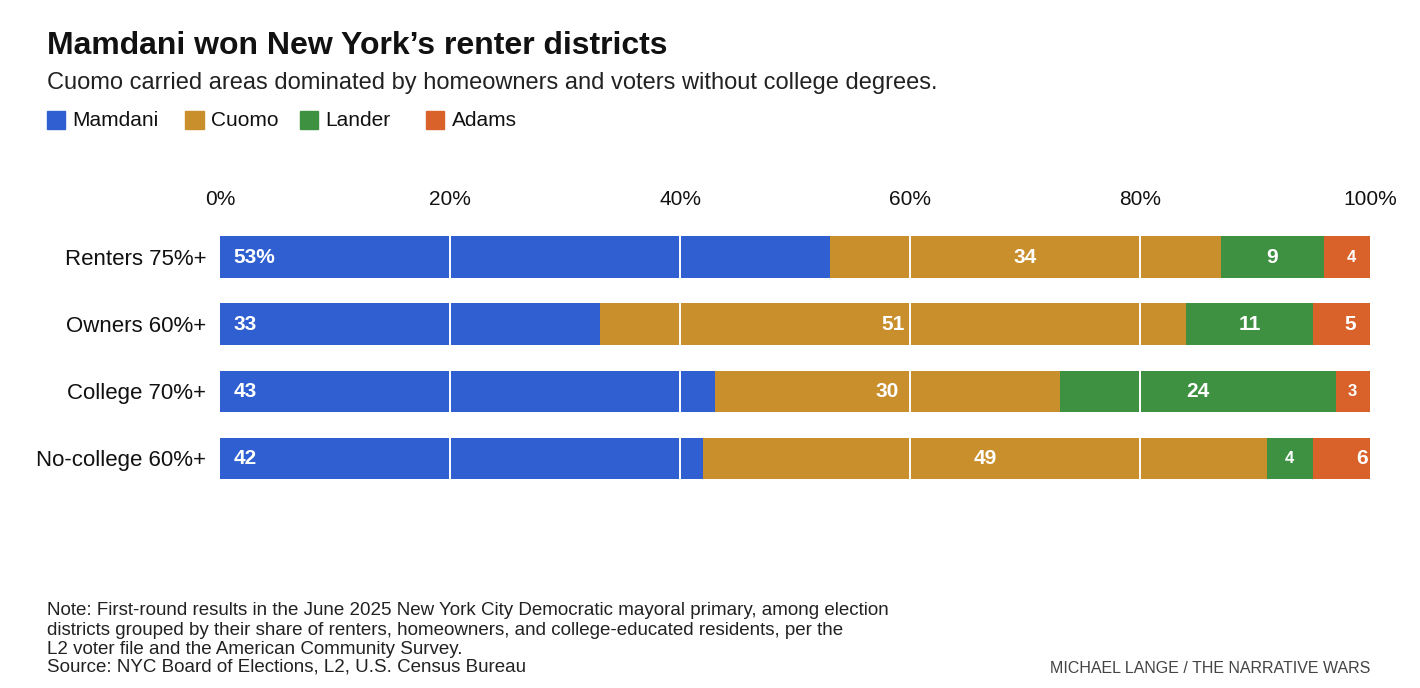
There is also education, and here the realignment is the starkest. College-educated voters, the demographic drifting most decisively towards Democrats over the past decade, are also the voters least tethered to the old party; rarely moved by an institutional endorsement, even from a popular Governor. In each contest, democratic socialist insurgents performed better in more white-collar, college-educated precincts, while the incumbents did better in more blue-collar neighborhoods.
And then there is the moral issue where the establishment has failed: Gaza. A litmus test for authenticity that has become a searing indictment of Democratic leadership. Espaillat, whose top organizational donor was AIPAC, was repeatedly hammered by Avila Chevalier for his deference to the pro-Israel lobby. Reynoso ran on “ending the genocide,” but had never used the term prior to launching his campaign, which Valdez highlighted repeatedly, to great effect. Rabb’s opponent, Ala Stanford, stumbled over the word and likened its use to a racial slur. The candidates who spoke plainly, and had a track record dating back to when the political conditions were less favorable to the Palestinian plight, were rewarded by an electorate for whom the war in Gaza has become a barometer of character and trust; a dynamic reminiscent of how the Vietnam War split the Democratic Party in the sixties.
The great irony is that, ten years ago, Bernie Sanders was weakest where his movement heirs are strongest. Across urban centers, Hillary Clinton crushed Sanders, whose coalition, by contrast, was built on whiter, more rural counties and college towns. The self-described democratic socialist won West Virginia and Upstate New York but lost San Francisco and Brooklyn. And a decade later, this political geography has inverted. The Squad of Trump 1.0 (AOC, Rashida Tlaib, Ilhan Omar, Ayanna Pressley) and the incoming DSA class of Trump 2.0 (Rabb, Valdez, Avila Chevalier, Kiros, Donavan McKinney) all hail from major cities. The urban middle class, once the establishment’s firewall, has become the vanguard of The Left.
So what’s changed?
A decade of demographic churn and institutional decline has accelerated this realignment. The neighborhoods that anchor the burgeoning leftist movement have grown younger and more educated with each passing year. In Astoria, once a stronghold of immigrants from Greece and Italy, older and more conservative white ethnic voters have aged out of the electorate, decamped for suburbia, or realigned towards the Republican Party. Puerto Ricans in North Brooklyn and Dominican-Americans in Upper Manhattan have followed a similar arc. And the local institutions — political clubs, unions, non-profits — built on their backs, swiftly faltered. As the establishment atrophied, The Left built their own organizations in the ashes of the Trump era.
By the time Claire Valdez was elected to Congress, NYC-DSA had spent a decade knocking on doors across the district she inherited, building up the capacity that allowed her campaign to reach out to every Democrat in the Seventh District, leaving Antonio Reynoso — a surefire winner of the seat even five years ago — on the wrong side of the political curve. Similarly, the proof of concept for Darializa Avila Chevalier’s path to victory was the twenty-point advantage won by Mamdani in the Thirteenth District the year prior. Adriano Espaillat came of age in an era of ethnic rivalries, but never adapted his worldview even as the demographics of his district changed beneath him. The ten-year incumbent failed to make inroads with his district’s Black voters, which cost him dearly on Election Day. But beyond demographic or institutional transitions, The Left’s coalition has increased organically.
This notion runs counter to the talking points the Democratic Party establishment pushed in the days after the socialists swept. New York Attorney General Letitia James told CNN the victors simply “do not understand the politics of New York City.” House Minority Leader Hakeem Jeffries waved away the losses, saying it was nothing more than a handful of “higher-income” districts. But the notion that these were transplant-only campaigns collapsed on contact with the election returns. In New York City, the DSA coalition was stratified less by race than by age and housing tenure. Avila Chevalier won Black voters against a ten-year incumbent, carrying younger Black voters decisively and fighting Espaillat to a draw among older ones, according to my analysis. Valdez won Hispanic-majority precincts by nearly twenty points, against a native son of the neighborhood no less. In Denver, Kiros also performed well in the city’s Hispanic precincts. In Philadelphia, Rabb was stronger with younger renters and weaker with older homeowners, a pattern repeated by Lewis George in Washington, D.C.
But it is not only millennials, renters, and urbanites who are disillusioned by Gaza, feeling the affordability crunch, and eager to shake up the Democratic Party. In New Jersey, progressive organizer Analilia Mejia, backed by Sanders and Ocasio-Cortez, won a closely contested primary in April to fill Governor Mikie Sherrill’s vacated House district. Months later, Adam Hamawy, a plastic surgeon and Army veteran who treated the wounded in Gaza, won an open Democratic primary in the adjacent congressional district. Among the older suburban counties where Hillary Clinton once ran up her largest margins against Bernie Sanders, The Left won twice by raising their floor with a national message — Medicare for All, ICE abolition, Israel’s genocide — against ill-equipped local candidates and a poorly consolidated establishment.
Collectively, these inroads and advances foreshadowed the results of the Democratic primary for U.S. Senate in Michigan, between Abdul El-Sayed and Rep. Haley Stevens. El-Sayed, 41, a Rhodes Scholar, son of Egyptian immigrants, and Wayne County’s former health director, was endorsed by Sanders, Ocasio-Cortez, and the United Auto Workers. Stevens, 43, is a four-term congresswoman from Oakland County, and was enthusiastically backed by Chuck Schumer, retiring Senator Gary Peters, and popular Governor Gretchen Whitmer. A third candidate, liberal State Senator Mallory McMorrow, briefly made headway in the polls as a “goldilocks” candidate, only to be short-squeezed by El-Sayed on her left and Stevens on her right; a similar dynamic to the one that befell Brad Lander, who was caught between Mamdani and Cuomo (McMorrow’s campaign, which initially built momentum, never recovered from attacking El-Sayed for hosting a rally with Hasan Piker).
No issue animated the Democratic electorate in the Wolverine State quite like Israel–Palestine. El-Sayed called Israel’s war in Gaza a genocide and pledged to halt U.S. military aid; while Stevens, infamously, declared at an event that “Israel comes to me in my dreams.” AIPAC’s election arm, the United Democracy Project, spent more than $30 million in an effort to save Stevens (who received $60M+ total from IEs), their largest single-race investment ever. (In 2022, UDP spent more than $3.7 million to help Stevens beat Andy Levin, a Jewish progressive and synagogue president, who was critical of AIPAC and Benjamin Netanyahu.) Despite being outspent by an 11:1 margin, El-Sayed scandalized the spending, and the electorate agreed: a Data for Progress poll found 64 percent of likely Democratic primary voters are less likely to support a candidate who takes AIPAC money; while only 10 percent said more likely.
Comparisons of Abdul El-Sayed to Zohran Mamdani are inevitable, and the surface similarities are almost too neat: both are young, handsome, charismatic Muslim leftists with affordability-focused messages and disciplined three-part slogans. The crowds at Mamdani’s canvasses and rallies chanted about sewer socialism (“We’re gonna freeze the… rent! Make buses fast and… free! Tax the rich to fund universal… childcare!”), while the call and response from El-Sayed’s audiences (“Money out of … politics! Money in your … pocket! Medicare for … all!”) represents a nationalized remix. In the vertical video era, no candidate has come closer to matching Mamdani’s prowess than El-Sayed. But the subtle differences matter just as much. Mamdani is a dues-paying democratic socialist, who has repeatedly called NYC-DSA his “political home”; El-Sayed rejects the socialist label (telling The New Yorker he is a “capitalist”), instead running as an economic populist. Whereas the Mayor of New York City is never seen without a suit, the Democratic nominee in Michigan much prefers a black V-neck with jeans. (One of them can also bench press a lot more than the other.)
But the most important throughline is The Coalition.
Abdul El-Sayed prevailed by one point; a margin of victory of less than 15,000 votes from more than 1.5 million ballots cast. His coalition was the culmination of fourteen months of gains for The Left, and every bloc was needed. Subtract any piece of the Mamdani coalition, and Stevens is the Democratic nominee.
El-Sayed won both Washtenaw and Kent Counties with more than 60 percent of the vote, buoyed by a 31-point advantage in the city of Ann Arbor (home to the University of Michigan) and a 43-point lead in the city of Grand Rapids (which ranks in the 90th percentile nationwide for millennials). Kalamazoo and Lansing (both ~50% renters), among the youngest cities in the state, also delivered pronounced margins to El-Sayed, who won all five counties home to large universities easily; dominating with college-educated voters, as was the case for Mamdani, Rabb, Valdez, and Kiros.
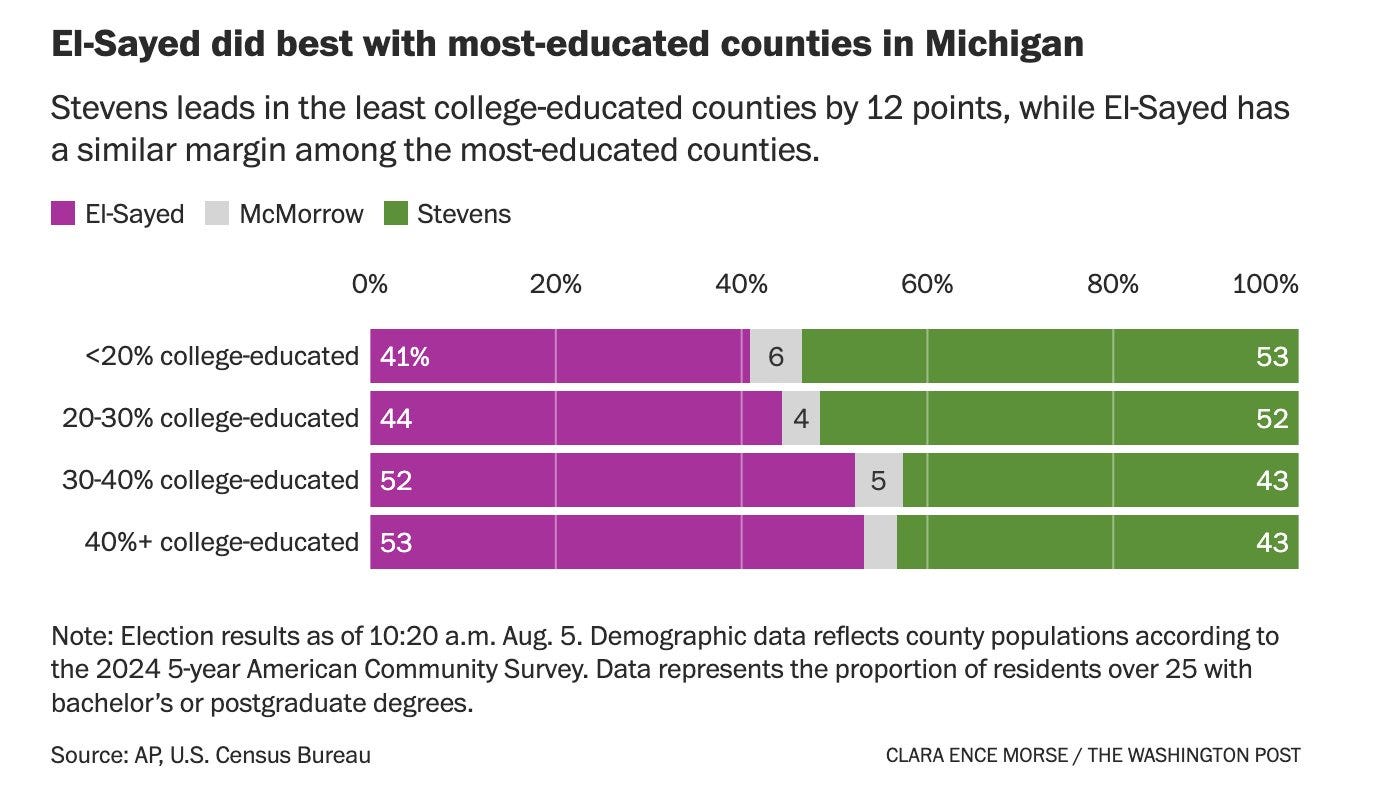
In Dearborn, Dearborn Heights, and Hamtramck — the birthplace of the 2024 “Uncommitted” movement and heart of Arab America — El-Sayed was untouchable, with turnout increasing 30% compared to the 2020 Presidential primary. The lone Dearborn precinct carried by Stevens was a retirement village, which once again reinforces age as the dominant fault line. Collectively, these three cities accounted for the entirety of El-Sayed’s margin of victory.
Stevens won Detroit by 28 points, dominating among older Black voters — the same generational stratification that Mamdani encountered in New York City; only Detroit’s electorate skews far older (and lower-income) than Harlem or Central Brooklyn, hence the wider deficit. A similar story played out in Flint and Saginaw, also home to an older, lower-income Black electorate. Nonetheless, while El-Sayed lost each of Wayne (Detroit), Genesee (Flint), and Saginaw counties, he performed far better than Sanders did in 2020, arguably the most important factor in his victory. (El-Sayed lost Wayne by 6 points, Sanders lost by 19 points; El-Sayed lost Genesee by 13 points, Sanders lost by 26 points; El-Sayed lost Saginaw by 18 points, Sanders lost by 30 points). The Michigan Senate primary marks the third high-profile race in the past year (New York City mayoral primary, Texas Senate primary) where Black voters (and the Black political establishment), once a prerequisite to victory in large-scale Democratic primaries, broke decisively for the losing candidate.
These modest but decisive beachheads in Black cities, when combined with a healthy performance in the inner suburbs of Detroit (instrumental to Donavan McKinney’s defeat of Rep. Shri Thanedar) and medium-sized cities, helped El-Sayed stave off a Stevens surge in Michigan’s rural counties, the product of an open primary and an eleven-to-one spending advantage. While AIPAC’s support was a net negative for Stevens, their ability to saturate the state’s less-expensive media markets to reach more isolated rural voters (and motivate Republicans to cross over) was effective in narrowing the contest.
All told, El-Sayed became the first Democrat to win statewide in Michigan without carrying Wayne, Oakland, or Macomb since Bernie Sanders in 2016. Yet, many of the counties where El-Sayed struggled the most were where Sanders performed best ten years ago (largely a byproduct of white working-class backlash to Hillary Clinton).
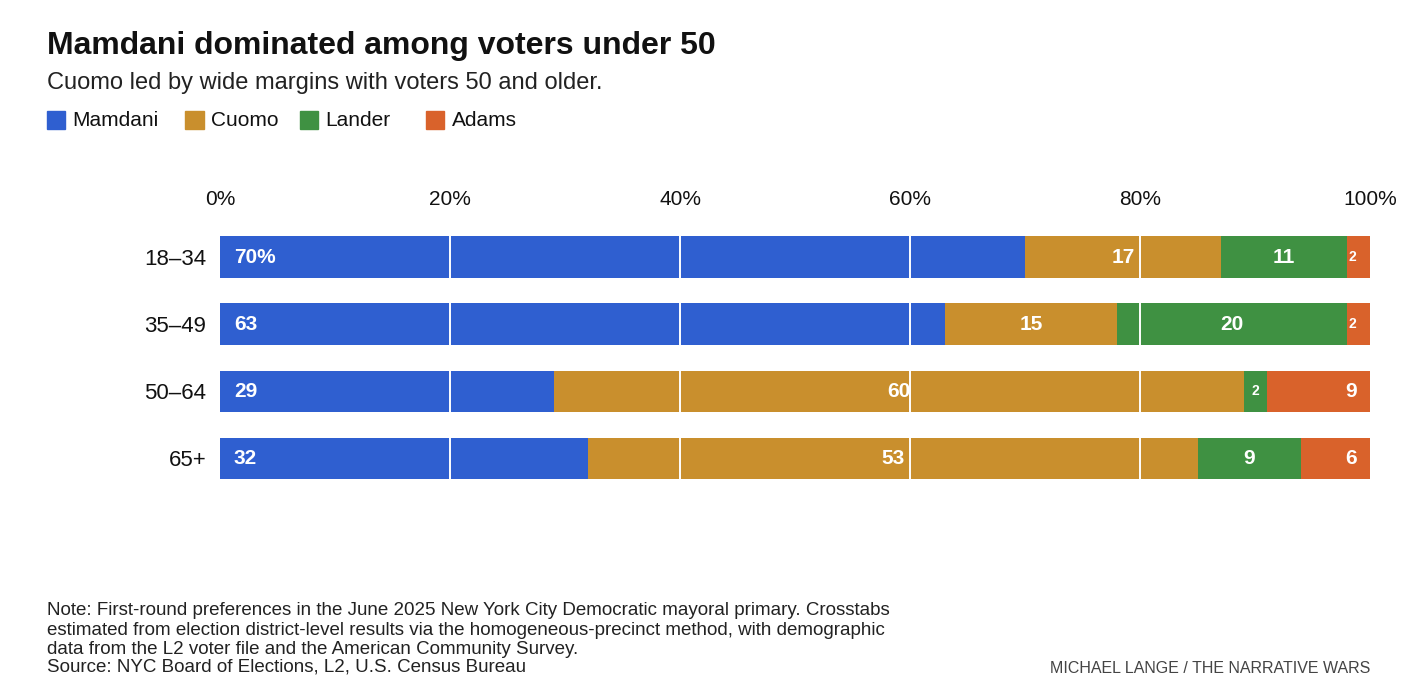
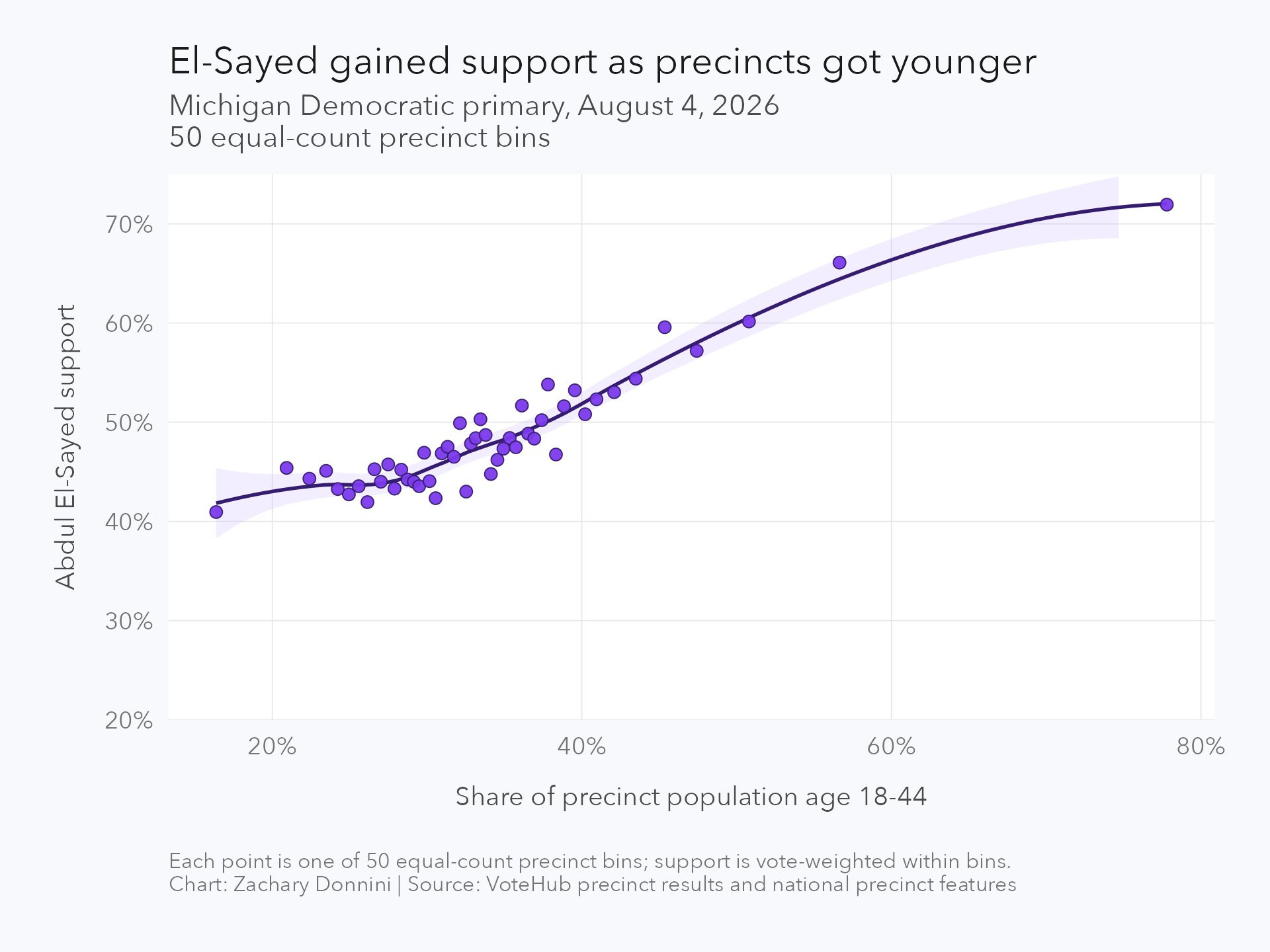
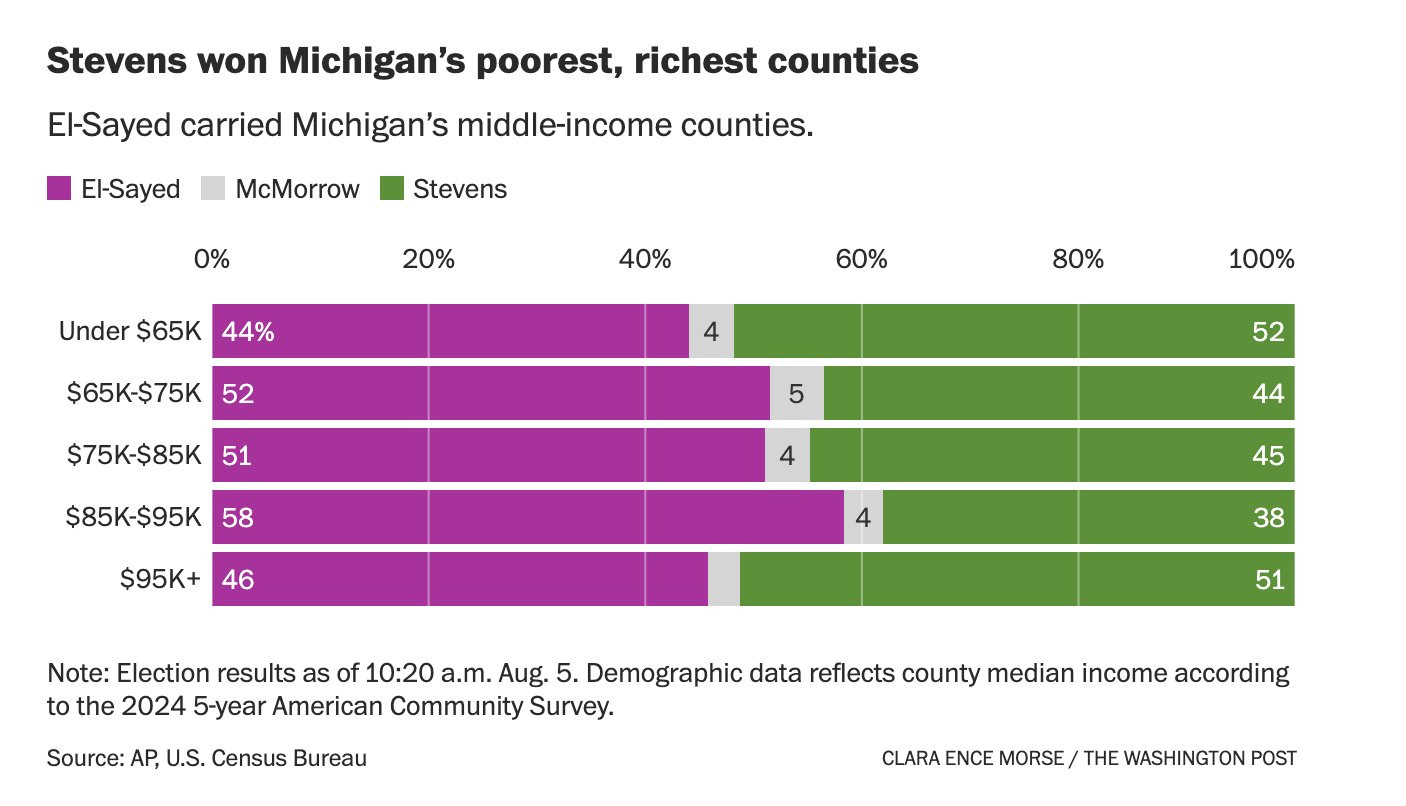
Nonetheless, the progressive populist doctor offset these losses with gains in urban and suburban counties — something Sanders, whose rural margins regressed against Joe Biden, failed to do in 2020. Thus, the map drawn by El-Sayed is more akin to an adapted Mamdani coalition than a redux of either Sanders campaign. According to analysis from Ence Morse of The Washington Post, Stevens won Michigan’s wealthiest and poorest counties, while El-Sayed performed better in “middle-income” counties; reminiscent of Mamdani’s “Coalition of the In-Between.” While what constitutes “middle-class” in Michigan is different from New York City, the top and bottom income earners, in coalition against the middle, is an important political pattern that dates back decades. Age, once again, was “the clearest dividing line in vote choice” per VoteHub data scientist Zachary Donnini. El-Sayed also expanded the electorate — both in support of, and in opposition to, his candidacy; the 2026 Senate primary drew over 1.5 million votes, on par with the 2020 Presidential primary.
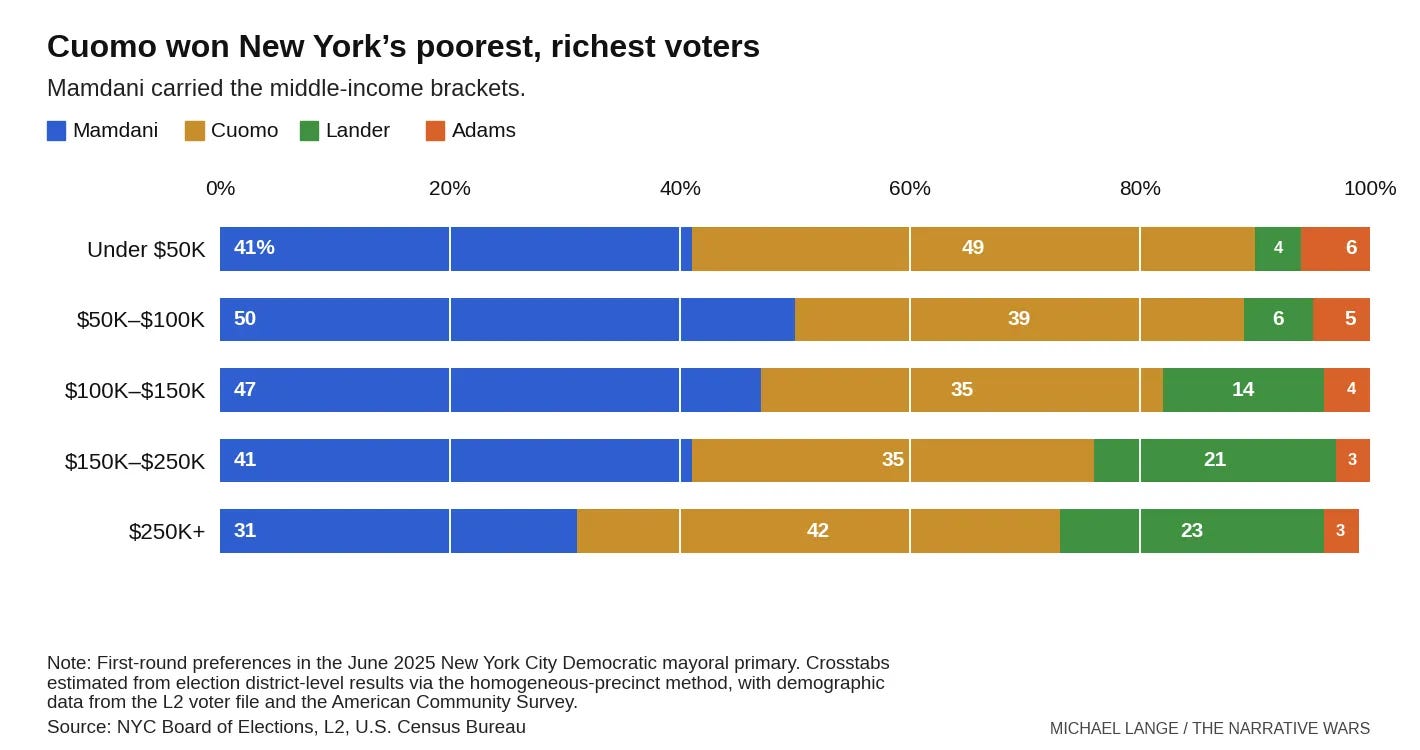
The closely contested results in Michigan, recently tapped as the all-important fifth early state in the 2028 Presidential primary calendar, land another blow to a reeling party establishment already fighting for its political life. One by one, the arguments used by the Democratic establishment to discredit and diminish The Left, from identity politics to “how will they pay for that,” have eroded entirely or lost salience with the electorate. The final narrative war, instrumental in elevating Joe Biden over Bernie Sanders in 2020, is electability. Which is why the future of this political project is so intensely leveraged on the outcome of El-Sayed’s election on November 3rd.
Win, and the notion that The Left can only succeed in deep-blue urban areas is upended at the most opportune time. If Abdul El-Sayed can overcome the impending nine-figure deluge and shift the narrative ahead of 2028, he will find himself standing alongside Zohran Mamdani, Alexandria Ocasio-Cortez, and Bernie Sanders at the next rally, wherever it may be: the past, present, and future of The Left sharing a stage. Lose, amidst a favorable national environment, and the gains from the past year will be discredited by those who have no other argument left to wield.
Michigan’s other Democratic Senator, Elissa Slotkin, a former CIA operative turned darling of the moderate establishment, often says that “what works on the coasts does not automatically work in Michigan.” But on Tuesday night, it did. While the spark was lit in New York City, this is no longer a five borough phenomenon.
Connect With Me:
Follow me on Twitter @MichaelLangeNYC
Email me at Michael.James.Lange@gmail.com
Powerhouse piece.
🧑🚀🔫🧑🚀 always has been