

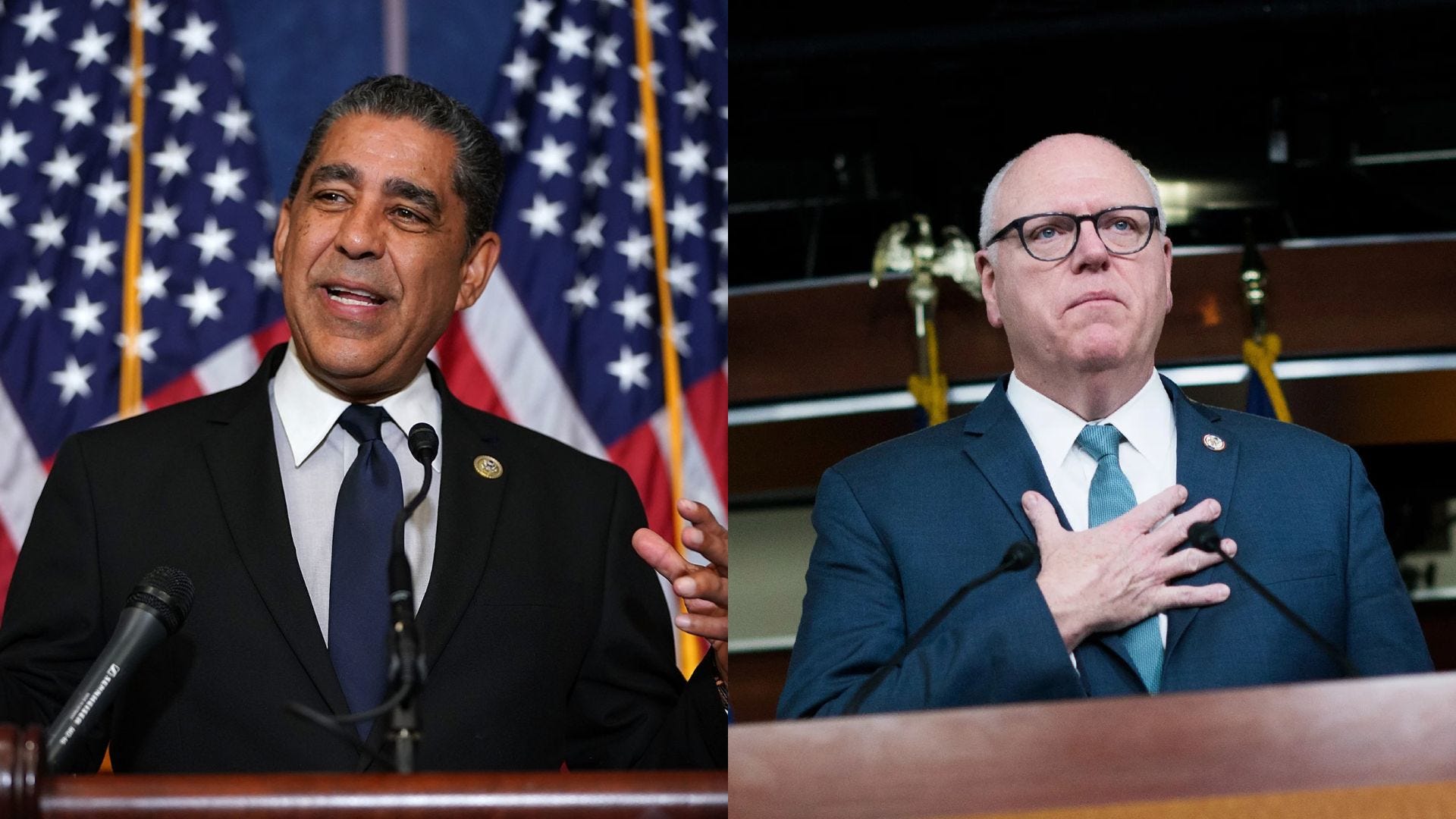
Most moments in political campaigns are fleeting, and ultimately lost to history.
But every so often, one breaks through the noise to stand the test of time: a perfect encapsulation of the present conditions that endures to become something greater than the campaign itself.
Such was the case, famously, in the least likely of settings: a half-empty parish hall in the Bronx on a sweltering evening in June 2018. There, a twenty-eight year old bartender debated an empty chair, left for Congressman Joe Crowley.
Crowley’s resume had created an aura of invincibility. In Washington, he was the fourth ranking House Democrat, destined to inherit the Speaker’s gavel from Nancy Pelosi. Back home, he was the mythical “King of Queens,” who reigned over the infamous machine that ruled the World’s Borough with a clenched fist. Crowley controlled the lawyers tasked with policing access to the ballot, and appointed the judges who ruled on those cases. He handpicked the leader of the City Council, armed with a rolodex where every labor leader and elected official was on speed dial.
He was the boss. Less Bruce Springsteen, more Richard Daley.
But all this power had made Joe Crowley quite complacent. On this fateful evening, Crowley had dispatched a surrogate, Annabel Palma, a former Council Member once ranked among the city’s worst, to a debate hosted by The Parkchester Times. This was actually considered an improvement; for Crowley had skipped the previous debate, leaving a literal empty chair in his place. Somehow, this was even worse.
Palma did little more than read the incumbent’s resume into the record; a laundry list of “accomplishments,” offered in place of the man himself; for Joe Crowley, like many a representative before him, had traded the concrete jungle for the sprawling D.C. suburbs. His district, once the fictional home of Archie Bunker and the white-ethnic working class, was now plurality Hispanic; but Crowley could not be bothered to learn even the most basic Spanish phrases. With each minute, the restless audience grew more and more frustrated with their Representative, who was nowhere to be found.
Alexandria Ocasio-Cortez cut a sharp contrast with the absentee incumbent. She was young and progressive, energetic and unapologetic, and always on the offensive. Ocasio-Cortez, never one to let a gift go unopened, slammed the incumbent for sending “a woman with a slight resemblance to me.” With a single tweet, the woman who would soon become known as A-O-C, turned Joe Crowley’s smugness into a referendum on his leadership. The New York Times Editorial Board publicly rebuked Crowley, asking on behalf of the district’s voters, “what are we, chopped liver?”
This moment, powerful and symbolic, was later immortalized by Knock Down The House. For it was less a gaffe, and more a diagnosis. Crowley’s complacency was not incidental to his defeat. The complacency was the defeat: a multi-year forfeiture of the relationship between an incumbent and his district, expressed in the most legible gesture available to a politician: not even bothering to show up.
In the wake of Crowley’s stunning defeat, incumbent Democrats around the country took notice. They would show up more, even if the underlying intent was self-serving.
No one wanted to be The Next Joe Crowley.
But perhaps those crucial lessons have faded over time.
Thus, imagine my bewilderment when, upon attending a local Democratic club forum in Morningside Heights — a neighborhood where the race for New York’s 13th Congressional District will be won or lost — I found that Adriano Espaillat, the five-term incumbent with his own aura of invincibility, was nowhere to be found. This was in February, early on in the campaign season. Nonetheless, Espaillat’s absence was notable, given he was on the receiving end of a rigorous challenge from Darializa Avila Chevalier, backed by both NYC-DSA and Justice Democrats. An inopportune time for an incumbent to be absent. But Adriano Espaillat was no ordinary incumbent.
He is the dean of Dominican elected officials and the first formerly undocumented immigrant to serve in Congress. An ethnic trailblazer who built the most formidable machine in Upper Manhattan, and now chairs the Congressional Hispanic Caucus.
A resume coupled with a mythos of inevitability. Sounds familiar, doesn’t it?
Reminiscent of Joe Crowley before him, Espaillat had even sent a surrogate to the forum in his place, City Council Member Shaun Abreu, whose career the legendary power broker helped build. Abreu, now the Majority Leader of the City Council, stood before the club — an audience of older liberals and progressives (many of whom are Jewish), the very constituency Espaillat needs to relentlessly court ahead of June 23rd — and promptly read prepared remarks from his phone, before swiftly departing.
Suddenly, the memory of Annabel Palma and Joe Crowley came flashing back.
A surrogate reading canned talking points; the incumbent somewhere else, certain his revered machine will take care of business. And maybe it will. Adriano Espaillat has buried more bodies across Upper Manhattan than anyone would care to count.
Still, I could not help wondering:
Could it be happening again?
What Makes a Machine
Before we eulogize, it is worth being precise about what a political machine in New York City actually is. The word has morphed into an epithet — something you accuse your enemies of running — and in the process has been stripped of its meaning.
A machine is not corruption, though corruption tends to find it. A machine is not money, though money surely helps it run. A machine is, at its core, an answer to a fundamental (and recurring) problem: how do you motivate a bloc of voters to the polls in a low-turnout election, year after year, without having to re-litigate your right to their vote each time? The answer which the great machines of yore arrived at — Tammany Hall first, and then its ethnic successors — was organization blended with community. Persuading voters in the final few weeks of a campaign is futile. Rather, embed oneself in the institutions where voters are: the block association, the local parish, the union hall, the senior center. Cultivate the ten percent of registered voters who actually vote. Solve their problems (the housing-court summons, the nephew who needs a summer job) and bank the gratitude. Then, every two years, when ninety percent of the district is asleep, wake up your ten percent and win.
What makes this ethnic, in the New York City sense, is not incidental. The immigrant machine is the oldest and most durable form of local politics because it solves a secondary problem at the same time. An ethnic machine offers a newly arrived community a path into a political system that was not built for them. The machine becomes the institution that says we see you, we are you. Vote for us, the saying goes, and we will be the voice for you, the little guy, in the halls of power. The Irish embodied this better than anyone, building the most powerful machine in American history, reigning for the better part of a century. Tammany dispensed patronage to their ethnic brethren from City Hall, but the fiefdoms that followed were far more localized. The Italians and Jews opened storefronts across the Outer Boroughs. Puerto Ricans, trading San Juan for the South Bronx, and Black Americans, fleeing Jim Crow for Harlem and Bedford-Stuyvesant, cohered political power in the city’s post-war ghettos. Even a class of educated, good government professionals (nicknamed “goo-goos”) emerged as their own constituency; after dethroning Tammany Hall’s leader, Carmine De Sapio, many regulars were left asking, weren’t these reformers a machine, too? The Hart-Cellar Act of 1965, which removed Eurocentric immigration quotas, birthed a new class of immigrants from the Dominican Republic, China, and the Caribbean. Gradually, they too amassed political power. Over the following decades, these ethnic machines wrestled power from one another; less a function of political acumen than the demographic changes endemic to the five boroughs. While representation spurred upset victories, constituent services were the key to re-election. A machine, at least a well-oiled one, was not merely a vote-extraction operation, but a durable link, oftentimes the only link, between overlooked ethnic communities and political power.
But power built on a single, cohesive, arriving community carries a hidden expiration date — one written into the demography itself. This is the part, inherent to New York City, that nobody likes to say out loud. But that is what our story is ultimately about.
In The Heights
No one in recent history has built an ethnic political machine in New York City more methodically, or from less, than Adriano Espaillat.
At nine years old, the scion of Dominican political royalty arrived in Washington Heights, the Caribbean island’s conduit in Upper Manhattan. His family overstayed their tourist visa, eventually becoming green card holders; (Espaillat is the first formerly undocumented member of Congress). An aspiring politico, Espaillat embedded himself in local institutions: serving on the community board, leading the police precinct council, advising Governor Mario Cuomo on Dominican issues, plus a gamut of nonprofit work: legal services, conflict resolution, victims’ services. After unsuccessful runs for City Council and State Assembly, his breakthrough came in 1996, as Espaillat dethroned sixteen-term incumbent John Murtaugh. Murtaugh, the last remaining Celtic pol in the area, had represented Inwood and Washington Heights since they were predominantly Irish and Jewish; but by the end of the 20th century, Murtaugh’s district had become 80% Hispanic, and majority Dominican. When he ran out of money, Espaillat, sensing this was his best chance at elected office, sold his car to keep campaigning. The gambit worked, as Espaillat won by 401 votes; a margin now etched in the folklore of Upper Manhattan politics. From there he never stopped running, making an ill-fated play for Manhattan Borough President before eventually ascending to the State Senate. But the crown jewel was always Congress.
There would be no amicable changing of the guard. For roughly seven decades, the Congressional seat in Upper Manhattan had only changed hands once: beginning with Adam Clayton Powell Jr., the firebrand who chaired the House Education and Labor Committee and was, for a time, the most powerful Black member of Congress; followed by Charlie Rangel, who unseated Powell in 1971, co-founded the Congressional Black Caucus, and became the Dean of the New York delegation. Harlem, and this seat, was the capital of Black political power in America, and the local establishment did not regard a Dominican insurgent from Uptown as its natural heir. Thus, when Espaillat challenged the aging Rangel — in 2012, and again in 2014 — the contest was not so much haunted by race as openly conducted on its terms.
The arithmetic beneath the bitterness stemmed from New York’s 2012 Congressional redistricting, which increased the percentage of Hispanic residents in NY-13: a burgeoning population of Dominican immigrants pitted against a Black institution overnight. Rangel survived both contests: the first round by fewer than one thousand votes, the rematch by fewer than two thousand. Each time Rangel netted a supermajority of the Black vote while Espaillat won a supermajority of the Hispanic vote: a pronounced ethnic cleavage as old as the five boroughs themselves. Rangel, cornered in a debate, said the quiet part out loud, that Espaillat “wants to be the Jackie Robinson of the Dominicans in the Congress,” and ought to tell voters “just what the heck he has done besides saying he’s a Dominican.” Espaillat’s allies, for their part, accused Rangel of running a “tale of two Harlems,” lavishing Central Harlem’s Black institutions with empowerment-zone money while starving Hispanic East Harlem and Washington Heights of funds. In 2012, critics charged that Espaillat leaned too hard into ethnic pride; to the point where in 2014 he conspicuously tried to downplay it: “ethnic pride has its place,” he conceded, “but when your rent goes up, it doesn’t matter whether you’re Latino or Black or White.” Still, he lost each time. The Dominican first framing that galvanized Washington Heights had alienated the broader Black, Puerto Rican, and White voters he needed to earn a majority.
Did Adriano Espaillat learn this lesson? As it turned out, he never needed to.
It all came to a head in the 2016 Democratic Primary, as Espaillat faced promotion or his third consecutive rejection. Rangel had finally retired, and Espaillat was no longer facing an institution. Nevertheless, the Lion of Lenox Avenue endorsed Harlem’s own Keith Wright as his chosen successor. While the race would narrow to Espaillat versus Wright, the field of other candidates arguably determined the outcome. In a battle of turnout between Black and Hispanic voters, the four Black candidates outpaced the two Hispanic candidates 56% to 42%. Nonetheless, Espaillat squeaked by head-to-head against Wright (35.9% to 34.1%), another racially polarized result. Wright, and Harlem’s Black establishment, did not concede graciously, demanding a recount of absentee ballots while the celebrations had already begun farther Uptown.
Of his three consecutive runs for Congress, Espaillat won both his lowest vote share and lowest vote total, in 2016. Not only had he failed to grow his coalition, he watched it diminish. For the first time in seventy years, Harlem would not have an African American representative in Washington. One community leader compared Espaillat’s victory to Neil Armstrong walking on the moon; others decried the changing of the guard as a hostile takeover. In a district both Hispanics and African Americans had to share, these resentments did not evaporate with the result; they merely went dormant.
The Franchise
Promptly, Adriano Espaillat did what political machines do best: he franchised.
Jeff Coltin chronicled the result for City & State, and gave it a name that stuck — the Squadriano, a loose-but-durable network of younger, mostly Dominican-American officials Espaillat has cultivated, funded, and elevated across Upper Manhattan and the West Bronx: Carmen De La Rosa, Shaun Abreu, Oswald Feliz, Pierina Sanchez, Manny De Los Santos, George Alvarez. Six candidates in fifteen months, by Coltin’s count, all Dominican-American, all in districts overlapping Espaillat’s own. They meet for strategy sessions, share a text thread, and hire the same consultants. Ritchie Torres, an ally, hailed his House colleague for building “a turnout machine the likes of which have rarely been seen in New York City politics.” After steering a successful slate of City Council candidates, Espaillat’s legend peaked in June of 2022. During that primary election, only one candidate in all of New York City unseated an incumbent; an honor bestowed, not to insurgent an leftist endorsed by NYC-DSA or the Working Families Party, but George Alvarez, previously a little known perennial candidate who was promptly carried to victory by the full breadth of the Espaillat machine, defeating Jose Rivera, a longtime Puerto Rican incumbent. Overnight, the kingmaker reputation, percolating in the background, was burnished.
This was, in the words of Bill Simmons, Adriano Espaillat’s “Apex Mountain.”
If this was the height of the Espaillat mythology, the following years exposed several, subtle cracks. The “Squadriano,” once cohesive, slowly frayed. When Carmen De La Rosa ran for City Council Speaker, Espaillat eschewed the Dominican solidarity he routinely champions in public, and instead backed Julie Menin, a wealthy white woman who represents the Upper East Side. When Pierina Sanchez, a progressive Council Member from the West Bronx, faced a serious challenge from Fernando Cabrera, the conservative pastor who formerly represented her district, Espaillat did not lift a finger, let alone return a phone call. When Espaillat convened a mayoral forum in Washington Heights last year, he promised the audience this would “be one of many public conversations.” Some of his alleged allies, out of earshot of the Congressman while he worked the room, grumbled that the entire affair was a farce, that the Dominican power broker had already decided to endorse Andrew Cuomo, to their collective dismay. They were correct: there were no more public forums, only a coronation; Espaillat endorsed Cuomo shortly thereafter, only to watch the former Governor get trounced in the 13th Congressional District by Zohran Mamdani.
But the most consequential crack in his armor — should Espaillat be dethroned on June 23rd — opened four years ago, when the Congressman foolishly backed a challenger to State Senator Robert Jackson. A brief bit of background: Jackson, a progressive Black Muslim known for decades of educational advocacy, succeeded Espaillat in the State Senate when the latter was elected to Congress; in 2022, Jackson’s district was redrawn to include more Hispanic voters, namely Dominicans, closely resembling the top-third of the 13th Congressional District; Espaillat, always a foe of Jackson, aggressively supported a well-funded Dominican challenger, Angel Vasquez, to the incumbent. A glance at the Census toplines, a majority Hispanic district, coupled with six-figure independent expenditures backing Vasquez, lent credence to the narrative that Jackson was vulnerable. Instead, Jackson won by 25 points, a landslide of epic proportions. In a midterm environment, Hispanic voter turnout lagged, while Jackson ran up the score (topping 90% in some precincts) with older liberals in Inwood and Hudson Heights, the White enclaves west of Broadway. This Senate District was the heart of Espaillat’s base — Washington Heights and Inwood — and his hand-picked challenger was crushed. Fast forward four years later, and now Jackson, one of the few beloved figures remaining in local politics, is wholeheartedly backing Darializa Avila Chevalier. “RJ” may have the last laugh.
When A King Meets A Queen
Here’s what should also keep Adriano Espaillat up at night, and serve as a cold sweat-inducing reminder of the perils of forum-skipping and general absenteeism.
Joe Crowley was not, in 2018, supposed to be vulnerable. He was the “King of Queens,” whose institutional reach stretched from the World’s Borough to Washington. He was a prodigious fundraiser and an old school back-slapping retail politician, marrying the stature of D.C. leadership with the infrastructure of an Outer Borough machine. The incumbent had even avoided facing a primary challenger since 2004. Internal polls from both campaigns estimated that Crowley was ahead by between forty and fifty points. He was, by every conventional metric, safe.
And he lost, convincingly (57.5% to 42.5%), on thirteen percent voter turnout.
The Crowley autopsy reads like a checklist that someone overlooking Fort Tryon Park (and his plethora of high-priced consultants) ought to be reading very carefully right now. By 2018, Crowley’s district was majority-Hispanic and increasingly young, flush with immigrants from South America and college-educated renters. His base aged out and moved out of the district; the white-ethnic Queens of old had been thinning for years, dying off and decamping to the suburbs. Once upon a time, New York’s machines worked tirelessly to bring new immigrant populations into the political process; and this arrangement, to varying extents, was mutually beneficial to both parties. Whereas Crowley’s organization, atrophied and complacent, lacked both the vernacular and, most importantly, the will to reach out to these new voters. His D.C. colleagues were blunt. “Joe is a great guy,” reflected James Clyburn, “but I don’t think he paid enough attention to those constituents at home.”
There remains an argument about which voters did Crowley in: The Intercept credited the gentrifying precincts of Astoria and Sunnyside, while Data for Progress countered that it was due to turnout from younger voters across the board, not explicitly gentrification. Regardless, the distinction matters less than the enduring thesis which binds both arguments: an atrophying political machine optimized for a past electorate was defeated by the electorate it had stubbornly refused to learn.
Compare the past plight of Joe Crowley with the present predicament of Adriano Espaillat, and the similarities are eerie. A political machine built around a community whose share of the primary vote is no longer growing. A district transformed by an influx of younger renters. An establishment apparatus that has never learned how to reach voters beyond their sphere of influence. An incumbent who skips forums and sends a surrogate in his place. And a hungry challenger he was slow to take seriously.
Now, the only question left is whether Espaillat will suffer the same fate.
The End of Ethnic Politics
There is a key difference between the two machines worth naming explicitly, because it describes why Espaillat’s vulnerability is structural rather than merely circumstantial.
Crowley’s power, in the end, was negative. The Queens machine’s greatest strength lay not in turning people out to vote so much as in keeping opponents off the ballot: they would challenge petition signatures, appoint the judges tasked with ruling on the cases, and clear the field of all competition. Those who erred against those rules would face retaliation. One young woman from Parkchester said that challenging Crowley would be nothing short of “political suicide for anyone with a semblance of a career”. But when a challenger — in this case, the charismatic Alexandria Ocasio-Cortez — finally gained access onto the ballot, the underbelly of the machine was soft.
Espaillat’s power is the opposite: affirmative, and built painstakingly over many campaign cycles. His reputation as a power broker, much disputed, is nonetheless earned; no elected official in recent memory has ground out more difficult races than Espaillat. Compared to the paper tiger apparatus Crowley presided over, Espaillat boasts the far more impressive operation. Nonetheless, his vaunted machine is impressive at mobilizing only one community: the Hispanic (namely Dominican) vote in Upper Manhattan and the West Bronx. Three consecutive wars with Harlem’s Black establishment has trained Espaillat for that fight — but none other.
A cursory review of the Census and Espaillat appears unassailable: NY-13 is a majority-Hispanic district (52%), with Dominicans alone accounting for almost half its immigrants. A political machine that turns out Hispanic voters in Upper Manhattan would appear to be turning out a majority of the vote. But residency is not akin to citizenship, let alone who shows up at the ballot box, aka the electorate. The 2025 Democratic Primary voters in NY-13 were roughly 34% Hispanic, 30% White, and 27% Black; arguably the most racially-diverse Congressional District in New York City with no single voting bloc in command. Many pollsters expect 2026 to look similarly; for with each passing cycle, the electorate uptown gets younger and whiter. And it is those voters, not the Census toplines, that a Democratic Congressman must win.
Adriano Espaillat is favored to lose the White vote by a significant margin, from the gentrifiers of Harlem to the young families of Hudson Heights to the liberal cooperators of Inwood. He is, by the most generous reading, barely above water with Black voters, a startling weakness for any longtime Democratic incumbent, and has failed to break fifty percent overall in any public survey; a five-term Congressman struggling to hold on against a thirty-two year old insurgent with no prior name recognition. Espaillat’s machine, coalitionally narrow, can dominate a third of the electorate and still lose, because a third of the electorate is no longer enough.
Espaillat has always been a stranger to Harlem — home to over twenty percent of all voters, and the most important neighborhood in NY-13 — because it was forever the power base of his African-American opponents. East Harlem, almost fifteen percent of the electorate, has never been a point of strength, either, despite its large and diverse Hispanic population. This was true ten years ago, and it is still the case today.
But back then, he could get away with it and still win. Now, it might cost him his job.
Even his Hispanic base is moving. The Dominican voters of Upper Manhattan are following the arc of every immigrant community in New York City’s illustrious history: aging and assimilating. And, like Hispanic voters across the country, they are drifting from the Democratic Party, their vote share gradually declining each June. Latino Victory Fund, a Super PAC spending $750,000 to boost Espaillat, is hoping to reverse those trends; but they are, like Antonio Reynoso in Brooklyn, running uphill against the changing demographics of the five boroughs. A friend raised in one of NY-13’s many public housing developments described these underlying physics to me better than any consultant ever could. “A real problem for immigrant machines is that their voters really want to drive and live in a house,” he said. “A core difference about machines is: do your voters live in apartments because they want to, or live in apartments because they have to?“ The Espaillat machine was built on the second kind of voter: rooted in place not by choice, but circumstance. Now, the erstwhile Espaillat base has migrated to the Bronx, let alone Somerset County in New Jersey.
The 13th Congressional District is filling more and more, year over year, with the first kind of voter: younger renters who live in urban apartments by choice, drawn to Upper Manhattan for its relative affordability. Once dismissed as transient and indifferent, they made up the heart of the Mamdani coalition.
And soon, perhaps, that of Darializa Avila Chevalier.
Avila Chevalier embodies the other Upper Manhattan. She too is Dominican-American; a Muslim convert and encampment organizer at Columbia University. Arguably no campaign in New York City has embraced Palestine this cycle in the manner Avila Chevalier has. But can this salient issue, in the Congressional District with more renters than anywhere else in the United States, motivate a critical mass of working-class voters to the polls? Between Avila Chevalier and Espaillat, who will carry the day across the many public housing developments of East Harlem, or the Black seniors of Esplanade Gardens and Lenox Terrace in Harlem? The whims of the district’s older liberals, of Riverside Drive and Fort Washington Avenue, loom large over the outcome, too. Will they view Avila Chevalier as a campus radical lacking experience, or an inspiring woman reminiscent of another young socialist, whose name can also be shortened to a three-letter acronym? And, in this battle between the past and future of Dominican-American politics, the most important constituency will be Hispanic voters under the age of 50, a demographic Mamdani won by 40 points. Were Avila Chevalier to win Hispanic voters under-50, she would deal a fatal blow to Espaillat amongst a constituency where he can ill-afford to lose more ground.
In the first quarter of this year, Avila Chevalier was the only primary challenger to outraise a sitting member of the House of Representatives (although Espaillat still has roughly a million dollars on hand compared to her more modest quarter million). Justice Democrats, the national outfit that helped elect AOC and Jamaal Bowman, has backed her, too, announcing a $250,000 ad buy this week. The one endorsement conspicuously absent is Zohran Mamdani. Mamdani, of course, has his hands full downtown, with no shortage of aspirants clamoring for his all-important blessing. But can the Mayor still feel the pulse of the people from the bullpen of City Hall? Mamdani has an innate sense of candidate quality, and Avila Chevalier has undoubtedly run a strong race. It would be uncharacteristic of Mamdani, always one to push the bounds of socialist electoral expansion, to miss the undeniable energy pulsing through Avila Chevalier’s campaign across The Next Commie Corridor.
Which raises the question, if the ethnic political machines of yore have finally run out of road — if Adriano Espaillat is, in fact, the next Joe Crowley — then can Darializa Avila Chevalier be the next…
Connect With Me:
Follow me on Twitter @MichaelLangeNYC
Email me at Michael.James.Lange@gmail.com
Hope this is well taken, but as a regular reader I have a critique: the framing here, and in your previous articles on the NY-13 race, presents 'Black' and 'Hispanic' as totally cleaved and simple ethnic categories which can be depended on for analysis.
Rangel was not just a 'Black' institution representing a district becoming rapidly more 'Hispanic'; he was Puerto Rican, and he relied on that growing electorate to build a coalition against Powell in 1970. Espaillat's 2010s challenge and subsequent support for the "Squadriano" represented a challenge to both established African-American and Puerto Rican political power in Harlem. (You yourself mention him sponsoring the ouster of a longtime Puerto Rican rep.) You present no data around Puerto Rican voters' political behavior in that race, which feels like an oversight.
It's also impossible to talk about the challenge to Espaillat by Avila-Chevalier without discussing generational differences between Dominican-Americans and their relationship to American Blackness. Espaillat, as is typical for someone of his generation, refers to himself as a "Latino of African descent," infrequently identifies as Black because of his relative remove from African-American culture. Avila-Chevalier uses the more recent neologism "Afro-Latina," and frequently talks about her politics within the tradition of Black Radicalism in this country. This greater assimilation into American Blackness is key to the coalition-forming you discuss at the end.
As a constituent, during the NYSNA strike I called the office of Espaillat to ask why he hadn’t yet appeared at any picket lines.
His Washington Heights office said he was currently in DC and to call there for comment; his DC office said he was currently in NY-13 and to contact a district office. His Harlem office said they couldn’t “disclose his whereabouts” and accused me of “amplifying social media concerns” before promptly hanging up.
He seems famously hard to reach, at least, until you cut a check.