

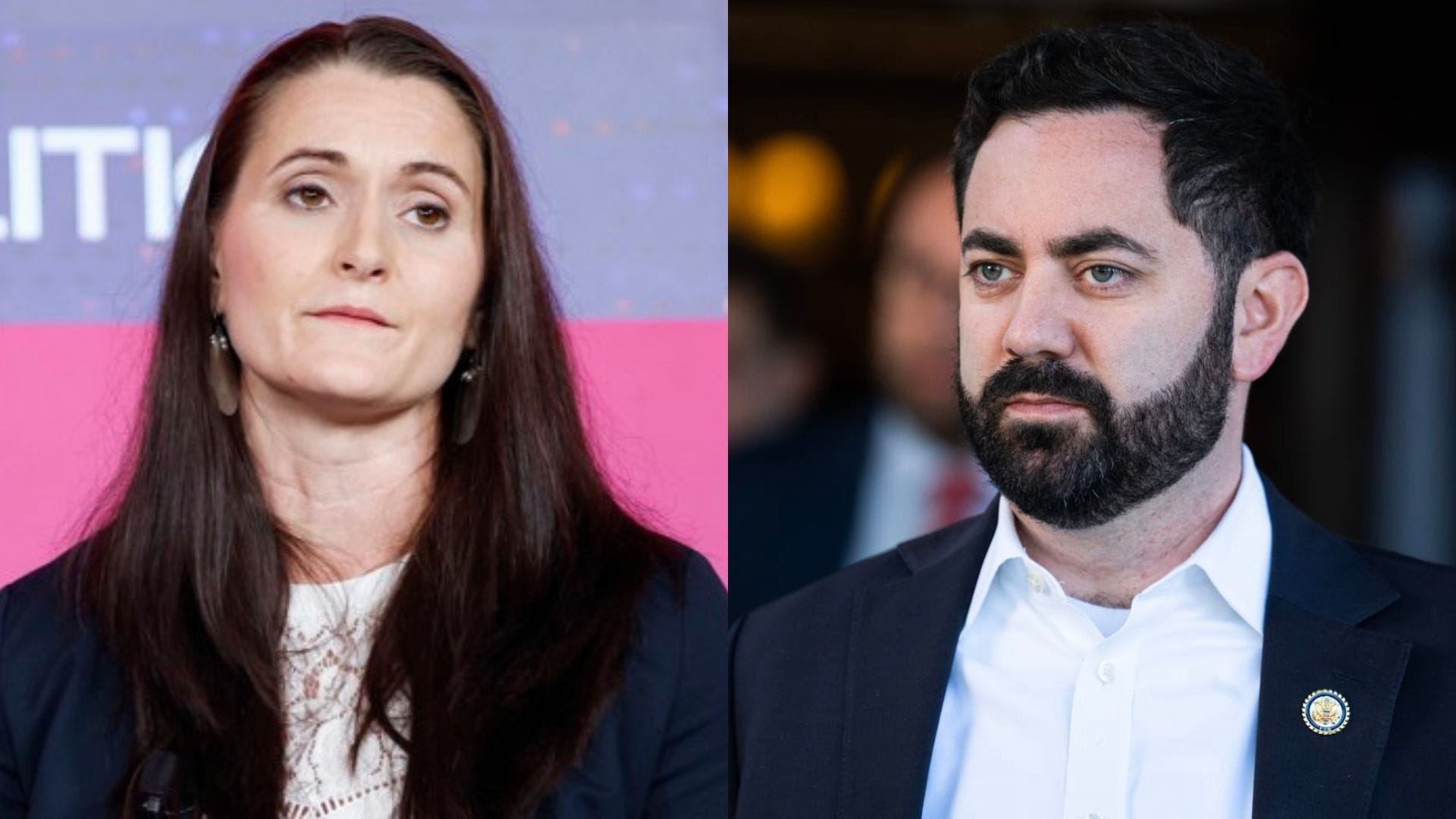
A special note of thanks to Timmy Facciola, author of the Judge Street Journal, for helping me learn the nuances of this district. Timmy has brilliantly covered NY-17 for the past year, and I encourage everyone to subscribe to his Substack.
The man walking his two dogs had not planned on interrupting the press conference down the street. He had returned from his morning stroll to find his subdued middle-class block in Rockland County lined with strangers behind television cameras. His neighbors had already come outside to observe from their respective lawns, as Hasidic men in long coats paced the sidewalk and four soldiers with automatic rifles were cloaked in a black SUV. The podium sat in a driveway beneath a maple tree with a red hue, while the cloudless blue sky framed another picturesque fall morning.
The man with the dogs got close enough to see who was behind the podium. And then, without hesitation, he began shouting: “You guys packing your bags? History is not going to be kind to you. You’re enabling that lunatic in the White House.”
Mike Lawler, the Republican incumbent representing New York’s 17th Congressional District, barely looked up. “Yup,” he responded in a monotone, “have a good day sir.”
That lunatic needs no introduction. Donald Trump has run in NY-17 three times and never won (Clinton +8, Biden +10, Harris +0.6), and currently sits at 38 percent approval in New York. And now, he is the albatross around Mike Lawler’s neck.
“Carpetbagging Cait Conley,” Lawler assailed his Democratic opponent as the cameras began rolling, with the clipped cadence of a politician who has already delivered the line hundreds of times. He read her property-tax bill (”almost $11,000” since January of last year) for Fairfax County in Virginia, before turning to the press, assembled across the blacktop, and asking, rhetorically, how much in taxes she had paid in this district. “Anyone? Anyone in the press want to answer the question?”
The answer he was looking for was zero.
The sign on the podium did not even have his name: instead, it read “VIRGINIA’S OWN CAIT CONLEY,” with a white silhouette of the Commonwealth and the letters A-I in her first name highlighted in red, a dig at her past consulting work for artificial intelligence companies. He then stepped aside, making room for Speaker of the House Mike Johnson, dressed in a dark suit and glasses. With his Louisiana drawl, Johnson opined on the national stakes of Lawler’s re-election as though he were doing a hit on Fox News. The Democrats “have taken a far leap to the left,” led blindly by the Democratic Socialists of America, the Republican Party’s newest boogeyman. They want to “take over the means of production,” Johnson lectured the crowd. “That means no more private property ownership.” He praised Lawler as his “secret weapon” in budget negotiations, integral to “the final product.” The average New Yorker, the Speaker added, had an extra $4,079 in their pocket because Lawler led the charge to raise the SALT cap in the One Big Beautiful Bill. “It’s common sense versus crazy.”
There was much talk of past accomplishments and his opponent’s vulnerabilities, but almost no mention of any affirmative vision for what lay ahead. The subtext being that on Wednesday morning, barring a miracle, Johnson will be a lame duck come January, while Lawler, if he even survives, will be relegated to the House minority.
“Everybody around America is watching this election,” Johnson closed. “Everybody.”
If nothing else, he was right about that.
Mike Lawler was born in Suffern to a family — Irish on one side, Italian on the other, Catholic on both — that had lived in Rockland County for more than a century.
Rockland County, a quasi-bellwether in the 2000s, never belonged to one political party (Bush, Obama, Obama, Clinton, Biden, Trump), and was routinely decided by no more than a couple points. The Tappan Zee Bridge opened in 1955, and middle-class expats from the Bronx — cops, firefighters, civil servants, teachers, Catholics and Jews — crossed in search of a backyard. Blue and white collar workers shared cul-de-sacs, while pensions and parochial schools sustained older generations and educated younger ones. The Rockland faithful were soon joined by the Hasidim of Brooklyn, who came up Route 59 and built the communities of Monsey, New Square, and Kaser: among the densest, fastest-growing, and reliable voting blocs outside the city.
Before he became a professional politician, Mike Lawler cut his teeth as an operative: managing Rob Astorino’s campaign for Governor, becoming an RNC convention delegate for Trump in 2016, and running his own comms shop. He loves the game of politics: the district lines and precinct maps; the back-and-forth jousts with journalists; and the thrill of not only winning, but ending your opponent’s career.
This combination of environment and enthusiasm made Mike Lawler into a nimble political athlete: relentless, unapologetic, and better in the fourth quarter than the first. He learned that, in the Trump era, a Republican who wants to win Rockland County in a General Election cannot be MAGA or moderate, but both at once.
In 2020, he ran for State Assembly against a seven-term Democratic incumbent, Ellen Jaffee. During COVID, his 76-year-old opponent could not campaign in public; while Lawler, blessed with antibodies, knocked on enough doors to flip the seat by four points. In 2022, a special master redrew New York State’s congressional map, shifting the boundaries of the Seventeenth District to include all of Rockland and Putnam counties, northern and central Westchester, and a sliver of Dutchess. Sean Patrick Maloney, the chairman of the DCCC, moved south into what was considered a comfortably Democratic seat. Lawler, having not yet completed his inaugural term in Albany, campaigned with zeal for seven months. By late October, he had secured the backing of nearly every Hasidic group in Rockland County; Bill Clinton himself brokered the single holdout, New Square, for Maloney in the final days. But it didn’t matter. Lawler won 80 percent of the Orthodox vote, and, aided by a red wave across the state, won by half a point — less than 1,800 votes — while Maloney spent election night in Washington D.C. The bloc was his margin, and he never forgot it.
In 2024, former Rep. Mondaire Jones returned home to reclaim his seat, but Lawler the operative made mincemeat of him. First, his allies in the Hasidic community flooded the Working Families Party primary, and swiped its ballot line — worth at least two percent of the vote — out from under Jones, handing it to a spoiler named Anthony Frascone. Then, Lawler mercilessly tagged Jones as a carpetbagger and buried him for past statements, issued during Woke 1.0, supporting Defunding the Police. Lawler won by six points on the same ballot Kamala Harris won by six-tenths. He won Rockland, his base, by a staggering 18-point margin.
That is the skeleton key to NY-17: blue Westchester casts around ten percent more votes than red Rockland; if Republicans run up the score on the western side of the Hudson River, they can withstand a wave from the bedroom communities along the Metro North train line. (Putnam and Dutchess are both safely Republican, but only make up one-fifth of the electorate combined). In 2024, Jones netted over 18,000 votes from Westchester, but Lawler gained almost 26,000 from Rockland. Once again, the five percent of the electorate simply known as the bloc voted 97 percent for both Trump and Lawler, supplying three-quarters of the Congressman’s margin of victory. Unsurprisingly, Split Ticket’s Wins Above Replacement metric rates Lawler as an over-performer (R+1.7 in 2022, R+3.8 in 2024) but not an electoral juggernaut.
Still, few Republicans in New York have done more with less.
But Mike Lawler has never had to answer for Donald Trump to the extent he does now. In 2022, he ran against the president — Joe Biden — in a midterm with inflation at forty-year highs and a Republican candidate for Governor with coattails (Lee Zeldin won NY-17 by four points). In 2024, he ran adjacent to the presidential election, and Jones’s warnings about “Project 2025” fell on deaf ears with the ticket-splitters who make up 30 to 40 percent of the electorate in NY-17. The difference, in 2026, is that Lawler is running with Trump, in a district where gas is over $4 and “threats to democracy” has doubled (from 10 to 23 percent) as one of voters’ top concerns. Never mind that the national environment for Republicans is verging on apocalyptic: The New York Times reported on Sunday night that Democrats lead in every battleground Senate race. If the GOP loses Kansas and Texas, how can Lawler be expected to hold a seat won by Kamala Harris in the New York suburbs?
Lawler has tried to keep one foot on each side of the fence. He votes with President Trump 94 percent of the time, including a deciding vote on the One Big Beautiful Bill. At Rockland Community College in May, Lawler welcomed Trump with open arms, the first sitting president to visit the county since Gerald Ford. This arrangement ensures the MAGA base remains behind him and the Congressional Leadership Fund continues writing checks. But the role of swing-district “moderate” occasionally calls for a fight with one’s own party. Lawler waged a public (and successful) fight with Trump to raise the SALT (state and local tax) deduction cap from $10,000 to $40,000; cast one of the six Republican votes for Temporary Protected Status (TPS) for Haitian immigrants; and occasionally rebukes the far-right fringes of his caucus. “The president and I don’t always agree,” he told the audience at the Republican midterm convention, “and that’s okay.” Lawler, much like one of his former opponents at the poker table in Albany, places a premium on deliverism. Across the Seventeenth District, one of the most common lawn signs reads, “Thank You Mike Lawler for SALT.” The deduction will save the average itemizer in NY-17 — which includes many of the ZIP codes with the nation’s highest property taxes — several thousands of dollars.
Yet, his net favorability has fallen from +10 to -1 in the past two years, while the share of Democrats crossing party lines to vote for him has dropped from 20 percent to 12.
And these are the voters — the thousands who cast ballots for both Harris and Lawler last time, now balancing fatigue with Trump and gratitude for SALT, and wavering between resistance and relationship — poised to decide this election.