

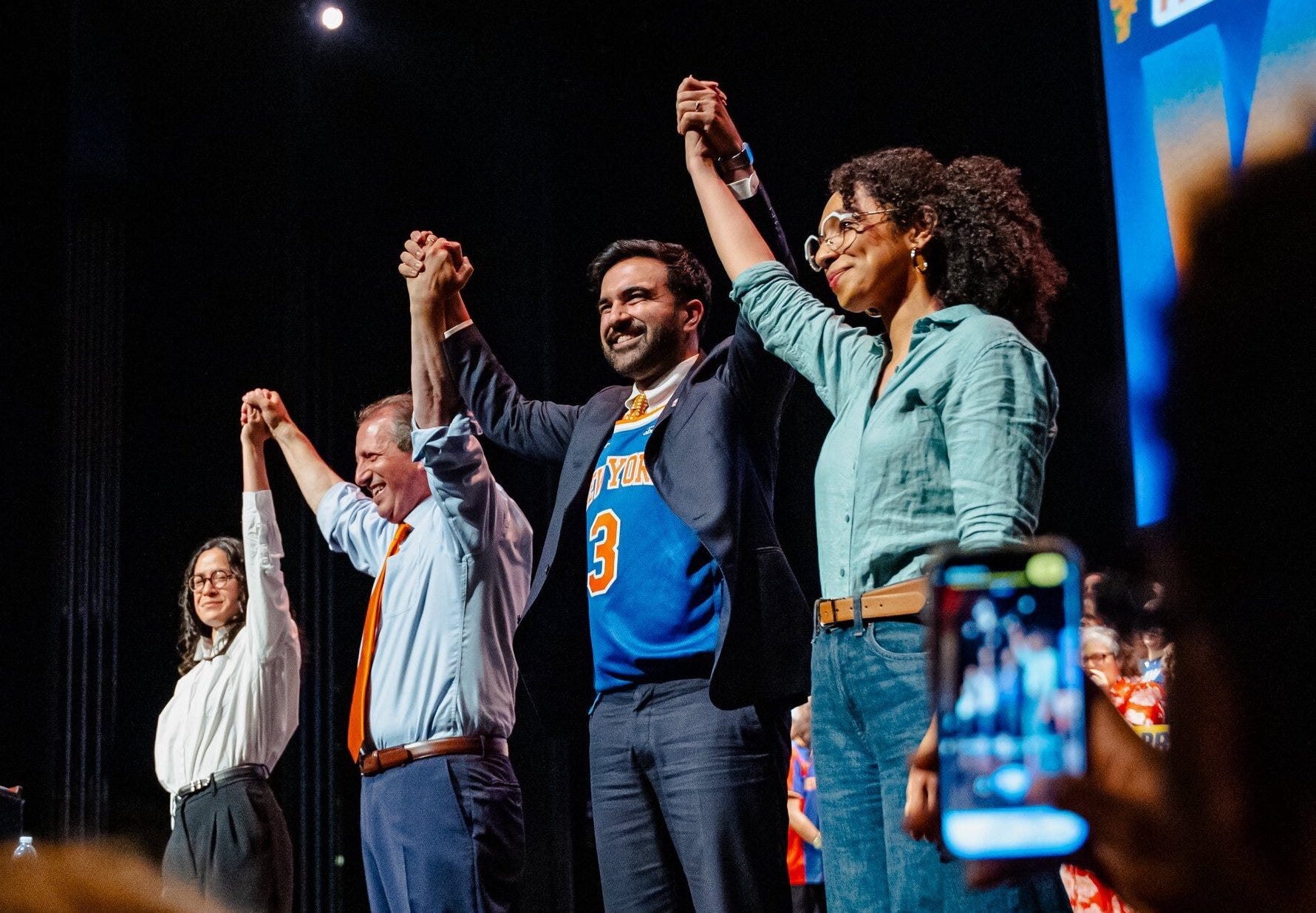
At 9:05 p.m., the ceiling started to shake.
I spent the night of June 23rd holed up in a basement. While the main floor of the Claire Valdez watch party filled with the volunteers who had spent the past few months knocking doors across The Commie Corridor, I retreated to a backroom in search of an outlet to charge my phone and a respite from the impending chaos above. Alongside a few friends (shoutout to Sam McCann, Claudia Morales, and Aaron Fernando) and my laptop, I refreshed the Board of Elections web page with the intensity of someone who needed a Xanax. Three days earlier, I told The New York Times that I had “a pit in my stomach because of secondhand anxiety“ — on behalf of Mayor Mamdani, and The Left more broadly. June 23rd was a prime opportunity to remake the Democratic Party, I said — but if Mamdani lost, the knives would be out.
I meant every word. The internal polls from both camps had the race for New York’s 7th Congressional District in a dead heat. The Satmar Hasidim, an Orthodox Jewish bloc in South Williamsburg, were poised to make up close to sixteen percent of the early vote, which meant Antonio Reynoso had a good chance of beginning the night in the lead. And, if Valdez failed to come back and the night went haywire, the pre-written postmortems would rebuke Mamdani and his political project:
The Mayor overreached. His movement was a mirage. And the honeymoon is over.
Then the early vote hit — like a tactical nuke. Valdez was ahead by thirteen points. Within minutes her margin had stretched past twenty, and it never came back down.
The race was called almost immediately.
Upstairs, every ballot drop was answered by a roar that traveled through the floorboards. We didn’t need to refresh Twitter to know how it was going, because we could feel it through the ceiling. And it wasn’t just bedlam in Brooklyn and Queens. Darializa Avila Chevalier was ahead in Upper Manhattan, her slim lead growing with every tranche of Election Day ballots. By the end of the hour, she too would complete an upset for the ages, slaying five-term incumbent Rep. Adriano Espaillat.
It was time to go upstairs.
That Tuesday night, every member of the Mayor’s slate swept. Aber Kawas, a Palestinian-American organizer, romped to victory in the State Senate seat held by retiring Deputy Majority Leader Mike Gianaris in Western Queens. Eli Northrup, a progressive public defender, outperformed Mamdani in the Assembly District covering the Upper West Side and Morningside Heights that Micah Lasher vacated to run for Congress. Illapa Sairitupac easily won a crowded open primary for an Assembly seat that covers Chinatown and the Lower East Side. Samantha Kattan succeeded Valdez in the Assembly, keeping The Commie Corridor in cadre hands down the ballot, while Brian Romero coasted to victory in the Jackson Heights and Astoria-based district previously held by Jessica González-Rojas. Five for five.
But the most important wins came without Mayor Mamdani.
NYC-DSA ran four insurgents that the Mayor pointedly declined to endorse. They were challenging sitting incumbents, and Mamdani exercised deference to Speaker Heastie and remained neutral. David Orkin, an immigration attorney with Make the Road New York, unseated Jenifer Rajkumar (and her red dress) by eighteen points. Eon Huntley took down Stefani Zinerman in a Bedford-Stuyvesant rematch, going from losing by six points to winning by twenty-one. Christian Celeste Tate ended the Dilan dynasty in Bushwick and Cypress Hills, winning by a resounding twenty-two points. Three challengers, three landslides, and only a wink from City Hall.
Downballot victories — defeating entrenched incumbents in their own backyards, without the movement avatar to point to — are sometimes the toughest of all. But endorsements from Rep. Alexandria Ocasio-Cortez and Senator Bernie Sanders certainly helped, as did the Valdez tsunami for both Orkin and Celeste Tate.
If The Commie Corridor was born in 2025, its legacy was cemented in 2026.
And it wasn’t just the five boroughs, either. Adam Bojak, a tenants’-rights attorney, won his Assembly primary in Buffalo, becoming the first DSA legislator elected in Western New York. In Syracuse, Maurice “Mo” Brown edged a fourteen-term incumbent by roughly 100 votes. These victories in Buffalo and Syracuse underscore the appetite for left-leaning insurgency in urban centers outside of New York City, and bode well for the statewide contests that inevitably await a burgeoning political movement. For the first time, there will be three democratic socialist legislators representing parts of Upstate New York.
But not everyone had a good night.
To say the bottom fell out from Antonio Reynoso is the understatement of the cycle. The Brooklyn Borough President — who represented Williamsburg, Bushwick, and Ridgewood on the City Council for two terms, who helped expel the Vito Lopez machine from North Brooklyn — was reduced, in the neighborhoods he built his career in, to the kind of numbers Andrew Cuomo and Elizabeth Crowley posted on their way out the door. He ran a relationships-based campaign too reliant on the local institutions of a previous era, the kind of effort that was standard political practice prior to 2018. Valdez and NYC-DSA simply ran the better campaign: knocking on more than 300,000 doors, ultimately winning the non-Satmar precincts of NY-7 by thirty-five points.
According to Maeve Andersen’s research, there were 43,257 first time Democratic Primary voters in NY-7 during the 2025 mayoral race. This year, 13,892 of those previous-first time voters came back to vote in the congressional primary for NY-7 (20.5% of the total electorate). Claire Valdez’s margin of victory was 13,571 votes.
Reynoso boasted a genuinely progressive record, with left-leaning campaign planks indistinguishable from his opponents, and endorsements from The New York Working Families Party, Nydia Velázquez, and a conglomerate of labor unions and non-profits. Still, Reynoso was no match for Valdez — backed by Mamdani and NYC-DSA — who swept every age bracket and racial group on her way to a twenty-point landslide.
“Who leads The Left in New York City?” I asked last month.
After Tuesday, the answer was crystal clear: Mayor Zohran Mamdani and NYC-DSA, and it is not particularly close. The Working Families Party did not merely lose its proxy war with NYC-DSA, but did so in blowout fashion — with a homegrown candidate whose relationships and network were supposed to carry the day. Even worse, the party was absent from the night’s other great upset in Upper Manhattan.
Consider what Darializa Avila Chevalier was up against. She was a thirty-two-year-old who had never held elected office, running against a ten-year incumbent who chairs the Congressional Hispanic Caucus and had spent three decades building a political machine from scratch. Avila Chevalier was outspent by something close to three-to-one, buried under a pro-Espaillat super-PAC avalanche, seeded by AIPAC, which mined her deleted Twitter account for everything it was worth. And she won anyway — by three-and-a-half points — making Adriano Espaillat the latest Democratic incumbent this cycle to be retired by his own party’s voters.
Start with the coalition that was supposed to abandon her and didn’t. The liberal and progressive Jewish voters of Morningside Heights, Hudson Heights, and Inwood stuck with Dari — and the endorsement of State Senator Robert Jackson, the Upper Manhattan institution and longtime Espaillat antagonist, was worth its weight in gold. The much-prophesied backlash to her October 8th rally attendance never materialized; if Mamdani survived Globalize, perhaps it was inevitable Dari would survive a rally.
NY-13 is one of the most working-class districts in America — home to the most renters of any congressional district in the nation. Unsurprisingly, a huge piece of Mamdani’s twenty-point victory over Cuomo in Upper Manhattan was his relentless focus on costs-of-living, whereas Dari took an alternate tack, leaning into Palestine and ICE, core to her organizing identity and the incumbent’s weaknesses. At certain junctures of the campaign, I pondered whether this would prove as effective.
You certainly can’t argue with the results.
According to my analysis, Avila Chevalier won Black voters. Espaillat, who spent the spring reminding voters his opponent once said “Fuck Kamala Harris,” may have blown the race due to his own surrogates’ anti-Haitian rhetoric in the closing days, costing him with Black seniors he assumed would come home. No poll, public or private, ever had the incumbent above 42%. And Espaillat, for his part, behaved like a politician who knew his ceiling and tried to juice his base rather than expand it. The question was always whether Dari had enough time to push past it. It’s safe to say she did, as the returning Mamdani Voters made up more than triple her margin of victory.
Mamdani spoiled our expectations for what constitutes a great campaign.
Avila Chevalier’s campaign, without a doubt, had its fair share of bumps and bruises. Still, she managed to build a viable operation, without much initial attention from Mamdani world (or even NYC-DSA institutional leaders), who gravitated towards the Valdez campaign in NY-7. The Bronx and Upper Manhattan branch of NYC-DSA, it should be said, had never won a race before, either. Avila Chevalier proved to be compelling, while Espaillat was villainized. Volunteers wanted to be a part of the next political earthquake. Perhaps campaigns don’t have to be perfect for them to be great.
Which brings us to the institutions of yore, and their quiet but swift collapse.
The Squadriano, the Upper Manhattan machine that Espaillat spent three decades building, could not even save its own founder. The progressive network in North Brooklyn, of labor unions and local non-profits, that orbits Velázquez and Reynoso, was exposed as electorally toothless. The traditional West Side versus East Side binary that has defined Democratic politics in Manhattan for half a century experienced significant geographical depolarization in the 12th Congressional District primary. Even in Buffalo, the once-vaunted Erie County Democratic Committee could not protect its chair, State Senator Jeremy Zellner, from defeat in his own primary.
Staring down defeat, a second contest began within hours — The Narrative War — with the goal of ensuring these victories meant as little as possible. The framing was pre-packaged: the socialists had not built a coalition, they had merely colonized one. It was an extension of the failed arguments that had culminated in Tuesday’s reckoning, but few seemed aware of the irony. Attorney General Letitia James, once one of Mamdani’s strongest allies, told CNN the victors simply “do not understand the politics of New York City” — ignorant of the race and class issues at the heart of the neighborhoods they had just won so convincingly. House Minority Leader Hakeem Jeffries waved away the loss of two incumbents in his backyard, saying it was nothing more than a handful of “higher-income” districts.
And last week, I proved why these sloppy allegations were untrue — block by block. Darializa Avila Chevalier won Black voters. Claire Valdez won every racial group and age bracket.
The throughline that explains both results is the one I’ve circled for more than a year: age. Mamdani and Avila Chevalier won the younger Black voters; Mamdani and Valdez won the younger Hispanic voters. Today, the single most important statistic in New York City politics is not someone’s race or whether they have a college degree or own their apartment — it is what year they were born.
Thus, the establishment is not spinning the results because they were ambiguous, but because they were clear. And clarity — that the coalition opposing them is not a vanity project, but actually increasing and getting younger and more diverse every June — is the one thing they cannot let the public see. They’ve lost the next generation.
And so, by the time I climbed up the stairs from the basement, the room at Valdez HQ had traded its nervous energy for euphoria. The audience was young and confident, for these were the organizers who had just rewritten the map — again. Reynoso and Espaillat were old news. The crowd had moved on to Hakeem Jeffries.
“You’re next,” they chanted.
June 23rd handed Mayor Mamdani something more durable than one good night.
It handed him soft power, and a twenty-month runway on which to spend it.
The Mayor is about to send three new allies to Congress: Claire Valdez, Darializa Avila Chevalier, and Brad Lander (who throttled Dan Goldman by thirty-three points) to anchor New York City’s congressional delegation alongside Alexandria Ocasio-Cortez. Even in the 12th Congressional District, the one Manhattan-based seat where Mamdani’s name is counted among the voter rolls but absent from the candidate’s palm cards, the Mayor’s interests arguably came out ahead. Micah Lasher may not have carried his lucrative endorsement, but The New York Times still counted him among Mamdani’s “inner circle” last summer. The net effect is unmistakable: power in the city’s delegation is migrating away from Hakeem Jeffries and Greg Meeks, two men who oscillate between indifference and contempt for Mamdani’s agenda.
Albany tells the same story, and the stakes there are even more concrete. The DSA bloc in the State Legislature doubled — from eight to sixteen, the largest socialist delegation Albany has ever seen. A bloc that size, paired with a mayor who needs the state to fund his agenda, changes what is attainable in the next legislative session, from aspiration to leverage. Tax the Rich — the perennial fight to raise tax rates on the highest earners and corporations, and the only way the affordability promises of last year are realized in full — stops being a rallying cry and starts being a whip count. The New York Health Act, the single-payer bill that has hovered maddeningly short of the votes for the better part of a decade, gets a fresher, younger coalition behind it.
I would add two legislative suggestions of my own. First, campaign finance and independent expenditure reform. Because of looser disclosure laws, the state regulations are markedly worse than the city’s; and this freshman class made it to Albany in spite of the deluge against them. This level of outside spending is only going to get worse in the coming years, but reforms have broad public support among Democratic voters. The second is to move New York State’s presidential primary up to Super Tuesday in 2028. For decades the Empire State has voted late, in April, after the nominee has effectively been chosen, surrendering our vast leverage. Move the primary up a month, and the nation’s most diverse collection of Democratic voters becomes the kingmaker it always should have been — instead of an afterthought.
NYC-DSA’s slate strategy — the deliberate overlap of a marquee campaign with downballot races beneath it — was exhausting, but nonetheless executed to perfection. Claire Valdez atop the ballot in NY-7 helped boost Kawas, Kattan, Orkin, and Celeste Tate. And this template bodes very well for City Council elections in 2029, where Mayor Mamdani, running for re-election, will be poised to lead the ticket.
Valdez’s victory settled not just one proxy war, but five. A closer outcome in NY-7 would have set up future installments and sequels of The Socialists vs. The Progressives across North Brooklyn. But the scale of her victory cemented a line of succession in The Commie Corridor. The electeds who stood with Reynoso — Maritza Davila in the State Assembly, and Lincoln Restler, Jenifer Gutiérrez, and Sandy Nurse on the City Council — will all likely be succeeded by NYC-DSA cadres blessed by the Mayor. Davila can expect a serious challenge in 2028, if she does not simply retire ahead of it; while Restler, Gutiérrez, and Nurse are term-limited in 2029.
It is now only a matter of time before Ridgewood, Bushwick, Williamsburg, and Greenpoint join Astoria as the only neighborhoods in the United States represented by democratic socialists at the city, state, and federal levels. But the next organizing frontier is one I called last year: Upper Manhattan as The Next Commie Corridor. Historically, NYC-DSA has built from the bottom up, but Dari’s upset victory was the beachhead. Al Taylor has been a marked man since Mamdani won his district by thirty two points. And incumbent Jordan Wright only held on by eight points as well.
Some, after the victories of Valdez and Avila Chevalier, will be bullish on future congressional races, with their eyes turned to Ritchie Torres, Grace Meng, Yvette Clarke, or Hakeem Jeffries. However, mid-decade redistricting looms as a wildcard that the socialists have few means of tangibly influencing. With Michael Gianaris, a progressive State Senator who co-chairs the LATFOR committee (Legislative Task Force on Demographic Research and Reapportionment), retiring and Jeffries and Rochester-area Congressman Joe Morelle poised to heavily influence the new maps, The Left’s congressional gains are not safe — yet. One key point: New York’s population bottleneck runs through the five boroughs, which significantly complicates any plan to gerrymander the seats now held by Valdez and Avila Chevalier.
Most importantly, there is the matter of protecting what was just won. Regardless of whether the congressional boundaries change, Avila Chevalier will need a strong defense. She has been dropped, as an avatar of the Socialist Left, into the middle of a multi-decade turf war between competing Dominican and African-American political machines. And it remains unlikely they will simply let her be. The wounded Squadriano, in the hopes of avenging their fallen leader, could re-group around Shaun Abreu, the ambitious Majority Leader of the City Council who represents the West Side from Morningside to Washington Heights. However, Dari’s most formidable opponent would be Abreu’s colleague, Yusef Salaam: one of the Exonerated Central Park Five who trounced a field of three incumbents on his way to the City Council in 2023. Salaam, a Harlem-native raised in Schomburg Plaza, is a compelling public speaker with exceptional retail political skills but a thin legislative record (he has never passed a bill). For Dari to survive an inevitable primary challenge, she’ll need help from her down-ballot allies — Robert Jackson and Gustavo Rivera. A well-connected District Director (like Johanna Garcia) would be invaluable, too.
There is also the pressing matter of succession in NY-14, given Rep. Alexandria Ocasio-Cortez is reportedly weighing whether to run for U.S. Senate or President. If she opts to succeed Chuck Schumer (whose retirement, in my opinion, is almost inevitable), the democratic socialists will have their first ever statewide candidate. But if she pursues the White House, a once-in-a-generation arms race will commence for an open New York Senate seat without a prohibitive frontrunner. Hudson Valley Congressman Pat Ryan will surely be interested, but the rest of the field is under-developed: Tish James is 67 years old and has historically struggled to raise money; Ritchie Torres has watched his political brand diminish over the past eighteen months; Brad Lander was just elected to Congress. And which democratic socialist, besides AOC and Mamdani, could actually win a statewide primary?
But looming larger than Hakeem, redistricting, or future insurgents, is the question I was asked more than any other late on Tuesday night (and in the early hours of Wednesday morning), which speaks to the hope that burns inside every canvasser when they scale a sixth floor walk-up to have a conversation with a stranger:
Can this go national?
Last year, at the peak of post-primary euphoria, I tried my best to lay out the honest case — both the promise and the peril — in the conclusion of The Mamdani Model.
With new evidence, the thesis bears repeating.
Mamdani’s win, I argued, could be broken down into two buckets: what is most replicable, and what is least replicable. The national party chronically undersells the breadth of what is repeatable, in favor of cherry-picking the easy lessons and watering down the edginess. But building a movement requires more than filming vertical videos and saying “affordability” a couple of times. Mamdani paired a relentless economic populist message with a campaign that, literally, met voters where they were — in their homes and on their phones — while remaining authentic on the moral issue of our time: Gaza. Above all, Mamdani worked tirelessly to organize the young, renter-majority, college-educated, multi-racial coalition that exists in every large metro area in America. Now, across the country — Katie Wilson in Seattle, Chris Rabb in Philadelphia, Janeese Lewis George in DC, Melat Kiros in Denver — that coalition, which once lay dormant, is waking up to reshape the Democratic Party.
But I was also transparent about four things I did not think would scale up: Mamdani himself, a once-in-a-generation talent; his uniquely vulnerable opponent, an arrogant fossil of the erstwhile establishment; the fleeting macro-political moment of Trump 2.0; and the uniqueness of the five boroughs themselves, one of the youngest, most racially diverse, best-educated, and renter-heavy constituencies in the country.
Which is why Red Tuesday’s results rippled far beyond New York. June 23rd was the first real test of the most important of those four cautions: the man. The fear, and the narrative in-waiting, was that Mamdani had struck lightning in a bottle: right place, right time, right candidate. But the movement avatar was not on the ballot, and his coalition showed up anyway, delivering blowout victories for public defenders and immigration lawyers and millennial organizers no one had heard of a year ago.
Was the ingredient I declared the least replicable in fact the most dispensable? Perhaps more than anything, this is why the establishment was so unnerved by the socialist sweep. The movement proved it was more than just one man.
The Democratic establishment may eventually adapt and run better candidates in the future, but the electoral turnover will not abate in the near term. And, so long as Donald Trump occupies the White House, the iron of insurgency will remain hot.
Nonetheless, one cannot conjure a five borough electorate in Michigan or Georgia or Nevada. You might, with a decade of patience and the right collection of organizers, build one — and the appetite for trying, after Tuesday, has never been greater.
The only question is whether there’s enough time.
I am a born-and-raised New Yorker. My focus has always been, and always will be, here — neighborhood by neighborhood, block by block. The city that raised me, healed me, changed my life, and still finds ways to mesmerize me all over again.
But I may not have the luxury of remaining parochial much longer.
If the moment demands a wider lens, I will have to find one.
Perhaps, in the wake of June 23rd, another native New Yorker — one with gifts far greater than my own, potentially the only person capable of uniting and galvanizing The Left in a manner not unlike the Mayor — may be feeling exactly the same way.
Connect With Me:
Follow me on Twitter @MichaelLangeNYC
Email me at Michael.James.Lange@gmail.com
Excellent piece Michael. Thanks for all of the work you put in this cycle!
I was wondering if you've thought of re-visiting/updating the "Seven Factions of New York City Politics" piece you wrote a few years ago?
The recap is fun, but your roadmap for the future is the real must-read. Awesome!